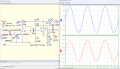
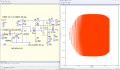
That's an interesting twist in my learning process.
I found this video while Googling about it:
This is going off on a tangent, but this awfully sounds like listening to a jet airplane doing a low flyover. I never gave it much thought why an airplane sounds the way it does when flying over, but I thought it was the doppler effect. But maybe it's the combing effect as the distance between the engines changes relative to the listener (and doppler)?
I have this circuit built on a real circuit board, but it's using a few adjustable resistors right now, and running with a Burr-Brown OPA134 op-amp.
I've decided to do some tests to see how replacing adjustable resistors with metal resistors would change noise, so I plugged in the output of this circuit into a sound card, set the op-amp to open-loop (120dB gain) and shorted the input. So only internal noise should show up.
Sound card with shorted input is at -58.6dB RMS. Sound card with op-amp plugged and open-loop is at -14.6dB RMS. So quite a bit of noise to look at.
The spectrum plot of this noise looks rather strange though. A gigantic peak at 4500Hz? It's not coming from the sound card. Is there a scientific explanation for this?
OP AMPS do generate some internal noise, some much more than others. try using a 1K resistor instead of a short circuit, and with a high value feedback resistor shunted by a small capacitance to reduce the high frequency gain. 120 Db gain =10,000x by my figuring. I may be off a bit on that, though.
Examine the data sheet, some of them give noise gain referenced to some input voltage equivalent.
There are some very low noise IC amplifiers available, made especially for audio and instrumentation systems, like ultrasound systems. Those might be a quieter choice.
I'm fairly content with what I built (maybe will try two stage amplification in the future, for fun and learning) and it's dead quiet when powered from a battery. No 60hz hum from the environment picked up.
Then I connected it to a switching power supply wall wart 12V of decent quality. Immediately got 60hz hum. I tried grounding the circuit to the 3rd prong, the house electric ground, and that knocked off about 15db of 60hz hum.
But the most interesting thing is that when I grab the electret microphone shell with 2 fingers, the shell is grounded in theory, it knocked another 15db of hum and it was barely audible.
Am I picking up 60hz EMI from the environment with my body and that's somehow cancelling the noise coming from the power supply?
Certainly you pick up the 60HZ o your body. That is a challenge to avoid. CORRECT shielding and tying to common will help more. And with the switcher supply, it is more than hum on the DC output, it is the capacitance coupled hum from the mains hot side onto the supply output. The conductive shell of the microphone assembly should be connected to the shield of the cable to the amplifier, and at the amplifier the shield hould connect to the circuit common, which might be called "ground".
That's the part that is unexpected. I thought that when I touch any part of the circuit my body would act like an antenna and increase 60 hz hum. But the opposite happens. When my body is coupled with ground of the circuit, by grabbing the shell of the microphone, 60hz hum almost completely goes away.
That's the part that is unexpected. I thought that when I touch any part of the circuit my body would act like an antenna and increase 60 hz hum. But the opposite happens. When my body is coupled with ground of the circuit, by grabbing the shell of the microphone, 60hz hum almost completely goes away.
The simple explanation is that the conduction thru your body is shunting the hum voltage away from the input to the amplifier.
What the effect explains is that there is inadequate connections in the grounding of the microphone body, that is, that the microphone body and the cable shield are not adequately connected to the amplifier's common ground circuit.

 Facebook
 Google
 GitHub
 Linkedin