Amplifier that outputs only at ground or above

Thread Starter

WattPusher

Joined Mar 24, 2014
8
Hi -
I'm interested in working with analog modeling of energy systems, in which one uses voltages or currents as representations of power flows. As such, I'm envisioning having a kind of amplifier that represents a power source and its input is computer-controlled using a D/A converter. Similarly, I would have a device that would form a computer-controlled load and in between would be either passive components or something more complex to represent storage, distribution, and transmission systems. I would want the amplifier to "hold true" regardless of how the load device behaves so it would need to be able to deliver some actual power. Anyway, what I could use some advice on is how I would design an amplifier that's meant to run with an offset, i.e., the output never goes negative. Zero input should produce zero output but positive input, even if it's a periodic signal, would produce proportional positive output. If it helps, I'm prepared to go tube because I have a high-voltage regulated power supply that I'm refurbishing.
 

dl324

Joined Mar 30, 2015
18,395
An opamp configured an a non-inverting amplifier can be used. If you use a single supply, you need to pay attention to the common mode input range, because some won't allow an input of 0V, and use an appropriate voltage.
 

crutschow

Joined Mar 14, 2008
38,561
how I would design an amplifier that's meant to run with an offset, i.e., the output never goes negative. Zero input should produce zero output but positive input, even if it's a periodic signal, would produce proportional positive output.
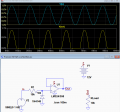
Sounds like you need a half-wave non-inverting precision rectifier, which can be performed by a circuit such as dl324 suggested.
LTspice simulation of example circuit below:
The op amp must be a single-supply or rail-rail type.

1594146693391.png
 

Irving

Joined Jan 30, 2016
5,167
An interesting idea, but I wonder about the practicality of it.

So you effectively want to build an old-school analog computer. You don't need the amplifier to deliver power, but you do need it to have a low impedance and have a sense feedback loop to maintain its output under load conditions. You need to consider how you're modelling the real world so your analogs are viable within the operational range of sensible building blocks. You can't model, for example, an 11kV power line with the same resolution and precision as modelling a 240v household supply. Similarly you wouldn't model a generating plant's MW output with an actual wattage, it would be impractical to do so, but you would model it with a voltage representing the output power.
 

Thread Starter

WattPusher

Joined Mar 24, 2014
8
An interesting idea, but I wonder about the practicality of it.

So you effectively want to build an old-school analog computer. You don't need the amplifier to deliver power, but you do need it to have a low impedance and have a sense feedback loop to maintain its output under load conditions. You need to consider how you're modelling the real world so your analogs are viable within the operational range of sensible building blocks. You can't model, for example, an 11kV power line with the same resolution and precision as modelling a 240v household supply. Similarly you wouldn't model a generating plant's MW output with an actual wattage, it would be impractical to do so, but you would model it with a voltage representing the output power.
Right - old-school analog computer. But the idea is not to just make a miniature version of a real system - just use analog components to reproduce the math behind the real system.
 

Alec_t

Joined Sep 17, 2013
15,125
Why not use LTspice as your analogue computer? By way of example, here's a model of a simple domestic central heating system :-
CH-model.png
The heating power input, house interior and outdoors are represented by voltage source Rads, capacitor V1 and voltage source V2 respectively. R1 and R2 represent thermal resistance. Heat flow is modelled by circuit currents. Temperature is modelled by voltages.
 
Last edited:

Irving

Joined Jan 30, 2016
5,167
Nice idea.

I used MATLAB Simulink to do much the same, including the PID Controller, then output the code to run on real hardware, what they call 'Hardware-in-the-loop' simulation.

There's a nice free online package at Systemvision.com that has components to model all sorts of real-world functions, eg mechanical motors, gearboxes, linear actuators, springs, etc., heating & thermal systems, energy storage & transmission and more. And if they dont have an analog, there's a whole suite of 'continuous quantity' building blocks to roll your own. Great fun to play with.
 

Reloadron

Joined Jan 15, 2015
7,893
OK, just as a channel check you are only interested in modeling correct? You are not planning to actually build using hardware correct?

You may want to read SPICE models for Precision DACs from Texas Instruments. Years ago we developed a software driven syatem using NI (National Instruments) DAC boards so you may also want to look to NI for Spice models.

You make no mention of voltages or actual power?

Ron
 
Top