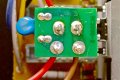
Hmmm. No further replies. OK, well I guess I'll just order some parts and see if they blow up again. At least if the smoke leaks out of something, maybe I'll see it and know which component MIGHT have been bad.
Thanks to all who've endeavored to reply to my questions.
FOR ALL WHO MAY WISH TO KNOW: The amplifier is working just fine. The ONLY thing that was bad was the Bridge Rectifier. The original BR was rated at 10 amps. Since it would take a couple months to get the exact replacement I decided to opt for a 25 amp BR. Hey! Larger capacity, but still works just fine.
I'm delighted to have my amp working again. Thanks to all who contributed.
As for the last post about using a light bulb in place of the fuse - I used a 120 V 40 W bulb. Upon startup the elements did glow slightly for a moment, but as the capacitors charged up the light dimmed. When I put the fuse in place everything started up just fine. Sounds good. Thanks again all.
Have a beer, and raise a toast as I say thanks again.
One last ODD comment: The BOUFFFF? It's back. As soon as I put the cover on the amp it returned. However, this time I happened to have the screwdriver laying on top of it. When I switched it on the cover sucked down to the transformer, then once the magnetic flux was established the lid settled down.
So the BOUFFFF is a mechanical noise, not a result of anything going on with the circuitry. The original Bridge Rectifier was rated at 10 amps. I replaced it with one rated for 25 amps. And I never found anything else wrong with the amp, other than the shorted BR.
I'm thinking of measuring the space between the transformer and cover. I may weld a plate (C channel) to the top of the transformer then drill and tap through the lid into the C channel and screw it down so it no longer can flex at start up. But I suppose that may transfer a little heat to the cover. Probably not a big deal as the transformer doesn't get too hot to to touch. Maybe I'll take a temperature reading some day just to see how warm it gets after an hour.
I would hesitate to weld on the transformer. I'm no expert on magnetics, but I would worry about changing the magnetic properties of the transformer core, either by introducing more metal, or by intense heating.
Perhaps you could attach the C channel to the cover instead, and put a rubber pad or feet between the C channel and the transformer. This wouldn't alter the transformer's magnetic properties and would have the added benefit of stiffening the cover considerably.
One last ODD comment: The BOUFFFF? It's back. As soon as I put the cover on the amp it returned. However, this time I happened to have the screwdriver laying on top of it. When I switched it on the cover sucked down to the transformer, then once the magnetic flux was established the lid settled down.
So the BOUFFFF is a mechanical noise, not a result of anything going on with the circuitry. The original Bridge Rectifier was rated at 10 amps. I replaced it with one rated for 25 amps. And I never found anything else wrong with the amp, other than the shorted BR.
This reminds me of a somewhat similar experience I had. I had built a circuit that needed a positive and negative power supply. I bought a cheap poser supply and did a simple modification for my use.
Once it was working I placed it next to me so I could occasionally check it for proper operation. While I was not looking, I heard a thump and a rattle . The circuit was no longer working so I opened up the case. Inside, I found that one of the filter caps had exploded. The thump was the cap exploding and the rattle was the screwdriver that was sitting on top of the box.
In hindsight, the cause was obvious. I had managed to put a cap rated for use on a 5 volt power supply onto the 12 volt power supply. An easy fix.
Good point. Perhaps I can epoxy it down to the top of the transformer. All I need to be sure to do is get an epoxy that won't be bothered by the heat from the transformer.

 Facebook
 Google
 GitHub
 Linkedin