Amplifier advice for digital cello with low output magnetic pickup

#12

Joined Nov 30, 2010
18,224
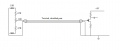
The 47 k resistors make the adjustment pot more delicate.
Without the 47K resistors, it's a pan pot.
With them, it's a balance pot.
You are trying to tune out a small imbalance between the two coils.
The 47K resistors make the pot range of adjustment very small so you can tune out a little imbalance without needing a microscope to adjust the knob.

The two circles are pretending to be the shield on a guitar cable.
 

#12

Joined Nov 30, 2010
18,224
You could also do it like this with a twisted, shielded pair, and the shield only connected at one end, but I don't know how to draw a twisted pair of wires.:Dshielded pair.png
 
Last edited:

Thread Starter

OnesAndZeroes

Joined Jan 19, 2017
25
You could also do it like this with a twisted, shielded pair, and the shield only connected at one end, but I don't know how to draw a twisted pair of wires.:DView attachment 119821
I tried the balanced variable resistor and was able to reduce the buzz somewhat. Thank you. A useful technique to have in my toolbelt.

I think though that the two coils are suffering from some geometric asymmetry which may be causing some issues. I blame my own inexperience by not originally understanding that the two coils should be as equivalent as possible.

My plan from here is to try:
1) pursuing the optical pickup idea (as the initial result was promising...just trying to think where I can orient the leds/phototransitors)
2) redoing the humbucker and making an effort to make the two coils the same

When I redo the humbucker I think I'll try 5k winds on each coil (rather than the 10k winds on each in the original). I'm hoping less winds will help reduce any asymmetrical hum.

I guess these iterations are what happens when someone starts from square one. Luckily for me...I find the process itself to be like 80% of the fun. :)

That said...I certainly appreciate the advice you've given me along the way. You've helped point me in the right direction multiple times.
 

#12

Joined Nov 30, 2010
18,224
Have you ever heard of, "bifilar"?
That's where you take (2) rolls of wire, connect the end of each roll to the other, and start winding by pulling off both rolls.
When you get done, your windings must be similar because they are physically almost the same wire.

If you just attach to the two wires at the end of the winding job you have (2) equal coils in series and opposing. Because they oppose, they (theoretically) have no inductance.
If you go back to the start and break the connection there, you have (2) coils that you can put in parallel or inverse parallel or in series, or inverse series...as you please.

Just another bit for your tool box.;)
 
Last edited:

Thread Starter

OnesAndZeroes

Joined Jan 19, 2017
25
Have you ever heard of, "bifilar"?
That's where you take (2) rolls of wire, connect the end of each roll to the other, and start winding by pulling off both rolls.
When you get done, your windings must be similar because they are physically almost the same wire.
The bifilar technique sounds intriguing, but I am unsure about the wiring of the multiple coils.

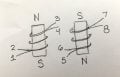
So, if you have two pickups wound with bifilar wire you wind up with 8 ends.

IMG_3312.JPG

Which ends would you connect to each other and which ends would then connect to ground and the pre-amp?
 

#12

Joined Nov 30, 2010
18,224
So, if you have two pickups wound with bifilar wire you wind up with 8 ends.
This started out with me failing to think about you winding your own pick-ups.
Now that I'm thinking in terms of you winding your own coils:

The major point of doing a bifilar winding is that you don't need two pick-ups to make a humbucker. It's already a humbucker.
This advantage arises from the fact that the two coils are on the same core permeability with the same magnetic fields at the same distance and oriented the same as each other in relation to the strings and the surrounding hum fields. I don't think you can do any better than that under any conditions.

The only hint I would add is to twist the two wires to each other occasionally so they lay into the winding form as a close coupled pair. That means, "Don't let one of the bifilar wires fall into a crack between some other windings unless its brother also falls into the same crack at the same depth." It wouldn't matter if you decided to do one twist per inch or three twists per inch or twenty twists per inch along the whole length of the bifilar winding. The twisting is only a method to make sure the two wires follow the same path during every turn. Think: Siamese twins.

As for winding two pick-ups in bifilar: That will produce 4 coils which you can arrange to add signal together or subtract signal from each other in two to the eighth power number of combinations. You just treat each winding as a free standing inductor and connect them as you see fit. Winding a single pick-up as a bifilar makes all that information irrelevant.
 
Last edited:

#12

Joined Nov 30, 2010
18,224
When I redo the humbucker I think I'll try 5k winds on each coil (rather than the 10k winds on each in the original). I'm hoping less winds will help reduce any asymmetrical hum.
Irrelevant. More turns = more music signal. Better symmetry = better hum rejection.
The resistance of the wire is almost completely irrelevant because the j-fet has such a high input impedance that the wire resistance doesn't matter. For example, you had to add 100k from the gate to ground just to keep the j-fet from having too much impedance. You changed the input resistor from 3 million ohms to 100 thousand ohms. The difference between 5K and 10K is trivial.

And while I'm here...this process of discovering which aspects are trivial, which are irrelevant, and which are critical, is what learning is about. You have a project. I have experience. I can point the way. You can build it.
 
Last edited:

Thread Starter

OnesAndZeroes

Joined Jan 19, 2017
25
As for winding two pick-ups in bifilar: That will produce 4 coils which you can arrange to add signal together or subtract signal from each other in two to the eighth power number of combinations. You just treat each winding as a free standing inductor and connect them as you see fit. Winding a single pick-up as a bifilar makes all that information irrelevant.
I think I am still confused about this. If I wind a single pickup with bifilar wire I can see how it will result in ambient interference being canceled out (provided the two coils are connected in reverse), but won't signal from the vibrating string also get canceled out as well (as the two opposing coils are the exact opposite and on the same magnet)?
 

#12

Joined Nov 30, 2010
18,224
I think I am still confused about this. If I wind a single pickup with bifilar wire I can see how it will result in ambient interference being canceled out (provide the two coils are connected in reverse), but won't signal from the vibrating string also get canceled out as well (as the two opposing coils are the exact opposite and on the same magnet)?
Theoretically, that seems right, but it's wrong. It must be wrong or humbuckers wouldn't exist. I remind you of the method of strapping two microphones together and wiring them out of phase. They pick up equal sound from distant sources but they manage to pick up different sound from sources nearby. The intentional signal is very much reduced from what a single microphone would produce but the far field sounds are almost completely eliminated. The goal here is signal to noise ratio. If the signal is clean, building gain is trivial. Your TV can get an excellent picture from 300 microvolts at the antenna terminals (and less than that after the TV signal runs through 30 feet of co-ax cable). We have been discussing a humbucker arrangement which produces maybe 10 millivolts. Even at 10 millivolts, we have 33 times as much voltage as a TV antenna produces. It's all about signal to noise ratio.

A vocalist sings into two (high impedance) microphones wired in reverse polarity to each other. Instead of producing 3 volts of signal, he produces 30 millivolts. The microphone signal has been reduced by 99% but the background noise has been reduced by 99.999%. The intentional signal is 30 millivolts but the background noise is 30 microvolts. That difference is what is important. When I can get the intentional signal to be 1,000 times the background noise, that is what I can get to come out of the speaker.
 
Last edited:

#12

Joined Nov 30, 2010
18,224
Here's a reference that came up in another Thread about sound.
Right now it just might muddy the waters, but put it in your kit.
If you don't like something about how your pick-up sounds, this page might steer you to the right way to alter the sound without starting over with a spool of wire.
http://www.buildyourguitar.com/resources/lemme/

PS, My transformer man told me the smallest wire that wouldn't have nuisance breaks while he was winding is 30 gauge.
 

Thread Starter

OnesAndZeroes

Joined Jan 19, 2017
25
Here's a reference that came up in another Thread about sound.
Right now it just might muddy the waters, but put it in your kit.
If you don't like something about how your pick-up sounds, this page might steer you to the right way to alter the sound without starting over with a spool of wire.
http://www.buildyourguitar.com/resources/lemme/

PS, My transformer man told me the smallest wire that wouldn't have nuisance breaks while he was winding is 30 gauge.
Thanks for that link. It looks super meaty on information. I'm looking forward to digging through it and trying to understand.

PS, you should tease your transformer man about only being able to wind 30 gauge without it breaking. As a complete novice I wound 10k the first time with 40 gauge and only 3 breaks. Second time...42 gauge and no breaks. But then I mount the pickup itself on a power drill (with tape), and have the spool spinning on a ball-bearing'd shaft as I apply finger tension to guide the wire.

PPS, did you know that the humbucker was originally developed by two guys named Seth Lover and Ray Butts? It's kind of a shame that they didn't call it the Butts-Lover pickup. :)
 

Thread Starter

OnesAndZeroes

Joined Jan 19, 2017
25
Theoretically, that seems right, but it's wrong. It must be wrong or humbuckers wouldn't exist. I remind you of the method of strapping two microphones together and wiring them out of phase. They pick up equal sound from distant sources but they manage to pick up different sound from sources nearby.
I'm still trying to get my brain around how humbuckers work exactly. I'm assuming part of the reason they work is that they are located on different parts of the string and pickup different vibrations? But interference from far away hits them equally and it cancels out?

Maybe the dual mics work in a similar way. The singer is never directly in the middle of both mics, so one mic is always getting a little more signal? But ambient noise hits them fairly equally and cancels out? If that's the case then having the singer sing more into one of the mics than the other would maybe increase SNR? If I had two mics...I'd try it out just to see what happened.
 

#12

Joined Nov 30, 2010
18,224
I've been poking around on the Internet to see how people wind pick-ups. It looks like 6 or 12 separate coils, and one of them is a single coil.:confused:
Nobody says to do it with a bifilar method, but one says wind them all the same and reverse the magnet in half of them.
The third link shows one big coil.
This could mean the bifilar idea is crap, but it seems right from my point of view.

https://courses.physics.illinois.ed...ing12/Ian_Dayton_P406_Project_Report_Sp12.pdf
http://makezine.com/projects/wind-your-own-guitar-pickups/
http://tech.thetonegod.com/coil/coil.html
 

#12

Joined Nov 30, 2010
18,224
you should tease your transformer man about only being able to wind 30 gauge without it breaking.
He had other advantages. His fingernails were so strong that he used them to guide the wires...all day!:eek:
That is not the kind of hands that use 42 gauge wire.:(
 

#12

Joined Nov 30, 2010
18,224
I'm assuming part of the reason they work is that they are located on different parts of the string and pickup different vibrations? But interference from far away hits them equally and it cancels out?
Look at the numbers. The intentional signal normally caused by the strings is lost by 99%. You're only getting 1% of the standard voltage. It only takes a 1% imbalance in the string movement to do that.

Of course you can't imagine how a set of opposing windings gets the same result as a single winding. They don't. They only pick up 1% of the near-field energy. The reason they work at all is that they only pick up o.oo1% of the far-field energy.
 

#12

Joined Nov 30, 2010
18,224
This is the next morning and I've had a new thought. Do not use 2 spools of wire. Do not wind 2 wires as if they are a pair and connect their ends later. Do not try to make two equal and opposite windings. Do not try to wind one pick-up as a humbucker, keep trying to use two pickups.

Does that make sense?
 

Thread Starter

OnesAndZeroes

Joined Jan 19, 2017
25
This is the next morning and I've had a new thought. Do not use 2 spools of wire. Do not wind 2 wires as if they are a pair and connect their ends later. Do not try to make two equal and opposite windings. Do not try to wind one pick-up as a humbucker, keep trying to use two pickups.

Does that make sense?
Yes, I think your new instinct may be correct. Kind of a shame as it would be a really elegant way to solve the asymmetry issue.

I might try it anyways with a simple coil...just to see what happens. Good to stretch the brain and try to figure what would happen before actually building it.
 

Thread Starter

OnesAndZeroes

Joined Jan 19, 2017
25
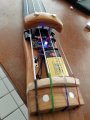
Well...it took me a while but here's what I finally came up with.

I'm using infrared LEDs and phototransistors to detect string vibration.

The curved wooden piece above the strings contains the infrared LEDs and the phototransitors are on the other side of the strings.

I'm using the pre-amp JFET circuit I mentioned previously.

Plenty of signal and no more humming interference which is nice. :)
 

Attachments

Top