Amplifier advice for digital cello with low output magnetic pickup

Thread Starter

OnesAndZeroes

Joined Jan 19, 2017
25
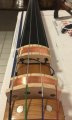
I'm building a digital cello and am trying to amplify a low output humbucker pickup that I made (two reversed 10k ohm pickups in parallel).

The pickup produces about 10mV AC RMS output (compared to a cheap pickup I tested which produces 30 mV AC RMS).

The speaker that I'd like to drive is a Dayton Audio ND105 (60Hz-10kHz range) which basically falls in line with cello output frequencies at a reasonable size/weight.

A standard cello hits about 90dB volume so I'd like to make it get close to that (not sure if it's possible with that speaker...but it's a goal).

I made a Ruby amp, and it works...okay. Not very loud...and the bass is too weak. I'd prefer the deep rumbling akin to a normal cello at low frequencies (though I understand the digital version will lack any of the body-driven acoustics).

I piped the Ruby amp output through a small D-class amp (https://www.adafruit.com/product/987) and it definitely increased the volume, but too easily distorted.

I'm open to different power requirements if necessary (hopefully still portable).

Any advice on achieving this would be greatly appreciated. I'm a novice in this stuff, but am definitely open to learning.
IMG_3290.JPG
 

blocco a spirale

Joined Jun 18, 2008
1,546
The amp and speaker you have can only produce around 91dB at full volume which is no good for handling the dynamics of an acoustic instrument as the average level would be much less than this. If you turn up the volume so that the average SPL is acceptable it will clip on the peaks.

I would start by selecting a very efficient loudspeaker e.g. Beyma 8AG/N (which, at 96dB/W is around 10dB more efficient that the speaker you have) and couple it to a class-d amplifier of at least 30Wrms. This combination could provide 20dB more SPL than your current set up.

You also need a pre-amp between the pick-up and the power amplifier. For good low-frequency response the loudspeaker enclosure will dominate but it will be a compromise between size/weight and portability.
 
Last edited:

#12

Joined Nov 30, 2010
18,224
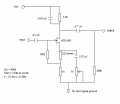
I designed this for a Rhodes piano with an average output of 5 mv. Undetectable background noise. Gets about 400 hours out of a 9V battery. Plenty of frequency response. Adjustable gain. Drives low impedance and high impedance inputs with no effect on the signal quality.

It's not going to drive a speaker, but it will get you a clean signal to drive a power amp.
 

Attachments

Thread Starter

OnesAndZeroes

Joined Jan 19, 2017
25
The amp and speaker you have can only produce around 91dB at full volume which is no good for handling the dynamics of an acoustic instrument as the average level would be much less than this. If you turn up the volume so that the average SPL is acceptable it will clip on the peaks.

I would start by selecting a very efficient loudspeaker e.g. Beyma 8AG/N (which, at 96dB/W is around 10dB more efficient that the speaker you have) and couple it to a class-d amplifier of at least 30Wrms. This combination could provide 20dB more SPL than your current set up.

You also need a pre-amp between the pick-up and the power amplifier. For good low-frequency response the loudspeaker enclosure will dominate but it will be a compromise between size/weight and portability.
Thank you for giving me the overview on how it should be done. I can see that I will likely need to rethink my idea of portability if I am going to get the sound output that I desire.
 

Thread Starter

OnesAndZeroes

Joined Jan 19, 2017
25
I designed this for a Rhodes piano with an average output of 5 mv. Undetectable background noise. Gets about 400 hours out of a 9V battery. Plenty of frequency response. Adjustable gain. Drives low impedance and high impedance inputs with no effect on the signal quality.

It's not going to drive a speaker, but it will get you a clean signal to drive a power amp.
Awesome! Thank you for the schematic. I will go ahead and build this.

Any suggestions for a power amp? I'd like to build it if possible, but looking at reasonable wattage D-class power amps, they look to be fairly complicated.
 

#12

Joined Nov 30, 2010
18,224
Normal people don't build Class D audio amps when they are so cheap in the Internet.
Just start with the idea that you have a 40+ volt power transformer and go fishing for a bridged Class D amplifier.
Or figure out you have way more volts than your watts can deliver with your 60 watt transformer and start over.
For instance, 40 volts into 4 ohms is 10 amps. That would require a 400 watt transformer.
You should spend some time running the numbers until you get a feel for volts and watts.

ps, the trick to that low noise pre-amp is that you pick an n-channel j-fet with at least 1 ma of Idss and trim it down to 1 ma by adjusting the resistor marked "220 ohms". Once you have it tamed down to 1 ma, everything else is aligned properly. It's a great little millivolt amplifier and can be altered for more gain and more frequency range with just 1 or 2 parts changes.
 

Thread Starter

OnesAndZeroes

Joined Jan 19, 2017
25
Magnetic pickup for a violoncello ? Something seems wrong there; a contact or not microphone is the usual.
I want to have the instrument/amp/speaker all as one unit and a contact/microphone would cause feedback issues.

Magnetic pickup allows me to avoid the feedback (so far anyways).
 

#12

Joined Nov 30, 2010
18,224
I want to have the instrument/amp/speaker all as one unit
Kind of like a cello neck attached to a speaker box instead of a hollow wooden sound box?
Sounds interesting and very difficult to do it well.
Definitely less bulky.
Like Blocco said,
Spend most of your money on the speaker. That's where the quality shows up.
Amplifiers are easy to do well. It's the speaker that needs attention.
 

Thread Starter

OnesAndZeroes

Joined Jan 19, 2017
25
Kind of like a cello neck attached to a speaker box instead of a hollow wooden sound box?
Sounds interesting and very difficult to do it well.
Definitely less bulky.
Like Blocco said,
Spend most of your money on the speaker. That's where the quality shows up.
Amplifiers are easy to do well. It's the speaker that needs attention.
Yes, essentially a cello neck attached to a speaker box. The good news about the cello is that there's space where you'd expect the body to be (against the chest, against the legs, etc).

Unfortunately, light and compact speakers dont' really seem to equate to efficient with good low response.

I've been looking at various speakers and can see that Blocco really recommended a good one. At 3lbs, I'd prefer something lighter naturally...but I can see it comes down to a balance between size and sound.
 

Thread Starter

OnesAndZeroes

Joined Jan 19, 2017
25
Normal people don't build Class D audio amps when they are so cheap in the Internet.
Just start with the idea that you have a 40+ volt power transformer and go fishing for a bridged Class D amplifier.
Or figure out you have way more volts than your watts can deliver with your 60 watt transformer and start over.
For instance, 40 volts into 4 ohms is 10 amps. That would require a 400 watt transformer.
You should spend some time running the numbers until you get a feel for volts and watts.

ps, the trick to that low noise pre-amp is that you pick an n-channel j-fet with at least 1 ma of Idss and trim it down to 1 ma by adjusting the resistor marked "220 ohms". Once you have it tamed down to 1 ma, everything else is aligned properly. It's a great little millivolt amplifier and can be altered for more gain and more frequency range with just 1 or 2 parts changes.
Okay...I'll be normal this time. :)

I'm looking forward to building the preamp though. It's quite fun to tweak the electronics yourself and see what kind of sound you can get. I'm sure you know this much better than me (as I've just started down this road myself).
 

#12

Joined Nov 30, 2010
18,224
Unfortunately, light and compact speakers dont' really seem to equate to efficient with good low response.
That's the crux of the biscuit (Frank Zappa). Cellos are big because low frequencies require "big". I think the design you are looking for is ducted port. The combined compressiblity of the air in the box and the air in the ducted port can be tuned to invert the back-side wave and present it so it reinforces the front sound wave at the lowest frequencies you need.

I have 2 books that pretty much tell the story: How to build speaker enclosures by Alexis Badmaieff and Don Davis
and Building speaker enclosures by David Weems. Each book has a few tads of information the other one doesn't have. Both of them put together and you have everything you need.

What I'm saying is that building speaker enclosures is a science all by itself. I'm thinking 80% of this job is the speaker enclosure. Foul that and you have junk on a stick. Do it well and you might have the next great musical instrument.
 

Thread Starter

OnesAndZeroes

Joined Jan 19, 2017
25
That's the crux of the biscuit (Frank Zappa). Cellos are big because low frequencies require "big". I think the design you are looking for is ducted port. The combined compressiblity of the air in the box and the air in the ducted port can be tuned to invert the back-side wave and present it so it reinforces the front sound wave at the lowest frequencies you need.

I have 2 books that pretty much tell the story: How to build speaker enclosures by Alexis Badmaieff and Don Davis
and Building speaker enclosures by David Weems. Each book has a few tads of information the other one doesn't have. Both of them put together and you have everything you need.

What I'm saying is that building speaker enclosures is a science all by itself. I'm thinking 80% of this job is the speaker enclosure. Foul that and you have junk on a stick. Do it well and you might have the next great musical instrument.
I'll read up on the ducted port technique, and check out the two books that you mentioned.

Speaker-wise I found the PRV Audio 8MB500-NDY. Similar size/sensitivity to the Beyma but stronger on the low end (91 dBSPL at 70Hz for the PRV versus 84 dBSPL for the Beyma). Less high end on the PRV, but for cello it should be okay (at least I think so...as cello's highest notes are about 1000Hz with then higher overtones). I guess I could always add a speaker later for higher frequencies if needed.
 

MrChips

Joined Oct 2, 2009
34,974
As blocco and #12 have already pointed out, the low frequency response is hugely dependent on the design of the box, not the speaker alone.
 

#12

Joined Nov 30, 2010
18,224
Look up Theil-Heil speaker theory. That tells which numbers you need. Is it a floppy cone surround with a long throw or a stiff one you need? What about the mass of the cone and its mechanical resonant frequency with the surround ring and the spider? This is the stuff you don't have to guess at any more. Efficiency is very important, but so is getting a speaker that will fit under 3 cubic feet and hit the bottom note.

Efficiency is mostly about that darned heavy magnet. More $ will get you a better magnet. More gauss per pound. Good design and precision assembly also cause efficiency. The size of the cone, its relative stiffness, and the design of the box is what hits the low note.
 

Externet

Joined Nov 29, 2005
2,645
Hi.
What is "digital" in a violoncello as in the thread title ?
And is amplification really needed ? Such instrument is loud enough by itself. I went to a solo recital by Pau Casals and the whole room was wonderfully filled unplugged with what is truly called highest fidelity by being the true sound source that most 'golden ears' rarely experience because of their attachment to electronic equipment.
 

Thread Starter

OnesAndZeroes

Joined Jan 19, 2017
25
Look up Theil-Heil speaker theory. That tells which numbers you need. Is it a floppy cone surround with a long throw or a stiff one you need? What about the mass of the cone and its mechanical resonant frequency with the surround ring and the spider? This is the stuff you don't have to guess at any more. Efficiency is very important, but so is getting a speaker that will fit under 3 cubic feet and hit the bottom note.

Efficiency is mostly about that darned heavy magnet. More $ will get you a better magnet. More gauss per pound. Good design and precision assembly also cause efficiency. The size of the cone, its relative stiffness, and the design of the box is what hits the low note.
Thank you for the suggestions. I will check out Theil-Heil speaker theory as well.

The PRV speaker I mentioned looks like it might fit the bill. Parts Express shows recommended cabinet volumes being .43 ft3 Sealed for F3 of 96Hz and 1.04ft3 Vented for F3 of 46Hz.

Curiously, I just weight my regular cello for comparison....7 lbs. Well...not sure this thing is going to be any lighter, but it will be more compact at least.
 

Thread Starter

OnesAndZeroes

Joined Jan 19, 2017
25
Hi.
What is "digital" in a violoncello as in the thread title ?
And is amplification really needed ? Such instrument is loud enough by itself. I went to a solo recital by Pau Casals and the whole room was wonderfully filled unplugged with what is truly called highest fidelity by being the true sound source that most 'golden ears' rarely experience because of their attachment to electronic equipment.
Sorry I didn't clarify, but digital means using electronic amplification. The instrument wont have a traditional wooden acoustic body to amplify string vibration, but rather will use electronics to amplify sound from the vibrating strings (namely a magnetic pickup, pre-amp, power-amp, and efficient speaker inside a speaker box of adequate volume).
 

#12

Joined Nov 30, 2010
18,224
That is a misconception for 'digital'
That had me confused for a minute. "If it's, "digital" do I need enough bandpass to allow a 50KHz PWM through the pre-amp?"
Fortunately, I have tested that pre-amp to 200 KHz.
Thankfully, no. It's not digital.

"That word you used, I don't think it means what you think it means." (Mandy Patinkin)
 
Top