Amplified(?) voltage limiter design (behavior at sagging input voltages)

tonyStewart

Joined May 8, 2012
238
I can simulate any LED array in Falstad by choosing the rated Vf @ If and choose the RdsOn using the Vth, & beta factor of any FET.
The 250m was my estimate of the stripled equivalent circuit (because the TS never gave us link or specs to the LEDs)
Falstad's sim. uses the rules of physics to compute to any user defined number of decimal places.
The voltage drop below threshold depend on the low Rdson,
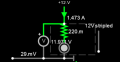
Below is 5.6A with 110 mV drop so 2A load will be proportionally lower. 110mV/55.6A = 2 mOhm e.g. https://www.mouser.ca/ProductDetail/Toshiba/TK160F10N1LLQ?qs=gt1LBUVyoHmcfW1Jy1odBw==
1707803327429.png
1707804000511.png
 
Last edited:

Thread Starter

Saluki

Joined Feb 23, 2019
80
Yes.
The main energy loss (dissipation in the MOSFET) equals the LED load current times the difference in the regulator input and output voltages.
That's a darn nice side-benefit in this usage. Losses are least when least affordable, at least from the battery's viewpoint. :)
 

Thread Starter

Saluki

Joined Feb 23, 2019
80
I can simulate any LED array in Falstad by choosing the rated Vf @ If and choose the RdsOn using the Vth, & beta factor of any
Very cool! (Whups, another unintended pun!) :D

The 250m was my estimate of the stripled equivalent circuit (because the TS never gave us link or specs to the LEDs)
Eh, well, TS (me) never gave us a link or specs to the LEDs) because the vendor didn't supply such or even indicate what LED's are in the module, what the internal series resistance is, etc. The modules are encapsulated so I can't isolate the resistor either, tho' if I did more rigorous / complete measurements I could estimate it.

The vendor's pertinent info. (Amazon listing):

Compatible: voltage at 12V fit for Vans, Boats, Lorries, HGV's, Horse boxes, Motorhomes, Lutons, Off Road Buggies, can be used at anywhere that equiped with 12 V power.

White (Pics in operation were also posted.)

Specifications: 1, Voltage: 12 V. 2, Module quantity: 20. 3, LED quantity: 60 (3 LEDs on every module). 4, Size: 2. 95 in X 0. 59 in (L&W) for every module. 5, 20 LED modules total length: 11 ft. 6, Wiring harness length: 14. 5 ft. Complete kits includes: 20 X LED modules (3 LEDs every module) 1 X wiring harness 100% Satisfaction .


From vendor responses in the Q & A:

The output for 10 modules is about 750 lumens (about 75 LM/modules).
0.4w for every bulb, 1.6w for one module, 16w for the 10 modules.


When I inquired about the LED type, the vendor did not respond, but someone else did:

Flat.

Doh!:rolleyes:

What I did measure (copy / pasted from my review):

(Setup / ambient) One section / module of 3 LED's was tested, powering it from my car's battery, both with the engine running and not running. Ambient temperature was ~ 56 deg. F. At various times:

12.58 volts applied gave a current of 0.096 amps, or 1.208 watts.

12.98 volts applied gave a current in of 0.110 amps, or 1.428 watts.
Re-measurement: 13.0 volts applied gave a current in of 0.112 amps, or 1.4563 watts.
(See follow up heat test below.)

14 volts applied gave a current of 0.129 amps, or 1.81 watts. (See follow up heat test below.) Note that this is above the module's rating of 1.6 watts.

14.7 volts applied gave a current of 0.153 amps, or 2.249 watts (quick measurement due to rapid heating).

Later, indoors, with the module left hanging "free air", with the ~13 volt input, and the self-adhesive tape stripped off, the module got fairly warm, but not excessively hot, even though ambient temperature was higher @ ~67 deg. F.

Those were fairly careful but obviously not "rigorous" measurements. For that I probably should have taken data @ 0.1v increments from, say, 5v input, to where I stopped @ 14.7 volts. The mostly white / "silver" coloration of the modules would likely throw off my narrow spot non-contact "temperature gun"; best bet would probably be to paint the back of, say, 3 modules, black, let dry / cure thoroughly, test keeping them closely packed*, and measure temps from the back.

*That will skew temps slightly high, but, the almost continuous back surface of 3 modules would be large enough to minimize problems of the spot being too large for a single module. 'Tis better to be "slightly hot" in tests anyway. :)

Anybody know offhand what the std. criteria is for determining If max, anyway?
 
Last edited:

Thread Starter

Saluki

Joined Feb 23, 2019
80
0.4w for every bulb * 60 = 24W. or ~2A
Yet none of your measurements were close to this. Why?
As stated, I measured one module. 3 LED's / module.
0.4w for every bulb * 3 = 1.2W. or ~0.1A
(In reality, each LED dissipates less as some power gets eaten by the resistor.)
 
Last edited:

Thread Starter

Saluki

Joined Feb 23, 2019
80
Yes.
The main energy loss (dissipation in the MOSFET) equals the LED load current times the difference in the regulator input and output voltages.
I may use a few of these where I can work them in, off the protected circuit:

https://www.amazon.com/dp/B07Q79C9LV

Scrolling down to this review:

https://www.amazon.com/gp/customer-...ef=cm_cr_dp_d_rvw_ttl?ie=UTF8&ASIN=B07Q79C9LV

the reviewer states:

These bulbs work on a very wide voltage range from less than 11V to above 14V, which is good since I intend to use them for dry camping and on shore power. Note however, that since they are a current mirror setup, the current (and light output) does not appreciably increase with higher voltage and you are just increasing the amount of waste heat generated. While that might make these less efficient then switching power supply they are still much more efficient than any incandescent/halogen bulbs, and their efficiency is higher when dry camping (when battery voltage is lower) when efficiency matters the most.
and makes several other interesting observations as well.

This apparently DOESN'T give the "tracks the input" characteristic at lower voltages, but, it's still nifty.

(I thought you might find it of interest!);)
 

Thread Starter

Saluki

Joined Feb 23, 2019
80
I'd like to be able to use a moderately varying source for 13 volts at well under 5 amps*, tapping from an automobile electrical system, and limit the output voltage to various LED modules to ~13.6 volts maximum. The load consists of LED modules I purchased which are evidently 3x 100 mA LEDS in series with a ~3 ohm resistor to somewhat limit current. However, powered off a variable DC power supply the current increases rather quickly at over 14 volts, and at 14.5 volts they get hot quite quickly -- In testing I removed the 14.5 volts quickly fearing the LEDs would "burn out". At 13 volts the LED modules are sufficiently bright and only a little warm.

*Note that "0" through at least 8 modules may be switched on at any given time. So, a constant current / LED driver doesn't work unless I want to feed each LED module with its own driver, after its switch or relay. :p

Note that below 13v, it is desirable to have the input to the modules follow the source (battery) voltage, as the weakening light output is a good indicator one is draining the battery too far. (I might even want to enhance that effect, but that's another circuit for a different discussion, I think. I could simply add a voltage display of the source, also, although that works against conserving battery power when the engine is off. In any event, a very sudden shutdown is undesirable.)

A simple zener-resistor "regulator" would "work", but is rather wasteful of the source power. I'm thinking a simple zener* + pnp-transistor or Darlington transistor (and a couple resistors) regulator would do the trick (circuits available online) but I am not sure of behavior as the source voltage falls UNDER the voltage needed to trigger limiting in the first place.

https://www.bristolwatch.com/ele/zener_power_supply.htm

I do NOT need "power supply for audio op amp" quality regulation. I just want to lop off the voltage to the modules when the "battery voltage" runs a little "hot", and follow the battery voltage otherwise.

I do not know how a PWM buck regulator will behave with sagging input voltage. The voltage differential is probably a "killer" anyway. A buck-boost regulator will draw more current from the battery at the worst possible time.

I'll add that one sees a great number of reviews on Amazon, etc., of LED lights and modules "burning out" in automotive and related use. I've tested a number and most* of the same lights and modules run fine (again, often just barely warm) at their nominal 12v rating, even up to 13v or so. I've never had one fail due to overheating if powered off a "12v" source that wasn't being also fed by a charger / alternator that could take the battery above 13.5 volts or so.

Thoughts? Will the zener+transistor regulator do the trick?

(Worst case, I can order parts, breadboard the thing, and see how it runs when I vary the voltage input. But discussions add to my and others knowledge base.) :)

Thanks!
Rough guess of PCB (perf board) area needed to build the 2nd circuit? (It's been a while since I've worked with smallish components. Typical for me these days would be a 10 uF 400v polypropylene cap!) Just a guess is fine, no need to optimize or layout or model. Thanks!
Any linear method to limit voltage will waste energy, but I don't see that as being significant in a vehicle application.
For 8 modules at 100mA each, the dissipated power would be about (14.5V-13V) * 800mA = 1.2W.

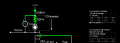
Below is the LTspice sim of an emitter follower regulator with a cheap TL431 voltage reference that may work for you.
The maximum output is about 12V, which can be varied by changing the value of R1, with the output being regulated at a Ref voltage of 2.5V.
The follower is a Sziklai pair, which has a lower in-out voltage drop (about 1V here) than a Darlington stage at low voltages, so it starts to come out of regulation at a battery voltage of about 13V.

You may prefer to avoid that 1V drop and have it regulate down to 13V input and output.
For that a slightly more complex LDO circuit should work, (bottom sim).
Note that the input and output voltages are now essentially equal below the regulation point, as determined by the MOSFETs on-resistance times the output current.

The P-MOSFET should be one in a TO-220 case to dissipate the power.

View attachment 314857

============================

View attachment 314863
(Anybody)

Rough guess of PCB (perf board) area needed to build the 2nd circuit? (It's been a while since I've worked with smallish components. Typical for me these days would be a 10 uF 400v polypropylene cap in a 3-way speaker passive crossover!) Just a guess is fine, no need to optimize or layout or model, as this is just a 1 or 2 off.

Plenty of perf board options on Amazon.

Edit: SOMEWHERE I have a ~ 3" x 7"(?) solderless breadboard with a +/- 15 volt power supply that would work for an initial prototype / try-out. :rolleyes:
Thanks!
 
Last edited:

Thread Starter

Saluki

Joined Feb 23, 2019
80
Yes.
The main energy loss (dissipation in the MOSFET) equals the LED load current times the difference in the regulator input and output voltages.
Speaking of MOSFET's, it looks like most available SI7469's are surface mount. I'll have to be a bit creative with heat sinking. They are seemingly a bit hard to find in the US without paying more for the shipping than 3 of the MOSFETS. Ebay and Amazon look to all be slow boat from China except one really expensive Amazon source. Guess I won't have any user feedback for a while. :-(

Is there a good alternative in a TO-220 package?
 

Thread Starter

Saluki

Joined Feb 23, 2019
80
One of these, for example, should work
Noted. Quite a list there. Any particular spec(s) to keep in mind?
Like I say, I'm not exactly well versed on MOSFETS -- just a general idea on how they work, and I replaced a few in blown audio amplifiers back in the day. That's not a criticism - one usually had to really abuse those ol' Hafler amps to hurt 'em. I still have a couple. :cool:

I prolly ought to study the tutorials over @ bristolwatch.com and / or his vids if I can get some time...

Thanks much!
 

Thread Starter

Saluki

Joined Feb 23, 2019
80
I can simulate any LED array in Falstad by choosing the rated Vf @ If and choose the RdsOn using the Vth, & beta factor of any FET.
The 250m was my estimate of the stripled equivalent circuit (because the TS never gave us link or specs to the LEDs)
Falstad's sim. uses the rules of physics to compute to any user defined number of decimal places.
The voltage drop below threshold depend on the low Rdson,
Below is 5.6A with 110 mV drop so 2A load will be proportionally lower. 110mV/55.6A = 2 mOhm e.g. https://www.mouser.ca/ProductDetail/Toshiba/TK160F10N1LLQ?qs=gt1LBUVyoHmcfW1Jy1odBw==
FWIW, I mentioned a light I might be able to use in a couple circuits off the main (protected) circuit. They came in, and I was able to do some testing.

Product link:

https://www.amazon.com/gp/product/B07Q79C9LV/ref=ppx_yo_dt_b_asin_title_o00_s00?ie=UTF8&psc=1

Listing pic:

1709439938597.png

My pic of rear:

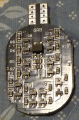
1709439883177.png

Note that the 16x "2TY" SMD transistors come up as being S8550's (I think):

A typical datasheet: https://datasheetspdf.com/product/1352843/JIEJIE/S8550/index.html

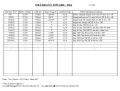
My tests on one of the lights. Note the current limiting that seems to be significantly board temperature driven:

1709439983526.png
Obviously my ambient temps were quite on the cool side!

I'm quite curious about this circuit, although I can't see the traces to trace it out. Also note I did not do current & temperature measurements at lower voltages, but I did run the light off a much smaller battery, running it down somewhat under 12v, and the light output seemed to decrease gradually. I didn't go much lower than 9v, so as to not severely stress the battery, so I don't know where total cutoff is.

Edit, to add more discussion / explanation about the testing :

After a few quickie measurements indoors to ascertain I had a light module working correctly (the 1st one I tried out had a 3-LED section not working, and another had at least 3 sections not working, the other 18 lights seem fine), my first step was to put my 2014 Chevy Tahoe SSV on an automatic charger, which charged it to 13.7 volts according to the charger, and 13.8 volts according to my Fluke 8060A. The I ran the engine @ idle for 15 minutes, resulting in a battery voltage of 15.05 volts which was the time I clipped the light "in circuit". Current monitoring through the light was done by my Beckman HD 160, board temperatures were measured with a 6:1 spot non-contact thermometer, air temp. was measured by a small digital thermometer I've checked in near vicinity to our (rather close) NWS office.

Yes it was a quite cool, and cloudy day, with very steady temperature and no noticeable warming by the sun: Almost perfect with regard to temperature stability for the 1-1/3 hour of the test. The air temperature did drop in the late afternoon, but at that point that was not a problem.

Measuring the temperature of the board involved holding the non-contact thermometer right up to the back of the board, both in "mid-air". I'd note the voltage and current, then the board temperature. I "fumbled" the temperature measurement a bit at "t=0", the temperature measurement itself was several seconds late which gave the board time to heat up. Most of those up arrows indicating rising board temperature as I tried to measure that were when I'd just reconnected the board. 30:00 was not, but the rise there was quite slight -- might have been 'technician error". Heh-heh. In several cases I didn't note anything more than a rising temperature, if I was unsure what the average really was. No 'rising temp. was over 100° F, I think...

Basically I tried to sequentially cover a number of "likely circumstances" the bulb might be used in, and at the same time get a feel for the current limiting that occurred when the bulb board got hot. Obviously the bulb would get hotter in a hotter ambient environment: I should re-test this summer! I definitely got the impression that the board tries to keep the current through it down to 300 mA or less if the board temperature exceeds 150°F.

My measurement of the battery voltage at 5:00, with the engine on, of 15.12v was for me a new high measurement of a running automobile's supply rail. It's definitely something to keep in mind!
 

Attachments

Last edited:

Thread Starter

Saluki

Joined Feb 23, 2019
80
Yes.
The main energy loss (dissipation in the MOSFET) equals the LED load current times the difference in the regulator input and output voltages.
I just posted about those 921 style LED bulbs I stumbled on, and, sure enough they seem to have fairly significantly self-limiting current draw. I'm not keen to build a 16 transistor circuit, but... Interesting. On of the Amazon reviewers said he thought a current mirror circuit is used. My tests are @ post # 54.* The strip-modules make more sense for most of my uses though.

* https://forum.allaboutcircuits.com/...at-sagging-input-voltages.199034/post-1893107
 
Last edited:

Thread Starter

Saluki

Joined Feb 23, 2019
80
I just posted about those 921 style LED bulbs I stumbled on, and, sure enough they seem to have fairly significantly self-limiting current draw. I'm not keen to build a 16 transistor circuit, but... Interesting. On of the Amazon reviewers said he thought a current mirror circuit is used. My tests are @ post # 54.* The strip-modules make more sense for most of my uses though.

* https://forum.allaboutcircuits.com/...at-sagging-input-voltages.199034/post-1893107
Info. added to my post #54 above...
 
Top