It has oscillations even with a 1mF capacitor on the output (albeit at a lower amplitude).
In my experience, if a simulation exhibits oscillations, then there's a fair chance the real circuit will also.
I always try to do a minimum amount of math so I find it easier to calculate that based upon the currents through the resistors rather then to solve a voltage divider equation.
The TL431 Ref voltage is 2.5V at the regulated output voltage, so the current through R3 is 2.5V / R3.
(2.5V / 4.99k = 501µA here).
Then calculate R1 = (Vo-2.5) / 501µA where Vo is the desired output voltage.
You could also, of course, use a pot for R1 to allow easy adjustment of the voltage.
I always try to do a minimum amount of math so I find it easier to calculate that based upon the currents through the resistors rather then to solve a voltage divider equation.
The TL431 Ref voltage is 2.5V at the regulated output voltage, so the current through R3 is 2.5V / R3.
(2.5V / 4.99k = 501µA here).
Then calculate R1 = (Vo-2.5) / 501µA where Vo is the desired output voltage.
Being able to use a pot or 2nd resistor opens up possibilities for variable dimming all the LED's even with switching of individual modules or sets of modules following the limiter. That could be useful when sleeping in the little pop-up camper...
R1 is the preferred adjustment in both circuits, correct?
One thing I didn't mention in my TS post is that power conservation IS somewhat important in a camper app: Sometimes one may be powering from the tow vehicle or a generator feeding the battery, other times one may be running solely off the battery. That said, burning off a little power to prevent over-voltage when the tow vehicle engine or a generator is running is not a big concern, as you said.
Now to find some other use for these extra TIP 31c's I have...
Any linear method to limit voltage will waste energy, but I don't see that as being significant in a vehicle application.
For 8 modules at 100mA each, the dissipated power would be about (14.5V-13V) * 800mA = 1.2W.
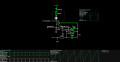
Below is the LTspice sim of an emitter follower regulator with a cheap TL431 voltage reference that may work for you.
The maximum output is about 12V, which can be varied by changing the value of R1, with the output being regulated at a Ref voltage of 2.5V.
The follower is a Sziklai pair, which has a lower in-out voltage drop (about 1V here) than a Darlington stage at low voltages, so it starts to come out of regulation at a battery voltage of about 13V.
You may prefer to avoid that 1V drop and have it regulate down to 13V input and output.
For that a slightly more complex LDO circuit should work, (bottom sim).
Note that the input and output voltages are now essentially equal below the regulation point, as determined by the MOSFETs on-resistance times the output current.
The P-MOSFET should be one in a TO-220 case to dissipate the power.
Balance it how?
And what's the purpose of this "balance"?
I used 15kΩ so that the maximum Vgs turn-on voltage would be applied to minimize the drop when the input voltage drops below the regulated output voltage.
I found most 12V stripleds use resistors per 3 LEDs to operate the rated power at 12V not 13.5V but yours may be an exception.
I would confirm what specs you want for regulation: max mean current, Vin range, control method and then choose a design such as ;
lossy linear fixed Vdrop, ((+ Sziklai or Darlington pair, )
lossy linear CC limiter, (I sense amplifier + NFET)
low-loss PWM, ( I sense amplifier, PWM IC + NFET)
lossy buck-boost CV or CC regulated
lossy buck CV or CC regulated.
low loss PFM ( I sense amplifier averaged with hysteretic comparator + NFET)
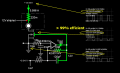
I simulated the last one below where the loss is lower because it eliminates the lossy inductor.
I chose a 10 mohm current sense for low loss and NFET <0.1 ohm, lower the more efficient, a R2R CMOS Op Amp with some Rout and some voltage reference scaled down < 5A = 50 mV.
I modeled some random 12V stripled with Req = 220m as the parallel equiv of all your 3 ohm resistors with a 12V power xx W LED, so your results will vary depending on your stripled specs.
The duty cycle will change as the frequency increases with a hysteretic deadband for the turn off pulse, so I call this the PFM method. (voltage controlled Pulse Frequency Modulation). It should show continuous voltage < 13.5V as you indicated this was your target limit tracking the battery voltage with engine off and vary the frequency of OFF pulses to maintain an average triangular voltage from the 10k 33nF integrator
Iref [V] = I * Rsense (10m) = 0 to 40 mV {= 4A} You may choose any way to create this low voltage using an R-divider with a low value << 2.2k
There are many variations of this simple design. Although using a 100 mohm NFET can be lowered easily, and the stripleds are not efficient due to the lossy resistors on the strip so low loss design is inherently not important yet it is 97% efficient which is better than most buck regulators and you wont have any hot linear series regulators to worry about. It is works with very low dropout using the low side switching of the stripled with a power NFET. It does not need to be a logic level FET but can be, so any std 2 to 4V threshold NFETs will work with Vgs/Vt>3 in this app.
Questions?
If you wanted to find a cheap IC to do all this, they must exist by now. It is easy to add UVP to cutout but I figured your ignition controlled relay power would enable LED power.
There seems to be some variance in various LED modules / strings* optimum voltage (or current) ** operation, depending on the vendor and part number, etc., even when ratings just state, for example, a nominal 12v input.
What I'm working with at the moment are 3-Led modules that come in a string of 20 or more modules, each module separated by ~100 cm of connecting 2-conductor wire. So, not exactly a "strip", but electrically similar.
**By optimum, usually I consider that is the module not getting over ~40 deg. C operated for 1 hour in an ambient of 25 deg. C, with whatever heat sinking or dissipation mechanism is in effect in actual usage. (By "dissipation mechanism" I include, say, one of those LED fog lights with a built-in miniature fan.) 30 minutes suffices in most cases where thermal lag of the sinking is minor. Then measure input current and voltage.
However, I consider that "optimum" operation of the module or light only as a starting point, as in automotive or "sheltered outdoor" (ie., dry through humid but not "wet") applications one must consider the upper end of the automotive temperature range in most cases. Usually(!), a LED light or module that meets that initial criteria of not getting over 40 deg. C in a 25 deg. C ambient is ok.
Even factors such as behavior with sagging input voltage sometimes are of concern. (I'm likely being way too rigorous for lighting for personal use, but, it's my training & desire to learn. OTOH, I'd guess this is just scratching the surface of proper design*** for retail sales...)
***I've noticed that some "12 volt" LED lights in housings can get quite hot even at 12.0 volts, and 25 deg. C ambient, so I consider their "specs" overrated. This is Chinese stuff, after all: I test everything myself for actual performance / behavior. It's more fun than replacing burnt out modules in sometimes hard to access spots, later. ;-)
So far, the behavior of Crutschow's 1st circuit on page 2 (his 2nd circuit on page 1) looks almost ideal. It creates basically no voltage drop (or energy loss, I believe) until limiting action begins, then steady (clipped) output above that. Ideal costs a bit of complexity, but.... Tanstaafl.
I found most 12V stripleds use resistors per 3 LEDs to operate the rated power at 12V not 13.5V but yours may be an exception.
I would confirm what specs you want for regulation: max mean current, Vin range, control method and then choose a design such as ;
lossy linear fixed Vdrop, ((+ Sziklai or Darlington pair, )
lossy linear CC limiter, (I sense amplifier + NFET)
low-loss PWM, ( I sense amplifier, PWM IC + NFET)
lossy buck-boost CV or CC regulated
lossy buck CV or CC regulated.
low loss PFM ( I sense amplifier averaged with hysteretic comparator + NFET)
I simulated the last one below where the loss is lower because it eliminates the lossy inductor. View attachment 315072
I chose a 10 mohm current sense for low loss and NFET <0.1 ohm, lower the more efficient, a R2R CMOS Op Amp with some Rout and some voltage reference scaled down < 5A = 50 mV.
I modeled some random 12V stripled with Req = 220m as the parallel equiv of all your 3 ohm resistors with a 12V power xx W LED, so your results will vary depending on your stripled specs.
The duty cycle will change as the frequency increases with a hysteretic deadband for the turn off pulse, so I call this the PFM method. (voltage controlled Pulse Frequency Modulation). It should show continuous voltage < 13.5V as you indicated this was your target limit tracking the battery voltage with engine off and vary the frequency of OFF pulses to maintain an average triangular voltage from the 10k 33nF integrator
Iref [V] = I * Rsense (10m) = 0 to 40 mV {= 4A} You may choose any way to create this low voltage using an R-divider with a low value << 2.2k
There are many variations of this simple design. Although using a 100 mohm NFET can be lowered easily, and the stripleds are not efficient due to the lossy resistors on the strip so low loss design is inherently not important yet it is 97% efficient which is better than most buck regulators and you wont have any hot linear series regulators to worry about. It is works with very low dropout using the low side switching of the stripled with a power NFET. It does not need to be a logic level FET but can be, so any std 2 to 4V threshold NFETs will work with Vgs/Vt>3 in this app.
Questions?
If you wanted to find a cheap IC to do all this, they must exist by now. It is easy to add UVP to cutout but I figured your ignition controlled relay power would enable LED power.
TANSTAAFL!! For those unfamilliar with this reality,: There Ain't No Such Thing As A Free Lunch!! A rather basic concept in engineering: There is always a tradeoff. Usually it is either cost or time to create versus performance of durability., but sometimes it is number of capabilities versus complexity.
TANSTAAFL!! For those unfamilliar with this reality,: There Ain't No Such Thing As A Free Lunch!! A rather basic concept in engineering: There is always a tradeoff. Usually it is either cost or time to create versus performance of durability., but sometimes it is number of capabilities versus complexity.
From one of my favorite books that popularized the term when I was a young man: Heinlein's "The Moon Is A Harsh Mistress". (The price was very high indeed.)
Balance it how?
And what's the purpose of this "balance"?
I used 15kΩ so that the maximum Vgs turn-on voltage would be applied to minimize the drop when the input voltage drops below the regulated output voltage.
Hey, I just got back on AAC after a 10 year hiatus. I don't want to stir up any hard feelings. I should have kept my "mouth" shut on this, since it ain't a big deal.
I was just admiring your circuit, so I sim'ed it. I noticed the regulated output voltage was about 200 mv higher than what I expected (12.8v, by my calculation) due to the feedback, so I set out to figure out why. The first thing I noticed was that the emitter currents were way out of balance in the regulated region. R1=39k makes them approximately equal, and brings the regulated output down to the expected value.
I then checked the output during the low input range, and found that I had only lost 6uV at the output with the change in R1 from 15k to 39k. Probing the gate drive showed that, with 15k, Vgs was about 8v to 12.5v until the output started to transition, while with the 39k, it was a nearly constant 5v over that range. A look at the datasheet for the Rds(on) of the Si7469DP shows why that is.
Bottom line is, I was being anal about the diff amp balance. Hope I didn't piss you off too bad.
What I'm working with at the moment are 3-Led modules that come in a string of 20 or more modules, each module separated by ~100 cm of connecting 2-conductor wire. So, not exactly a "strip", but electrically similar.
**By optimum, usually I consider that is the module not getting over ~40 deg.
So far, the behavior of Crutschow's 1st circuit on page 2 (his 2nd circuit on page 1) looks almost ideal.
Thanks for your feedback. I agree temperature rise is a critical design criteria.
Below I simulated a 76Wpk 55Wavg load and the losses are less than 1/4W in Rs and Nch FET at a bit more than 5A.
I don't think any other topologies that I listed here are as efficient.
When one is dealing with an automobile interior that can get hot enough to melt, or at least "seriously un-mold" a (probably poor grade) ABS speaker grill, sinking heat can be problematic. For some years I mostly did design of car stereo subwoofers (the drivers themselves), and a lot of voice coils die in the summer...
Luckily, it's VERY unlikely ambient temps will be in remotely near that sort of range when these modules are in use.
That's pretty darn efficient! But, I'm juggling several criteria. What happens to the output voltage when the input falls? These modules I'm working with at present seem to work nicely at 13v, using 14.563 watts (which BTW is slightly below their rated 1.6 watts, which "BTW" the vendor incorrectly says is @ 12v.) However, for reasons stated, I do not want to see a sharp output chop off until the source voltage is under 12v, and preferably well under that. And, an output voltage with little differential from the input when the input is in the 12-13 volt range is very nice. Modules optimum @ 12v would be a bit different story. I just got some different modules in today - warm white ~3000k instead of ~5000k. Supposedly use 2835 LEDs. No tests yet.

 Facebook
 Google
 GitHub
 Linkedin