Facebook
 Google
 GitHub
 Linkedin
I'd like to be able to use a moderately varying source for 13 volts at well under 5 amps*, tapping from an automobile electrical system, and limit the output voltage to various LED modules to ~13.6 volts maximum. The load consists of LED modules I purchased which are evidently 3x 100 mA LEDS in series with a ~3 ohm resistor to somewhat limit current. However, powered off a variable DC power supply the current increases rather quickly at over 14 volts, and at 14.5 volts they get hot quite quickly -- In testing I removed the 14.5 volts quickly fearing the LEDs would "burn out". At 13 volts the LED modules are sufficiently bright and only a little warm.
*Note that "0" through at least 8 modules may be switched on at any given time. So, a constant current / LED driver doesn't work unless I want to feed each LED module with its own driver, after its switch or relay.
Note that below 13v, it is desirable to have the input to the modules follow the source (battery) voltage, as the weakening light output is a good indicator one is draining the battery too far. (I might even want to enhance that effect, but that's another circuit for a different discussion, I think. I could simply add a voltage display of the source, also, although that works against conserving battery power when the engine is off. In any event, a very sudden shutdown is undesirable.)
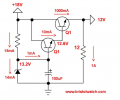
A simple zener-resistor "regulator" would "work", but is rather wasteful of the source power. I'm thinking a simple zener* + pnp-transistor or Darlington transistor (and a couple resistors) regulator would do the trick (circuits available online) but I am not sure of behavior as the source voltage falls UNDER the voltage needed to trigger limiting in the first place.
https://www.bristolwatch.com/ele/zener_power_supply.htm
I do NOT need "power supply for audio op amp" quality regulation. I just want to lop off the voltage to the modules when the "battery voltage" runs a little "hot", and follow the battery voltage otherwise.
I do not know how a PWM buck regulator will behave with sagging input voltage. The voltage differential is probably a "killer" anyway. A buck-boost regulator will draw more current from the battery at the worst possible time.
I'll add that one sees a great number of reviews on Amazon, etc., of LED lights and modules "burning out" in automotive and related use. I've tested a number and most* of the same lights and modules run fine (again, often just barely warm) at their nominal 12v rating, even up to 13v or so. I've never had one fail due to overheating if powered off a "12v" source that wasn't being also fed by a charger / alternator that could take the battery above 13.5 volts or so.
Thoughts? Will the zener+transistor regulator do the trick?
(Worst case, I can order parts, breadboard the thing, and see how it runs when I vary the voltage input. But discussions add to my and others knowledge base.)
Thanks!
*Note that "0" through at least 8 modules may be switched on at any given time. So, a constant current / LED driver doesn't work unless I want to feed each LED module with its own driver, after its switch or relay.
Note that below 13v, it is desirable to have the input to the modules follow the source (battery) voltage, as the weakening light output is a good indicator one is draining the battery too far. (I might even want to enhance that effect, but that's another circuit for a different discussion, I think. I could simply add a voltage display of the source, also, although that works against conserving battery power when the engine is off. In any event, a very sudden shutdown is undesirable.)
A simple zener-resistor "regulator" would "work", but is rather wasteful of the source power. I'm thinking a simple zener* + pnp-transistor or Darlington transistor (and a couple resistors) regulator would do the trick (circuits available online) but I am not sure of behavior as the source voltage falls UNDER the voltage needed to trigger limiting in the first place.
https://www.bristolwatch.com/ele/zener_power_supply.htm
I do NOT need "power supply for audio op amp" quality regulation. I just want to lop off the voltage to the modules when the "battery voltage" runs a little "hot", and follow the battery voltage otherwise.
I do not know how a PWM buck regulator will behave with sagging input voltage. The voltage differential is probably a "killer" anyway. A buck-boost regulator will draw more current from the battery at the worst possible time.
I'll add that one sees a great number of reviews on Amazon, etc., of LED lights and modules "burning out" in automotive and related use. I've tested a number and most* of the same lights and modules run fine (again, often just barely warm) at their nominal 12v rating, even up to 13v or so. I've never had one fail due to overheating if powered off a "12v" source that wasn't being also fed by a charger / alternator that could take the battery above 13.5 volts or so.
Thoughts? Will the zener+transistor regulator do the trick?
(Worst case, I can order parts, breadboard the thing, and see how it runs when I vary the voltage input. But discussions add to my and others knowledge base.)
Thanks!