amp/pwr supply work fine seperate, but not together

studiot

Joined Nov 9, 2007
4,998
OK let us go back to the beginning and set multisim aside for the moment, until we have circuit to model.

Please set out the design requirements for this project.
That is what input and output are required?
What other restrictions are there? for instance do you have to use a two stage transistor amplifier?
 

Thread Starter

zionarbadon

Joined Jun 10, 2011
52
OK let us go back to the beginning and set multisim aside for the moment, until we have circuit to model.

Please set out the design requirements for this project.
That is what input and output are required?
What other restrictions are there? for instance do you have to use a two stage transistor amplifier?

Okay here goes:
a) AC input to amplifiers: 20 mVpp, 2500 Hz, 600-ohm internal (source) resistance
(with occasional symmetrical spikes that exceed 20mVpp but won’t hurt the
amplifiers)
b) AC output to speaker: 2 Vpp into an 8-ohm speaker. (The peak limiter circuit is
used to limit the output spikes due to the input spikes to 4Vpp.)
c) Transformer(s): Assume 90% efficiency and standard house current.
d) Transistors: At least 1-NPN and 1-PNP to be used
e) Transistor amplifier circuitry: At least two of the ones I did in class: CE,CC,CB, or
Darlington. (Each Darlington counts at 1 transistor)
f) Transistor bias method: Any 2: voltage divider, emitter-bias,base-bias,emitter feedback, collector feedback
g) Rectifier(s): Bridge or Full-wave
h) Filter(s): Not more than 0.5% ripple
i) Regulator(s): "use something simple but effective" his suggestion was 7815 and 7915
j) Speaker: Whatever maximum wattage rating is needed with a directly driven
voice coil winding (no transformer is used)
 

studiot

Joined Nov 9, 2007
4,998
OK

Your power supply seems a reasonable beginning so lets concentrate on the amp part.
Let's start at the beginning (the speaker)

2 volts peak to peak is 1 volt peak or 0.7 volts RMS

Can you calculate the current and power this means into 8 ohms?

20 mv pk to pk input to 2000 mv pk-pk output is a voltage gain of 100.

A gain of 100 at the frequencies you describe is quite possible with a couple or three transistors. The current levels are within (just) the 2N3904 capability.

Have you learned anything useful from Sgt Wookie's links ?
 

Thread Starter

zionarbadon

Joined Jun 10, 2011
52
OK

Your power supply seems a reasonable beginning so lets concentrate on the amp part.
Let's start at the beginning (the speaker)

2 volts peak to peak is 1 volt peak or 0.7 volts RMS

Can you calculate the current and power this means into 8 ohms?

20 mv pk to pk input to 2000 mv pk-pk output is a voltage gain of 100.

A gain of 100 at the frequencies you describe is quite possible with a couple or three transistors. The current levels are within (just) the 2N3904 capability.

Have you learned anything useful from Sgt Wookie's links ?
Yeah .707 I is what I got last time around (as you can see in the schematic where i have the 'correct' output).


So:
V=IR, I=V/R, I= 2/8, I(L)=250mA
P=IV, P=.25*2,P=.5W

Is that correct?

and I'm looking though the westhost site and there is a ton of information, I'm looking around to see if there is anything I can use.
 

studiot

Joined Nov 9, 2007
4,998
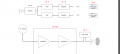
Looking at the block diagram and the other requirements, what do you know about the voltage and current gainss of CE, CC and CB amplifiers?

It is common in transformerless audio amplifiers to first use one or more stages to achieve all the voltage amplification, then use an output stage to achieve all the current amplification.

Does this suggest anything?
 

studiot

Joined Nov 9, 2007
4,998
V=IR, I=V/R, I= 2/8, I(L)=250mA
P=IV, P=.25*2,P=.5W
I make it 0.7 volts RMS so I = 700/8 = 87.5 milliamps

So wattage = rms current x rms voltage = 0.7 x 0.875 watts = 62.5 milliwatts

This is pretty basic stuff.
 

Thread Starter

zionarbadon

Joined Jun 10, 2011
52
Looking at the block diagram and the other requirements, what do you know about the voltage and current gainss of CE, CC and CB amplifiers?

It is common in transformerless audio amplifiers to first use one or more stages to achieve all the voltage amplification, then use an output stage to achieve all the current amplification.

Does this suggest anything?
Lets see here, common emitter provides current and voltage gain,

common collectors provide current but little or no voltage gain if I recall correctly,

and base was the opposite of that, giving a voltage gain without a current gain

So my initial thought (this time and last time) was to use a common emitter to see what I can get out, and then another stage for whatever I need more of (originally I guessed it would be current).
 

studiot

Joined Nov 9, 2007
4,998
OK

A CB stage is not appropriate because the input impedance is (very) low. This is good for 50 Ohm radio work but not for a 600 ohm audio source.

In general we try to arrange the input impedance of a stage to be much greater than the output impedance of the source.

We can get this from either a CE or a CC input stage.
But only a CE stage will give us voltage gain.

So a good strategy is to obtain our 100 voltage gain with a CE input stage.

This is likely to have a medium to high output impedance, compared to 8 ohms (as Audioguru said) so this is where a CC stage steps in. The CC stage will have near unity voltage gain but lots of current gain with a high input impedance compared to the output impedance of the first CE stage, but a low output impedance compared to 8 ohms.

Again as Audioguru said you have +/- supply rails so a stage using a complementary pair of CC amps would work well.

It is well past midnight here so I am off for my beauty sleep but will try to post some circuits tomorrow.

go well
 

Thread Starter

zionarbadon

Joined Jun 10, 2011
52
OK

A CB stage is not appropriate because the input impedance is (very) low. This is good for 50 Ohm radio work but not for a 600 ohm audio source.

In general we try to arrange the input impedance of a stage to be much greater than the output impedance of the source.

We can get this from either a CE or a CC input stage.
But only a CE stage will give us voltage gain.

So a good strategy is to obtain our 100 voltage gain with a CE input stage.

This is likely to have a medium to high output impedance, compared to 8 ohms (as Audioguru said) so this is where a CC stage steps in. The CC stage will have near unity voltage gain but lots of current gain with a high input impedance compared to the output impedance of the first CE stage, but a low output impedance compared to 8 ohms.

Again as Audioguru said you have +/- supply rails so a stage using a complementary pair of CC amps would work well.

It is well past midnight here so I am off for my beauty sleep but will try to post some circuits tomorrow.

go well
Alright, thank you so much for your help. :) I'm learning so much already. I wish you taught at my school!
 

Thread Starter

zionarbadon

Joined Jun 10, 2011
52
Okay, using the formula that you had used earlier I came to this conclusion for my circuit:

15-({30/[R1+R2]}xR1) =VB

So say, for example, I pick 7.5k for R1 then and I want to use 1.4V for VB then I can figure out that R2 should be 9k.

Does that sound right? I just want to make sure, because the method you used to figure that out was different than what we have done, as we've always used β for calculations. :)
 

studiot

Joined Nov 9, 2007
4,998
Okay, using the formula that you had used earlier I came to this conclusion for my circuit:

15-({30/[R1+R2]}xR1) =VB
Yes that right.

R1 & R2 form a voltage divider bias, which is one of your required bias methods in (f)

For this method you choose (guess) the operating current levels in the transistor, say 10 milliamps in the collector and 0.1 to 1 milliamps in the base.

Then choose the total R1+R2 to pass say 10 times the expected base current with the supply voltage. This means that the variation in base current with the signal is so small that it does not affect the voltage point at the junction of R1 and R2 in the divider. That is how the bias stabilisation works for this arrangement.

So your divider will pass 10 x 0.1 milliamps = 1 milliamp.

This establishes the sum of R1 + R2. You then choose real values to set the bias point where you want it. It is usual to set this midway between the supply rails to maximise the available output swing (this is where you need to know the peak to peak).

Some more thoughts.

Firstly looking at your specification it does not say specifically you have to use a + and - supply - is this a requirement?
The power and current levels required are within reach of a single power supply of 15 volts and the circuitry is easier. If you have to use both then the rquirement for both NPN and PNP is met by using a complementary pair output stage.

Secondly the block diagram seems to be leading in a certain direction (that I am trying to follow) are the references in red to chapters in your textbook?

Finally what timezone are you in -this will help posting times for best effect?

You will get through this. I am trying to help you do the work rather than just supply a design, but bearing in mind the timescale , I'm sure we can cut a few corners. Most designs are made by taking standard circuit arrangements (circuit topology) and working the values to suit the application.
 

Thread Starter

zionarbadon

Joined Jun 10, 2011
52
Yes that right.

R1 & R2 form a voltage divider bias, which is one of your required bias methods in (f)

For this method you choose (guess) the operating current levels in the transistor, say 10 milliamps in the collector and 0.1 to 1 milliamps in the base.

Then choose the total R1+R2 to pass say 10 times the expected base current with the supply voltage. This means that the variation in base current with the signal is so small that it does not affect the voltage point at the junction of R1 and R2 in the divider. That is how the bias stabilisation works for this arrangement.

So your divider will pass 10 x 0.1 milliamps = 1 milliamp.

This establishes the sum of R1 + R2. You then choose real values to set the bias point where you want it. It is usual to set this midway between the supply rails to maximise the available output swing (this is where you need to know the peak to peak).

Some more thoughts.

Firstly looking at your specification it does not say specifically you have to use a + and - supply - is this a requirement?
The power and current levels required are within reach of a single power supply of 15 volts and the circuitry is easier. If you have to use both then the rquirement for both NPN and PNP is met by using a complementary pair output stage.

Secondly the block diagram seems to be leading in a certain direction (that I am trying to follow) are the references in red to chapters in your textbook?

Finally what timezone are you in -this will help posting times for best effect?

You will get through this. I am trying to help you do the work rather than just supply a design, but bearing in mind the timescale , I'm sure we can cut a few corners. Most designs are made by taking standard circuit arrangements (circuit topology) and working the values to suit the application.
So if I am understanding I'd want to set my 1mA = 30/Rtotal(of that branch). Which would give me 300k to play with. However, if thats the case, I'm not sure what to do from there, if I set each at 150k then I wont have anything on the base right?

Also, I don't believe I have to use a negative rail. I was using it because I thought I needed a negative voltage due to the picture from the requirements (with an LED showing that the negative voltage is on. However, as I said, at this point I don't really think I have to have it as long as I can power whatever PNP I use without it.

Yes, they refer to the book but all of the examples in the book start with knowing resistances and beta, and the examples themselves are few and incomplete. (Electronic devices conventional current version Floyd).

As for time zone, I am eastern. Additionally I will have to step out for a few hours as my good friend is getting married today, but do to these unfortunate circumstances (I had thought I was nearly finished yesterday) I will make my appearance at the reception brief and get right back to this.

And I am glad you are taking the time to lead me through it rather than just designing it, I will need to know this information!
 

Audioguru

Joined Dec 20, 2007
11,248
Using a plus and minus 15V supply (a total of 30V):
The total of R1 plus R2 is 30k ohms, not 300k ohms because 30V/1mA= 30k.

You want 10mA in the collector resistor and you want the collector to have an operating point at about half the supply voltage which is 0V, then the collector resistor has 15V across it at idle so its value is 15V/10mA= 1.5k ohms.

You want about 1.5V across the emitter resistor which will also have a current of 10mA so its value is 1.5V/10mA= 150 ohms.

The base voltage will be about 0.65V higher than the emitter voltage so it will be 1.5V = 0.65V= 2.15V higher than the -15V supply voltage.
Then simply make a voltage divider to provide the base voltage and the total resistance of the voltage divider is about 30k ohms.

This amplifier will have a voltage gain of a little less than 1.5k/150= 10 times. The gain can be increased by adding a capacitor across the emitter resistor.

This amplifier transistor must drive a fairly high load resistance like the inputs of a CC transistor pair. The CC transistor pair can be complementary (an NPN and a PNP) and must have current and power ratings that is adequate for this job of driving an 8 ohm speaker.
 

Thread Starter

zionarbadon

Joined Jun 10, 2011
52
Using a plus and minus 15V supply (a total of 30V):
The total of R1 plus R2 is 30k ohms, not 300k ohms because 30V/1mA= 30k.

You want 10mA in the collector resistor and you want the collector to have an operating point at about half the supply voltage which is 0V, then the collector resistor has 15V across it at idle so its value is 15V/10mA= 1.5k ohms.

You want about 1.5V across the emitter resistor which will also have a current of 10mA so its value is 1.5V/10mA= 150 ohms.

The base voltage will be about 0.65V higher than the emitter voltage so it will be 1.5V = 0.65V= 2.15V higher than the -15V supply voltage.
Then simply make a voltage divider to provide the base voltage and the total resistance of the voltage divider is about 30k ohms.

This amplifier will have a voltage gain of a little less than 1.5k/150= 10 times. The gain can be increased by adding a capacitor across the emitter resistor.

This amplifier transistor must drive a fairly high load resistance like the inputs of a CC transistor pair. The CC transistor pair can be complementary (an NPN and a PNP) and must have current and power ratings that is adequate for this job of driving an 8 ohm speaker.
You are right, i hit my 0 key one too many times when trying to type .001 into my calc xD

I'm going to use .7 as my CE because that is what our teacher taught and he may take points off if I use .65 :-/. Is .65 more accurate?

So using the voltage divider method I'd want:
15-([30/30k]*x)=2.2
Which should come out to about 2.2k

Which means my R1 should be 27.8k to make VB 2.2V.

Unfortunately I cant find a 27.8k ohm resistor so the closest is 27.4k which would make VB 2.6V. Is that still acceptable? Did I do this correctly?

I understand that IE should be about 10mA but where did you get the 1.5V from? :)
 

Audioguru

Joined Dec 20, 2007
11,248
I'm going to use .7 as my CE because that is what our teacher taught and he may take points off if I use .65 :-/. Is .65 more accurate?
Simply look at the datasheet for the 2N3904 transistor. It has a graph of the typical Base-Emitter on voltage at various collector currents at various temperatures. In the circuit we are discussing it is fairly warm so its base-emitter voltage is not 0.72v as shown on the graph, it is about 0.65V.
but it doesn't matter because the base voltage will be fixed and the emitter voltage will change from 2.15V to 2.2V which is a change of only two percent!

So using the voltage divider method I'd want:
15-([30/30k]*x)=2.2
Which should come out to about 2.2k

Which means my R1 should be 27.8k to make VB 2.2V.
Yes, but a 27.8k resistor is not available so you will use 27k instead which changes the operating point of the transistor slightly (the small change doesn't matter).

I understand that IE should be about 10mA but where did you get the 1.5V from? :)
The emitter must have an emitter resistor so that the different Vbe, different temperatures and different betas of different transistors do not change the operating point a lot. I use 1/20th of the total supply voltage for the voltage across the emitter resistor. You could use a voltage that is 1/10th the supply voltage instead but then the output swing will be reduced.
 

Thread Starter

zionarbadon

Joined Jun 10, 2011
52
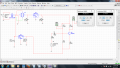
So I took a few minutes to set up what I have thus far. Using the 27k resistor my calculations are as follows:
27k*1mA= 27V
leaving VB= 3V
3V-.65 leaves 2.35V

2.35V/150ohms = 15.667mA

So should I adjust my RE to a 225 ohm resistor to get closer to 10mA?
 

Attachments

Top