Hi.
How do you calculate the amount of heat needed for one cubic metre of fresh water to raise its temperature from 15 degrees Celsius to 25 degrees Celsius ?
No, it is not homework.
1 g water requires 1 cal. for 1 deg. C of temperature change. Density of water is 1 g/cm^3, so 1g/cm^3 * 100^3 cm^3/m^3 * 10 degrees * 1 cal/degree = 10 MCal (or 10k kilocal).
1 cal is just about 4.1 J, so 41 MJ. With a 1 kWatt heater at 100% efficiency, that'd take about 11.4ish hours to heat.
Edit: A better estimate of 1 cal is actually 4.2 J; I forgot to round.
Edit 2: specific heat calculations are what you want to look up for more general solutions:
\[{\Delta}E = mc {\Delta}T\]
Here, \(c\) is the specific heat of the material (energy per unit temperature per unit mass), \(m\) is mass, \(\Delta T\) is the temperature change, and \(\Delta E\) is energy change (sometimes written as \(q\). Sometimes \(mc\) are combined into a single unit too).
Uh... no. Where on Earth are you getting those figures from?
A gallon of water is more like 8.34 lb.
1 m^3 of water is right at 1000 kg.
Water is (nominally) 1 g/cc.
1 cubic meter of water is (100 cm)^3 which is 10^6 cc, making it 10^6 g/m^3 which is 1000 kg/m^3 (or 1 Mg/m^3, but no one uses Mg).
As for that gallon of water, one gallon is, by definition, 231 in^3, and 1 inch is, by definition, 2.54 cm. So one gallon is 3785.411784 cc, which is therefore 3785.411784 g. The pound is defined as 453.59237 g, making 1 gallon of water nominally 8.34540... lb.
This very conveniently makes 6 gallons of water have a weight of almost exactly 50 lb.
OK.
1 cubic metre of water has a mass of 1 tonne, = 1000 Kilograms.
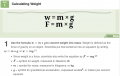
The formula for mass is weight divided by gravity; then, mass = weight / gravity :
1000 = weight / 9.81m/s2
The weight of a cubic metre of water is then 1000Kg divided by 9.81 m/s2 (G) = 101.93 Newtons. Is it ?
Now, this throws me off:
Which would mean that the weight of 1 cubic metre of water = 1000Kg is W=m g = 1000Kg x 9.81 m/s2 is instead, W = 9810 Newtons;
OK.
1 cubic metre of water has a mass of 1 tonne, = 1000 Kilograms.
The formula for mass is weight divided by gravity; then, mass = weight / gravity :
1000 = weight / 9.81m/s2
The weight of a cubic metre of water is then 1000Kg divided by 9.81 m/s2 (G) = 101.93 Newtons. Is it ?
It is an oddity that the pound and the kilogram are considered to be the same type of unit by pretty much everyone, except physicists. But in reality the pound is a force whereas the kilogram is a mass. The unit of mass in the imperial units is the slug which is the mass the exerts a force of 32 pounds in the gravitational field of earth at the surface. 1 slug or 1 kg remains the same on Mars, but 1 pound does not.
If you need a precise value, you can't rely on methods that assume a constant heat capacity. In fact Cp is a mild function of temperature and you have to integrate the Cp function over T to get a better estimate.
The best estimate available – internationally accepted as state-of-the art – is provided by the IAPWS model. The conditions given in #1 are well within the range a IF97, a simplified but still very accurate version of the full IAPWS model.
The iOS app RIDS can execute the IF97 calculations:
At 15°C and 1atm, fresh water is 0.99910 kg/L and 62.98 kJ/kg (with isobaric heat capacity = 4.189 kJ/kg/K)
At 25°C and 1atm, fresh water is 0.99705 kg/L and 104.8 kJ/kg (with isobaric heat capacity = 4.182 kJ/kg/K)
A cubic meter is 1,000L and so the starting mass is 1000/0.9991 = 1000.901kg. The final volume is 1000.901kg ÷ 0.99705kg/L = 1,003.86 L
The change of enthalpy is 1,000.901kg • (104.8 - 62.98)kJ/kg = 41,857.67 kJ
That's about 11.63 kW•h.
A simplified calculation using an average heat capacity of 4.186 kJ/kg/K gives ∆H = 1,000.901kg • 4.186 kJ/kg/K • 10K = 41,897.71 kJ. Not bad.
OK.
1 cubic metre of water has a mass of 1 tonne, = 1000 Kilograms.
The formula for mass is weight divided by gravity; then, mass = weight / gravity :
1000 = weight / 9.81m/s2
The weight of a cubic metre of water is then 1000Kg divided by 9.81 m/s2 (G) = 101.93 Newtons. Is it ?
This notion that "weight" is ONLY a force due to gravity or that the "pound" is a ONLY unit of force and not mass is an artifact of a push by textbook writers back in the early 20th century.
If you look at the actual definitions, as set out in international treaties, "weight" almost always refers to mass and not force (though these documents tend to use "mass" instead of "weight" so as to be unambiguous), but the "pound" almost always refers to a unit of mass, and not force. It is, in fact, explicitly defined as a unit of mass and NOT a unit of force. They also recognize that the interpretation of these terms is context-sensitive, so that "weight" frequently DOES refer to force and, also frequently, the "pound" is referring to a unit of force. But the same is true in the metric system, despite it seemingly having this nice, clean, clear distinction between the two. We talk about the load on a bridge being in kilograms or the pressure being kg/m^2, when in both cases we are actually talking about forces. The problem is that, in normal parlance, the distinction between the two is largely immaterial, and so most people get sloppy because most people are able to correctly interpret what was intended.
This is why, when it matters, it is a good idea to be very explicit and use lb-f (pounds-force) when you are talking about force and lb-m (pounds-mass) when talking mass.
It is an oddity that the pound and the kilogram are considered to be the same type of unit by pretty much everyone, except physicists. But in reality the pound is a force whereas the kilogram is a mass. The unit of mass in the imperial units is the slug which is the mass the exerts a force of 32 pounds in the gravitational field of earth at the surface. 1 slug or 1 kg remains the same on Mars, but 1 pound does not.
Tell that to all the physicist that defined the unit of the pound to be exactly 0.45359237 kg. There's no wiggle room in this -- that is the legal, internationally adopted definition of what the pound (or, more specifically, the pound in the avoirdupois system of measures) is.
Tell that to all the physicist that defined the unit of the pound to be exactly 0.45359237 kg. There's no wiggle room in this -- that is the legal, internationally adopted definition of what the pound (or, more specifically, the pound in the avoirdupois system of measures) is.
Correct, otherwise we'd have to specify the gravitational field. FWIW, in chemical engineering one refers to lb-m (pound mass) and lb-f (pound force) in dimensional analysis, to avoid any ambiguity.
Why? Metric system users have the same problems with confusing/misusing the kg as either a mass or a force, depending on context. It doesn't matter how clearing some standard of units spells things out, as long as we live in a world where, for the vast majority of people, there is no meaningful distinction between mass and the force of gravity on that mass, we will have this issue.
Why? Metric system users have the same problems with confusing/misusing the kg as either a mass or a force, depending on context. It doesn't matter how clearing some standard of units spells things out, as long as we live in a world where, for the vast majority of people, there is no meaningful distinction between mass and the force of gravity on that mass, we will have this issue.
Yeah, that is a great point. I was just remembering back to a series of confusing class discussions back in undergrad. I never seemed to run into any issues with kg or N. Probably simply heard the first mention of lbf and lbm incorrectly and struggled to unhear whatever confused me. Over 30 years ago, but I can still somewhat remember how the page in the book looked.

 Facebook
 Google
 GitHub
 Linkedin