Am I lucky or a hidden soul directs me ?

Status
Not open for further replies.

wayneh

Joined Sep 9, 2010
18,104
The 13.6V battery allows the output Mosfets to produce a squarewave that is about 13.2V p-p. The RMS voltage is 13.2V/2 x root of 2= 4.7V RMS
The output power is 4.7V squared/16 ohms= 1.38W which is not much. Bridged into 4 ohms= 20W.

I agree that 10 times the power sounds twice as loud. 2 times the power is barely noticeable.
The square root of two factor is only valid for a sine wave. For a square wave, it’s just the simple average, ie. 6.6V. Not that it matters much.
 

AnalogKid

Joined Aug 1, 2013
12,126
Staying with one FET, it will be a bit louder if you replace the diode with a 15 V zener.
Why would that be?
Dymanic braking. The high spike current through the diode actually slows down the return motion of the speaker cone due to back-emf and Lenz force. This is the same action that makes a generator harder to turn as the load increases. Over-damping the cone motion slows it down, reducing overall volume, especially the higher frequency harmonics. Here are two documents about the response time of relay armatures; same physics.

ak
 

Attachments

Last edited:

wayneh

Joined Sep 9, 2010
18,104
When explained this way it makes sense. Thanks.
Another way to picture it is the increase of surface area of a sphere with the radius. All the energy of the transmitter is diluted over the imaginary surface area inside the sphere, which increase with the square of the distance, the radius of the sphere.
 

Tonyr1084

Joined Sep 24, 2015
9,744
Another way to picture it is the increase of surface area of a sphere with the radius. All the energy of the transmitter is diluted over the imaginary surface area inside the sphere, which increase with the square of the distance, the radius of the sphere.
Will have to spend some time wrapping my head around that one. I know how to calculate surface are of a sphere, but right now I'm getting ready for Yoga. (the wife insists) "(
 

Audioguru

Joined Dec 20, 2007
11,248
The horn speaker is directional which might increase its output at a distance since it is no longer with a "square of the distance" because its sound does not spread out over a large area.
 

MisterBill2

Joined Jan 23, 2018
27,501
With a 16 ohm speaker the power is limited because of the resistance. No way around that except to add a transformer to match the impedance. And it may be that tose transistyors are not getting switched on enough. Just because it ius working does not mean that it is working right.
 

AnalogKid

Joined Aug 1, 2013
12,126
The horn speaker is directional which might increase its output at a distance since it is no longer with a "square of the distance" because its sound does not spread out over a large area.
Agree. A directional speaker is a good example of when inverse-square does *not* apply. The ultimate example is a laser.

The inverse square law is based on an infinitely small point emitter with a perfectly even radiation pattern in all directions. No real world transducer of any kind matches this, so the real discussion is how well (or not well) a specific device approximates the ideal. The critical parameter is beam dispersion. A laser has almost zero, so the beam energy density at 2 m is practically identical to that at 1 m.

A round horn speaker attempts to make a cone of audio. Obviously more dispersion than a laser, but better than a single point. The energy density and perceived loudness both decrease with increasing distance, but not nearly as rapidly as inverse-square predicts. A rectangular horn has a more complex energy-distance relationship, but still more focused than a single point radiator in free space.

ak
 

Thread Starter

ilker06

Joined Jun 26, 2018
34
Actually it takes 10X the power. A 10db increase in sound pressure is considered twice the volume.
Four times the power is a 6db increase and 50% louder.

EDIT: My point is (and before we get into discussing sound pressure levels) if the TS is getting a 110-115 db sound level that is easily heard at a 1/4 mile then do you really need any more volume?
SG
Dear friends,

Many thanks for your comments and suggestions. Actually 110 dB - 115 dB is enough for me I don' t want more but I think neither bridged TDA 2005 nor 2 MOSFETS give these decibels. Well I don' t have a decibel meter but I feel it.

But I am lucky again as mentioned on the topic :)

I found a very special sound chip at last. It is specially designed to work with car battery.
And ..... ! Here is the king: TDA1562Q

Data sheets say that under 13 - 14 v bridged TDA 2005 which I recently use can give 20 w with 4 ohms LS.
The same holy datasheets say that under 13 - 14 v TDA 1562Q gives 70 w with 4 ohms...... Thank God ! :D

Actually with bridged TDA 2005 the sound is being heard from 100 m. Also the MOSFETS gives the same effect. But not far from 100 m. That' s why I am looking for more power. I am sure that this sound level is not 110 dB or more. Yes I know you will all say that " Change the 16 ohm horn with 8 ohm " but maybe I will not need after TDA 1562Q' s arrival. It may satisfy me.

By the way, it is really important for me to understand the difference between dB and watt. Which one is the real indicator for the sound level and audibility ? ( I guess this is the same like horsepower and torque affairs :D )
 
Last edited:

Audioguru

Joined Dec 20, 2007
11,248
The TDA1562Q is obsolete and is not produced anymore. It was the only class-H amplifier I ever heard about. Class-H boosts the supply voltage to give a momentary peak power to music type of signals and its datasheet says with steady sounds (like your siren) it would get too hot and revert to an ordinary bridged 18W into 4 ohms amplifier. But since the power into your 16 ohms horn is so low then it might work well enough to boost its power to 18W when the supply is 14.4V if you can find one somewhere.

A horn speaker focusses the sound in one direction making it loud in that direction and not loud in other directions. Loudness is measured in decibels. The loudness of a speaker is measured with a certain power at a distance of one meter. The loudness decreases when the distance increases.
 

sghioto

Joined Dec 31, 2017
8,634
Another idea is to use two 16 ohm horns or speakers and point in different directions. Not any significant increase in loudness but better sound coverage.
SG
 

MrChips

Joined Oct 2, 2009
34,807
3dB is power x 2
6dB is power x 4
10dB is power x 10

You need 10dB power gain or 10x power to perceive a doubling of loudness.
 

sghioto

Joined Dec 31, 2017
8,634
In all fairness recent research suggest that a 6 to 10db increase in sound level can be perceived as twice the volume depending on who the listener is. But on average it's usually defined as 10db.
SG
 

Thread Starter

ilker06

Joined Jun 26, 2018
34
The TDA1562Q is obsolete and is not produced anymore. It was the only class-H amplifier I ever heard about. Class-H boosts the supply voltage to give a momentary peak power to music type of signals and its datasheet says with steady sounds (like your siren) it would get too hot and revert to an ordinary bridged 18W into 4 ohms amplifier. But since the power into your 16 ohms horn is so low then it might work well enough to boost its power to 18W when the supply is 14.4V if you can find one somewhere.

A horn speaker focusses the sound in one direction making it loud in that direction and not loud in other directions. Loudness is measured in decibels. The loudness of a speaker is measured with a certain power at a distance of one meter. The loudness decreases when the distance increases.
Yes I have ordered one and waiting for it' s arrival. There are a couple of sellers in a Chinese international site.( I don't want to make a commercial advertisment here but you have already guessed. )

The chip temperature can be ignored since it's continous working time will be maximum 10 seconds or less.

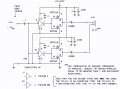
When I complete it I will share the result with you. By the way do you think that below version of my first shared circuit can satisfy me ? Shall I try it ? Because author says that " if you think that 6dB increasing is worth to build it up "

High-Power (160-watt) Output
This variation on the basic amplifier circuit shown in Fig 1 adds a second pair of complimentary output transistors connected as a classic H-bridge. The result is a quadrupling of output power. The high-power output circuit can be substituted for the output section in any of the versions above. It would be up to you to decide if the extra 6 dB of loudness is worth the effort.


Quadrapling.jpg
 
Status
Not open for further replies.
Top