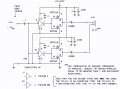
Why would that be?Staying with one FET, it will be a bit louder if you replace the diode with a 15 V zener.
ak
Why would that be?Staying with one FET, it will be a bit louder if you replace the diode with a 15 V zener.
ak
The square root of two factor is only valid for a sine wave. For a square wave, it’s just the simple average, ie. 6.6V. Not that it matters much.The 13.6V battery allows the output Mosfets to produce a squarewave that is about 13.2V p-p. The RMS voltage is 13.2V/2 x root of 2= 4.7V RMS
The output power is 4.7V squared/16 ohms= 1.38W which is not much. Bridged into 4 ohms= 20W.
I agree that 10 times the power sounds twice as loud. 2 times the power is barely noticeable.
Staying with one FET, it will be a bit louder if you replace the diode with a 15 V zener.
Dymanic braking. The high spike current through the diode actually slows down the return motion of the speaker cone due to back-emf and Lenz force. This is the same action that makes a generator harder to turn as the load increases. Over-damping the cone motion slows it down, reducing overall volume, especially the higher frequency harmonics. Here are two documents about the response time of relay armatures; same physics.Why would that be?
When explained this way it makes sense. Thanks.Inverse-square is a way to predict changes in energy density as a function of distance from the source.
Another way to picture it is the increase of surface area of a sphere with the radius. All the energy of the transmitter is diluted over the imaginary surface area inside the sphere, which increase with the square of the distance, the radius of the sphere.When explained this way it makes sense. Thanks.
Will have to spend some time wrapping my head around that one. I know how to calculate surface are of a sphere, but right now I'm getting ready for Yoga. (the wife insists) "(Another way to picture it is the increase of surface area of a sphere with the radius. All the energy of the transmitter is diluted over the imaginary surface area inside the sphere, which increase with the square of the distance, the radius of the sphere.
Agree. A directional speaker is a good example of when inverse-square does *not* apply. The ultimate example is a laser.The horn speaker is directional which might increase its output at a distance since it is no longer with a "square of the distance" because its sound does not spread out over a large area.
Dear friends,Actually it takes 10X the power. A 10db increase in sound pressure is considered twice the volume.
Four times the power is a 6db increase and 50% louder.
EDIT: My point is (and before we get into discussing sound pressure levels) if the TS is getting a 110-115 db sound level that is easily heard at a 1/4 mile then do you really need any more volume?
SG
Do you have a document or site on that?You need 10dB power gain or 10x power to perceive a doubling of loudness.
http://www.physics.mcgill.ca/~guymoore/ph224/notes/lecture12.pdfDo you have a document or site on that?
ak
Rod Elliot is excellent with sound thingy's:Do you have a document or site on that? ak
Yes I have ordered one and waiting for it' s arrival. There are a couple of sellers in a Chinese international site.( I don't want to make a commercial advertisment here but you have already guessed. )The TDA1562Q is obsolete and is not produced anymore. It was the only class-H amplifier I ever heard about. Class-H boosts the supply voltage to give a momentary peak power to music type of signals and its datasheet says with steady sounds (like your siren) it would get too hot and revert to an ordinary bridged 18W into 4 ohms amplifier. But since the power into your 16 ohms horn is so low then it might work well enough to boost its power to 18W when the supply is 14.4V if you can find one somewhere.
A horn speaker focusses the sound in one direction making it loud in that direction and not loud in other directions. Loudness is measured in decibels. The loudness of a speaker is measured with a certain power at a distance of one meter. The loudness decreases when the distance increases.

| Thread starter | Similar threads | Forum | Replies | Date |
|---|---|---|---|---|
| C | What is a cheap circuit to broadcast location of buried/hidden sensors? | General Electronics Chat | 6 | |
|
|
EasyEDA: Any hidden traps or important tips? | PCB Layout , EDA & Simulations | 2 | |
|
|
Lucky Day Thread | Off-Topic | 48 | |
|
|
must be my lucky day | General Electronics Chat | 20 | |
| T | Scored lucky with a 42" LCD TV | General Electronics Chat | 22 |