Aluminum Foil Heater

Thread Starter

wxman

Joined Oct 13, 2022
69
I have a digital rain gauge and on occasions when we get ice/snow, it ices over. Snow is somewhat rare in my area; Not enough to justify a professional rain gauge heater....But I would like to make a simple, temporary solution to melt the snow and keep the gauge flowing when it does occasionally happen. Basically, I need some way of electronically adding a slight bit of heat to the plastic surface of the gauge. Whatever I use must be flexible and very thin so as to not alter the shape and diameter of the gauge...

The first thing that came to mind would be tightly wrapping the inside and outside of the gauge with aluminum foil, then clamping a fully adjustable power supply (constant voltage, constant current and constant power) to the foil and allowing a limited small amount of electricity to flow through the foil. Just enough to warm the foil a few degrees above freezing (maybe around 40ºF / 4.5ºC) from an ambient air temperature that would probably be no colder than 25ºF / -4ºC....This would be using a voltage somewhere in the range of 5v-12v dc and a very low wattage.

Biggest question I have is, would this idea even work? Second, would there be any major risk involved that I'm overlooking? I realize shorting an "unregulated" source like a battery with foil would be an overheating/fire risk as there would be essentially no current limit (other than the limited resistance of the battery and foil)....But with a constant current/constant power regulation of the power source, it seems to me it would be safe so long as I don't crank the limits up to high.

Any thoughts would be appreciated!
 

LowQCab

Joined Nov 6, 2012
5,101
The Aluminum-Foil would be far too low of a Resistance,
most of the heat would be lost heating-up the Wires connecting to it.

A better plan would be to wrap just the BOTTOM of the container with small-gauge "Magnet-Wire",
the type that has an Enamel-Insulation,
several layers of it,
then wrap the Windings in Foam-Tape for outside insulation.
This will concentrate the Heat right where You want it, and it won't require such heavy Current to work.

I would want a thermostat to turn-off the power when temps get above freezing.

Or, You could just move to Florida.
:D
 

Thread Starter

wxman

Joined Oct 13, 2022
69
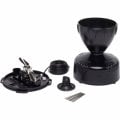
Part of the problem is the size/shape of the gauge. It's an "aerocone" bucket that sits on top of tipping scales:


aerocone2.jpgBasically, precipitation falls into the hollow cone on top, drips through a pinhole drain at the bottom of the cone part and into the tipping scales within the round bottom compartment. Once a scale fills to a known amount, it tips and pours out the water. To make it work in snow, I would have to warm the inside surface of that top cone so that ice/snow melts and drips down the drain. Then I would also need to warm inside the bottom compartment so that the melted water doesn't refreeze inside the tipping scales. That's why I was thinking if there were some way of heating aluminum foil, I could wrap the whole bucket (inside and outside) and that would warm all the areas needed.

What if wrapped in aluminum foil inside and out, then wrapping a resistance heated wire/cable around just the outside of the bucket. Would that heat then be transferred by the aluminum foil to the insides of the gauge? The plastic of the gauge insulates, so simply heating the outside of the bucket would not heat the insides; Some added surface would have to spread that heat from outside to inside and not sure if foil would adequately do that or not.
 

LowQCab

Joined Nov 6, 2012
5,101
After seeing a picture, I would now suggest placing the entire contraption inside of an insulated Box,
something like a small Igloo-Cooler, or some sort of Beer-6-pack-Cooler would do fine.
Then cut a hole in the top that would allow the Funnel to poke through.
Then place a ~60-Watt-Incandescent-Bulb inside for a Heater.
This will keep the entire device toasty-warm.
I would still recommend a Thermostat to keep things from getting too Hot.
.
.
.
 

sparky 1

Joined Nov 3, 2018
1,218
The humidity always changes, humidity can be seen as fog inside a car window, relates to inside outside temperature differential.
Fog inside a motorcycle helmet on a cold day affects visability. In order to move water down hill the lens surface is treated to make it hydrophobic in turn the water will bead up. The water phobic polished surface where (like charges repel) these water spheres roll downward with gravity.
Determining best choice in material should use scientific method to select if one cone design works better than another and why.
The interior of the cone could benefit from sufficient heat that is evenly distributed. I think the temperature gradient slightly favors the top.
A conical shape of sheet metal having mass might be easier to measure its cooling characteristics, I suspect it cools more at the top.
The rate of changes in foil temperature vs thermistors might favor more mass. Testing answers some of the what if.
 
Last edited:

Ian0

Joined Aug 7, 2020
13,097
I tried the aluminium foil approach to make underfloor heating once, by sticking the foil to the underneath of some vinyl flooring and cutting a zigzag pattern into it using a scalpel. It ran from a 12V halogen lighting transformer. It worked until the foil got damaged.
I'd recommend either of @LowQCab 's suggestions of winding it with magnet wire, or a small filament lamp such as an automotive lamp, running from a 12V transformer.
 

Ya’akov

Joined Jan 27, 2019
10,226
I tried the aluminium foil approach to make underfloor heating once, by sticking the foil to the underneath of some vinyl flooring and cutting a zigzag pattern into it using a scalpel. It ran from a 12V halogen lighting transformer. It worked until the foil got damaged.
I'd recommend either of @LowQCab 's suggestions of winding it with magnet wire, or a small filament lamp such as an automotive lamp, running from a 12V transformer.
The heater I linked to could be placed inside the housing of the gauge and used to heat the air in it. It would be easier and more compact. The same could be done with a simple resistor scaled to the necessary power rating.
 

Ian0

Joined Aug 7, 2020
13,097
The heater I linked to could be placed inside the housing of the gauge and used to heat the air in it. It would be easier and more compact. The same could be done with a simple resistor scaled to the necessary power rating.
Your Aliexpress link doesn't quite work here. I get a brief glimpse of something red and square with two leads before it says "not available in your location" and "wind turbine generator" appears in the search box!
 

Ian0

Joined Aug 7, 2020
13,097
Like this one, but in different sizes. Can you see that one? There are also the film type.
Yes. I agree that would be a good thing to use and better than magnet wire, but we’ve probably all already got a reel of magnet wire!
As Aliexpress ships from China, i don’t quite understand why there is stuff that can be sent to USA but can’t be sent to Europe and vice versa.
 

MisterBill2

Joined Jan 23, 2018
27,186
I suggest a box with adequate drainage so the water can drain out. And then a mains powered incandescent light bulb for heat. Have it at a distance so it does not melt the plastic gage parts. Ands unplug it before opening the box.
 

Thread Starter

wxman

Joined Oct 13, 2022
69
Thank you all for the responses! Interesting discussion

I tried the aluminium foil approach to make underfloor heating once, by sticking the foil to the underneath of some vinyl flooring and cutting a zigzag pattern into it using a scalpel. It ran from a 12V halogen lighting transformer. It worked until the foil got damaged.
Curious for a little more info on how you did this. We only get snow maybe one day per year, so durability is not important. It can be something disposable that I can remake whenever snow is in the forecast and trash it after a day or two. Few questions...

Did you essentially just "short" the 12v transformer by clamping the postive and negative leads onto the strip of foil and allowing current to flow through the foil?

Do you recall how much current? I'm assuming the transformer was current limited.

No issues with the transformer itself or lead wires getting hot?

What was the purpose of cutting the zigzag pattern instead of leaving it a solid sheet of foil?
 

MisterBill2

Joined Jan 23, 2018
27,186
The zig-zag cuts are to make the current path much longer, and also, increasing the resistance reduces the current to something closer to the power supply capability.
 

Thread Starter

wxman

Joined Oct 13, 2022
69
Welcome to AAC.

Something like this should work.
Thanks for the welcome!

Was looking at some of those types of strips on Aliexpress....Those patches are a little short for the area I need to cover without wiring a bunch of them together...Perhaps I could wrap the insides and outsides with a longer strip....Maybe something like the 100cm version of this:

https://www.aliexpress.us/item/3256805075016928.html

or this:

https://www.aliexpress.us/item/2255800143375534.html

Not sure of the total surface area of the gauge bucket because of it's shape, but max diameter at the bottom is 8.75" (16.5cm), top diameter 6.25" (15.9cm) and overall height is 9.5" (24cm)...

The heat would need to be evenly distributed across the bucket and the temperature would need to be above freezing, but just barely. The warmer the surface, the more evaporation that occurs in light precipitation. In some tests with other style buckets, warming the gauge surface to 60ºF (15ºC) resulting in the gauges underreporting the liquid melt by over 30% in light snow, due to the small melted droplets evaporating on the warm surface. Higher the temp, the more evaporation. So the goal is to evenly heat the gauge as little as necessary to cause melting, while limiting the evaporation rate as much as possible.

Surrounding the whole gauge in a container is an interesting idea, but has some drawbacks. For one, there are other weather sensors, solar panels, wireless transmitters, etc. all mounted below the rain gauge. To do this would require separating the rain gauge from the rest of the station...Doable, but would take a lot of remounting and perhaps rewiring with longer cables....Also, the hour-glass shape of the bucket is by design to minimize the effects of wind turbulance. By effectively changing the gauge surroundings into a box shape, would defeat the anti-turbulence design and cause less accurate measurements in wind. Of note, I'm actually a meteorologist, and my data is used for research and real-time forecasting and warnings, so maintaining accuracy is more important to me than it would be for the average weather hobbyist.
 

Thread Starter

wxman

Joined Oct 13, 2022
69
The zig-zag cuts are to make the current path much longer, and also, increasing the resistance reduces the current to something closer to the power supply capability.
Ok, that makes sense...Wondering how I could incorporate a zig-zag if I were to try this for a temporary solution....Inside of the top cone would need to be solid, but perhaps on the outside, I could cut out a zig-zag design....Or maybe cut out strips of foil to spiral around the outside leaving gaps in between.

Would crinkling the foil also serve the same purpose of increasing resistance?
 

metermannd

Joined Oct 25, 2020
472
I like Yaakov's suggestion the best.

The insulated box would also be good, but instead of a 60-watt lamp, I would suggest one of the old ceramic power resistors, the type that uses a through-bolt for physical support. That approach has apparently long been used in utility switching apparatus to raise the temperature just high enough to keep the inside of the control box from freezing up.

You don't want it to burn anything, just a steady source of heat that will eventually thaw out everything inside the insulated box.
 

Ian0

Joined Aug 7, 2020
13,097
The zig-zag cuts are to make the current path much longer, and also, increasing the resistance reduces the current to something closer to the power supply capability.
Precisely.
I calculated the resistance based on the width and length of the strip and the thickness (measured with a micrometer) and the resistivity of aluminium.
 

Ya’akov

Joined Jan 27, 2019
10,226
Your newly added requirement for high precision, accuracy, and repeatability changes the answer. This is no longer about freeze prevention, it is about temperature control. If you need to maintain a narrow temperature range on the outer surface of the plastic bucket I would use nichrome wire spirally wrapped on the interior cone and a PID temperature controller.

The wire should be Ni80 alloy for corrosion resistance.
The diameter of the wire will depend on the overall length of the element. A SWAG puts it at .25mm, but this project will require empirical testing. Your narrow temperature range requirement makes very careful measurement a necessity.

Ideally, I would 3D print a mold and use silicone to embed the wire in what amounts to a custom heat blanket. Alternatively, a two piece 3D printed cone could be coated with hight temp RTV and applied. This would protect the (presumably) ABS plastic of the gauge's cone while providing insulation for the heating coil to improve efficiency and stabilize the temperature with a thermal mass.

One of the difficulties you will encounter is the lack of conformability of many desirable materials (e.g.: Kapton tape. aluminum tape, &c). Creating a template to cut pieces that will properly cover the cone's surface would be very helpful.

The PID controller could be (relatively) easily be implemented using an Arduino compatible MCU. I would suggest the PID Library by Brett Beauregard. It dramatically simplifies the implementation of a PID controller, exposing only the critical bits and handling the rest under the covers.

The temperature sensor will be a critical element in this design. Initially, I would suggest a DS18B20 sensor in a TO-92 package. By drilling a hole in the cone that can accommodate passing the end through and flush to the surface, then insulating and waterproofing the sensor using RTV or a similar compound, you can sense something that should track the surface temp accurately. Again, empirically testing, and calibration using that data, will be critical to providing the accuracy required by your goal.

The selection of MCU is not as critical as other elements, but I would consider the possible advantage of having it serve more than one function since—in the case of an ESP32, for example—wireless connectivity comes along free, and you could even choose an option that supports LoRA for lower power and longer range connectivity. Having the ability to send and receive dat opens the possibility of transmitting telemetry not currently supported by the weather station, or controlling the station or elements of it.

The power supply selection will depend on the overall power requirements of the heater assembly. I might be inclined to choose a voltage like 24V or 48V and feed the station DC remotely instead of colocating the power supply with it. Feeding the mains supply to the station is fraught and lower voltages demand higher currents and so thicker wires.

Both 24V and 48V supplies are readily available, and the voltage needed by the MCU can be derived from such a feed using a buck converter. The heater itself can probably be efficiently run on the direct 24/48V.

One last point I will make, but an important one—the heater system must be designed failsafe. That is, should something go wrong—temperature sensor failure, MCU lockup, &c—the heater must turn off. A frozen rain gauge is not as bad as a melted one.

In addition to careful design that maintains positive control over the current in the heating element, this probably also calls for an NTC (Negative Temperature Coefficient) element that will increase in resistance, therefore limiting current, and as a consequence temperature. The NTC would maintain an upper limit and would be selected to prevent the heater from exceeding. current which would resulting in a damaging temperature.

Because you are concerned with the accuracy of the data to the level of a scientific instrument, the design of the gauge heater takes on a different aspect. This is not a particularly difficult project, but it does require more rigor than one that simply keeps the ice off.

Best of luck, and while I would normally wish someone "clear skies" I learned from working with a meteorologist colleague that I should probably wish you "stormy skies" instead.
 
Top