Alternating circuits

Thread Starter

WSUBG

Joined Jun 12, 2021
50
I can definitely see how you can come to the conclusion that absolutely everything in that chapter is about sinusoidal signals, but the key to answering this problem is Equation 5-3. Authors, particularly in older texts, almost always included a small handful of problems that require a closer level of attention to the details. They still do the same thing today, but they mark the problems as being more challenging.

I've skimmed quite a bit of the text and don't see anything that hints that a circuit that varies at a uniform rate of 500 A/s means that it is a sinusoid that goes from 0 A to a peak of 500 A in one second. If you can find such a place, could you indicate what page number it is on?

It is certainly NOT the case that the entire book is purely sinusoidal. Just look at the names of some of the later chapters.

Equation 5-3??? Is there no SIN in equation 5-3? I am beginning to give up on this thread, it provides no helpful information for me. I am no closer to understanding this problem then when I started. Perhaps I come back to it when I find someone willing to include me in the celebration of their intelligence. Regards.
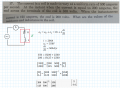
1734580894491.png
 
Last edited:

Papabravo

Joined Feb 24, 2006
22,084
Although the possibility of designing a switch mode power supply was not widely recognized in the early part of the 20th century, the problem is certainly relevant to a circuit where on each cycle the current will linearly increase at a uniform rate and linearly decrease at some, perhaps different rate. Can you at least imagine a situation that is NOT sinusoidal, that might be worthy of your consideration, since the the word "uniform" has a very precise and widely accepted definition. That definition apllies to functions with linear derivatives. There is NO trigonometric function with a linear derivative: period, full stop.

Maybe try to look at the problem from a different perspective and the light bulb just might go on.
 

WBahn

Joined Mar 31, 2012
32,878
Equation 5-3??? Is there no SIN in equation 5-3? I am beginning to give up on this thread, it provides no helpful information for me. I am no closer to understanding this problem then when I started. Perhaps I come back to it when I find someone willing to include me in the celebration of their intelligence. Regards.
View attachment 338390
Looks like you are using the 1st Ed. I'm looking at the 2nd Ed, which was revised in 1951.

Here's Eqn 3 from the 2nd Ed. It is shortly prior to the equation you have there (which is part of the development of Eqn 5-4).

1734619672973.png
 

MrAl

Joined Jun 17, 2014
13,709
Hi,

To start, I am not sure why there seems to be some arguments against the current being 500 amps per second as written.
Yes, it could be written incorrectly, but if we take it at face value, then although this may seem atypical it is certainly not without precedent. A simple example is a ramp function used as an input drive source.

The view that 500 amps per second will increase to infinity is one way to view it, which at first makes it seem to not make any real sense. Although that is certainly something to consider with vigor and can't be quickly dismissed, the other view is that 500 amps per second, if taken verbosely, will never reach infinity, ever, because it's now considered to exist in the realm of a real current source, and real current sources never reach infinity. This allows us to use this kind of source to power something in a theoretical circuit as a matter of testing to find out what would happen with a ramp source. It can, amazingly, also allow us to solve some problems in nature that would not be as easy to solve had we rejected the whole concept of a ramp signal source.
It's not like we actually want to do this, but we could if we ended the experiment at some reasonable time where the limits were able to be handled without a problem. With 500 amps per second this would not be easy (chuckle) but what about with 500 ma/s or 500 ua/s or 500 pa/s. We could probably only use 500 amps per second over longer time periods if we had the equipment to handle that, or just kept the time period very short. 500 amps per second for 1ms is only 500ma.

Another interesting example is when we use the mechanical/electrical equivalency: the Force-Current equivalency. In some scenarios we have to allow a platform (a simple geometric plane) to accelerate indefinitely. It can reach velocities of millions of miles per second, or even faster than the speed of light. It's not a practical result, but it leads to a practical understanding of the given problem.
An example similar to this would be to form an equivalency for gravity on earth. If we allow the surface of earth to increase outward with an acceleration equal to the equivalent acceleration of gravity, we see it work to model basic gravity. Realize that this would make the earth get bigger and bigger with no end in sight, but the calculations for gravity would still work. We could say it would increase to infinity, but how long would that take. It would take a very long time, during which we could calculate all sorts of things due to gravity. Not that we need to do this, but it could be done.

So now to the subject at hand: a circuit where the input is a ramp.
This is not uncommon at all. A ramp is a ramp, is a ramp. In Laplace form it is K/s^2, which is not a big deal at all, and still the calculations are not much more difficult than using a step K/s. Granted, we don't usually let the ramp run indefinitely, but rather halt the ramp and then apply a different signal. If we apply a negative ramp -K/s^2, we then eventually get back to zero units. Within that total time we learn something interesting about the circuit: how it responds to a ramp input.
With a resistor in series with an inductor in series with a current source, the resistor would not do anything, but with a resistor in parallel with an inductor the resistor would have an effect worth noting when we apply a ramp or any other signal for that matter.

Ramp signals are good when we want to model a more real-world pulse which has some rise and fall time. The ramp gets us up to the pulse amplitude, then a negative ramp gets us back down. If the rise time was 1us then the positive ramp would go from 0 to maximum in 1us, then if the fall time was 2us then the negative ramp would go from max to zero in 2us. We could look at a simple example.
 

WBahn

Joined Mar 31, 2012
32,878
I think I got it. Why is Inductance negative?
It's not the inductance that is negative, it's that the current is ramping down at 500 A/s, which I would argue should have been given as -500 A/s. You might recall that back in my very first response I stated, "Having said that, there is a slight subtle point involved in how you set things up, but it is consistent with the letter of the statement, though I would argue still a bit sloppy." The author may have done that intentionally intentionally.
 

MrChips

Joined Oct 2, 2009
34,829
I do not have a copy of the textbook in front of me but others have provided some insight to the question.
The question is taken out of context and one would have to read the chapter to understand the question.

The question has nothing to do with alternating currents. It is simply selecting some hypothetical values to ask you to solve simultaneous equations with two unknowns, R and L.

di/dt is fixed at 500 A per second which is not practical in the real world.
You are given two cases of e0 and i. Now solve for R and L.

Note that R is the resistance of the coil, i.e. it is the internal resistance of the coil and not an external resistor.


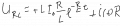
1735141461487.png
 

Thread Starter

WSUBG

Joined Jun 12, 2021
50
It's not the inductance that is negative, it's that the current is ramping down at 500 A/s, which I would argue should have been given as -500 A/s. You might recall that back in my very first response I stated, "Having said that, there is a slight subtle point involved in how you set things up, but it is consistent with the letter of the statement, though I would argue still a bit sloppy." The author may have done that intentionally intentionally.
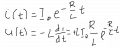
1735159219356.png
 

MrChips

Joined Oct 2, 2009
34,829
The question states "a uniform rate of 500 amperes per second". It does not state increasing or decreasing. Hence it could be either. This text is so old I think that you should put it to rest.
 

MrAl

Joined Jun 17, 2014
13,709
It's not the inductance that is negative, it's that the current is ramping down at 500 A/s, which I would argue should have been given as -500 A/s. You might recall that back in my very first response I stated, "Having said that, there is a slight subtle point involved in how you set things up, but it is consistent with the letter of the statement, though I would argue still a bit sloppy." The author may have done that intentionally intentionally.
Hi,

I have to agree with that. Negative inductances are allowed in theory in circuit analysis, but I don't think there is anything like a negative inductance inductor in real life, maybe a negative inductance due to some other thing but I've never had to deal with one (except in theory).
 

WBahn

Joined Mar 31, 2012
32,878
From which fact is " -500 A/s " conclusion is drawn? From the fact that Inductance should be positive or is there another fact that I am missing?
From the fact that inductance should be positive.

As soon as I got a negative inductance, I looked at what the simplest interpretation of the information given would result in a positive inductance, and it was that the current is changing at -500 A/s.

Sometimes sign issues can be resolved by how the reference directions for the various voltages and currents are chosen, if they aren't specified by the problem statement (which they really should be, unless it truly makes no difference).
 

MrAl

Joined Jun 17, 2014
13,709
From the fact that inductance should be positive.

As soon as I got a negative inductance, I looked at what the simplest interpretation of the information given would result in a positive inductance, and it was that the current is changing at -500 A/s.

Sometimes sign issues can be resolved by how the reference directions for the various voltages and currents are chosen, if they aren't specified by the problem statement (which they really should be, unless it truly makes no difference).
It's also a little interesting that they mentioned the 350v operating point *before* the 200v operating point, which may be a clue (or not).
 

Motanache

Joined Mar 2, 2015
652
The problem does not tell us that it is a sinusoidal current. It says it's just variable.
It is the classic way of charging a coil through a resistor.
It is an exponential but can be approximated quite well with an oblique straight line.
Voltage on the coil is given by Farady's law, i.e. U=-Ldi/dt where di/dt=i'(t) is the derivative of the intensity/
 

MrAl

Joined Jun 17, 2014
13,709
The problem does not tell us that it is a sinusoidal current. It says it's just variable.
It is the classic way of charging a coil through a resistor.
It is an exponential but can be approximated quite well with an oblique straight line.
Voltage on the coil is given by Farady's law, i.e. U=-Ldi/dt where di/dt=i'(t) is the derivative of the intensity/
Hi,

It has been agreed that the source is a ramp. This is mostly due to the problem statement where it says "uniform" and the results match that assumption.
 
Top