Alternating circuits

MrChips

Joined Oct 2, 2009
34,628
Is this a homework question?

I think that you should abandon this question because you cannot have current varying at a uniform rate of 500 amperes per second.
 

MrChips

Joined Oct 2, 2009
34,628
If the rate is uniform at 500 amperes per second, then the current has to keep on increasing to infinity.
If the rate is 500 A per second, in the first second, the current increases from 0 A to 500 A.
In the second second, the current increases from 500 A to 1000 A.
In the third second, the current increases from 1000 A to 1500 A.... etc. to infinity.

Also 1 ampere per second makes no sense in terms of scientific units.
1 ampere = 1 coulomb per second
Hence,
1 ampere per second = 1 coulomb per second per second which is an acceleration of coulombs.
 

Thread Starter

WSUBG

Joined Jun 12, 2021
50
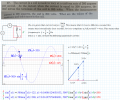
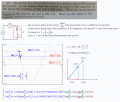
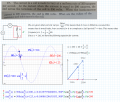
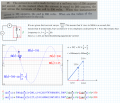
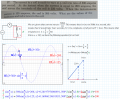
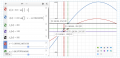
I can see your point. However, from the merit and the essence of the chapter, other exercises in it and the nature of the described circuit, it could be deducted without being overly contesting of the phrasing deviation from the typical frequency description of the modern scholarly literature that what is in fact implied here is the current described by the following function:
1734321602417.png
Let's omit the contesting of the wording and assume that we are given this function instead which verifiably provides us with instantaneous values given in the problem statement at X1 and x2. Would it be then possible to determine the values for resistance and inductance? Thanks
 

MrChips

Joined Oct 2, 2009
34,628
Perhaps we can tackle the question using the following assumptions:

1) The writer incorrectly assumes that alternating current refers to a sinusoidal waveform.

2) Instead of the phrase, “a uniform rate of 500 amperes per second”, the writer should have said “a sinusoidal waveform with amplitude of 500 amperes”.

I have yet to determine if there is a solution to the given problem. There is no information given or that can be deduced on the frequency of the sinusoid.

Since the question introduces resistance and inductance, the equations involved are complex in nature. In order to solve for three unknowns, one would require three equations using complex arithmetic. I don’t know as yet if this can be solved using phasors.
 

WBahn

Joined Mar 31, 2012
32,703
Keep in mind that we have no idea what conventions the author has established previously in this book, so we only have your description to go on.

You claim that the author's prior use implies that what he means is that the waveform is a sinusoid of the form

\(
v(t) \; = \; (500 \, A) sin \left( \omega t \right)
\)

I would definitely argue that if this is what the author means when he says that the current is varying at a uniform rate of 500 A/s, that you need to throw that book away because, at the very least, the author is teaching you very, very poor ways of thinking about and describing circuits and systems. It's also likely that the author is completely unqualified to be writing a textbook and that it is littered with completely wrong content.

The other, more likely, scenario is that the author means exactly what he said -- that the current in the coil is being made to vary at a uniform rate of 500 A/s.

This is not at all uncommon in large magnet power supplies, some of which actively control the rate of change of current to a preset value (others simply hold a constant voltage across the coil, which results in a nearly constant rate of change for larger coils). The author is not claiming that this is constant for all time, only at the times when the two conditions specified are met. Just like the statement that a system is in sinusoidal steady state does not imply that the circuit has been in steady state from the beginning of time and will be until the end of time, only that it is in steady state during the period of interest.

If we make this assumption, then the fact that it leads directly, almost trivially, to two very "nice" values for R and L lends some significant support for the notion that the assumption is likely correct. Having said that, there is a slight subtle point involved in how you set things up, but it is consistent with the letter of the statement, though I would argue still a bit sloppy.
 
Last edited:

Thread Starter

WSUBG

Joined Jun 12, 2021
50
Keep in mind that we have no idea what conventions the author has established previously in this book, so we only have your description to go on.

You claim that the author's prior use implies that what he means is that the waveform is a sinusoid of the form

\(
v(t) \; = \; (500 \, A) sin \left( \omega t \right)
\)

I would definitely argue that if this is what the author means when he says that the current is varying at a uniform rate of 500 A/s, that you need to throw that book away because, at the very least, the author is teaching you very, very poor ways of thinking about and describing circuits and systems. It's also likely that the author is completely unqualified to be writing a textbook and that it is littered with completely wrong content.

The other, more likely, scenario is that the author means exactly what he said -- that the current in the coil is being made to vary at a uniform rate of 500 A/s.

This is not at all uncommon in large magnet power supplies, some of which actively control the rate of change of current to a preset value (others simply hold a constant voltage across the coil, which results in a nearly constant rate of change for larger coils). The author is not claiming that this is constant for all time, only at the times when the two conditions specified are met. Just like the statement that a system is in sinusoidal steady state does not imply that the circuit has been in steady state from the beginning of time and will be until the end of time, only that it is in steady state during the period of interest.

If we make this assumption, then the fact that it leads directly, almost trivially, to two very "nice" values for R and L lends some significant support for the notion that the assumption is likely correct. Having said that, there is a slight subtle point involved in how you set things up, but it is consistent with the letter of the statement, though I would argue still a bit sloppy.
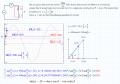
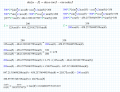
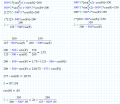
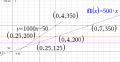
So, here is my attempt. I am not getting nice values, could you please point out my error? 1734480110967.png

1734484480115.png
 

Attachments

WBahn

Joined Mar 31, 2012
32,703
Your error, I believe, is that you are completely misinterpreting the problem. The current in the coil is made to change at a uniform rate of 500 A/second. There is nothing sinusoidal about it.

What is the constitutive (defining) equation for the voltage across an ideal inductor in terms of the inductance of the coil and the current through it?

What is the voltage across an ideal inductor if the voltage current is changing at 500 A/s (in terms of the unknown inductance)?

EDIT: Fixed typo.
 
Last edited:

Thread Starter

WSUBG

Joined Jun 12, 2021
50
Your error, I believe, is that you are completely misinterpreting the problem. The current in the coil is made to change at a uniform rate of 500 A/second. There is nothing sinusoidal about it.

What is the constitutive (defining) equation for the voltage across an ideal inductor in terms of the inductance of the coil and the current through it?
L=V/(di/dt)?
What is the voltage across an ideal inductor if the voltage is changing at 500 A/s (in terms of the unknown inductance)?
Sorry I don't understand (voltage is changing at 500 A/s )
 

Thread Starter

WSUBG

Joined Jun 12, 2021
50
Your error, I believe, is that you are completely misinterpreting the problem. The current in the coil is made to change at a uniform rate of 500 A/second. There is nothing sinusoidal about it.

What is the constitutive (defining) equation for the voltage across an ideal inductor in terms of the inductance of the coil and the current through it?

What is the voltage across an ideal inductor if the voltage is changing at 500 A/s (in terms of the unknown inductance)?
All the problems in this chapter are sinusoidal. The whole book is strictly sinusoidal. The name of the book is Alternating Current Circuits K.Y. Tang Professor of Electrical Engineering OSU
 

WBahn

Joined Mar 31, 2012
32,703
All the problems in this chapter are sinusoidal. The whole book is strictly sinusoidal. The name of the book is Alternating Current Circuits K.Y. Tang Professor of Electrical Engineering OSU
Which edition of the text?

What chapter is this problem from?
 

WBahn

Joined Mar 31, 2012
32,703
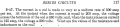
I can definitely see how you can come to the conclusion that absolutely everything in that chapter is about sinusoidal signals, but the key to answering this problem is Equation 5-3. Authors, particularly in older texts, almost always included a small handful of problems that require a closer level of attention to the details. They still do the same thing today, but they mark the problems as being more challenging.

I've skimmed quite a bit of the text and don't see anything that hints that a circuit that varies at a uniform rate of 500 A/s means that it is a sinusoid that goes from 0 A to a peak of 500 A in one second. If you can find such a place, could you indicate what page number it is on?

It is certainly NOT the case that the entire book is purely sinusoidal. Just look at the names of some of the later chapters.
 
Top