allowed input RF power level in downconverting mixer

Thread Starter

yef smith

Joined Aug 2, 2020
1,447
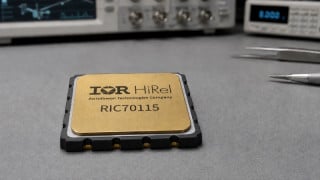
Hello I want to use the following mixer as down convernter.
I am intrested regaring the allowed power levels that could be used.
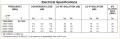
according to the datasheet the reccomended LO power level is 13dBm.
I read in the internet the RF needs to be 10dbm lower then LO power level.(13-10=3dBm RF input)
1dB compression point of 9dBm means I can use this RF input up to 9 dBm?
What is the allowed RF level?
https://www.minicircuits.com/pdfs/SIM-24MH+.pdf
1736850608054.png
 

ZCochran98

Joined Jul 24, 2018
351
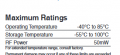
Maximum RF power is 50 mW (17 dBm):
1736886084563.png

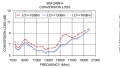
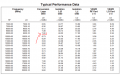
With P1dB being 9 dBm, assuming that's measured output power at 1dB compression (like I've always seen it), and given the conversion loss numbers (between 6 and 8.5 dB), the 17 dBm value for this mixer makes sense.

Usually, the 10 dB difference you're citing I've seen being an average-case difference between P1dB and IP3 (\(IP3 \approx P1dB + 10\)). It can vary from operating-point-to-operating-point, and device-to-device. So a 9 dBm P1dB tracks with the 20 dBm IP3 number.
 

Thread Starter

yef smith

Joined Aug 2, 2020
1,447
Hello, I am using this mixer as down converter. So if they say P1dB 9dBm then the RF input at this compression point is 15dBm
9+7=15dBm. So at RF input 10dBm we are not going to be compressed
But then we have a situation when LO power is larger then RF power only by 3dBm (in contrast to the rule that LO=RF+10dBm)
Thanks.

1736944465565.png
 

ZCochran98

Joined Jul 24, 2018
351
For your first statement, if I understood you right, that is correct. With the conversion loss in the datasheet, depending on what frequency you're at, for a P1dB level of 9 dBm and conversion loss of 7 dB, your input power will be 16 dBm, which is still below the absolute maximum allowed of 17 dBm.

For your second statement, I've never seen a "LO = RF + 10dB" rule. LO and RF are usually specified separately, depending on the technology. You'll see isolation values between RF/IF and LO, and maximum power levels on RF/IF (for a specified LO power level), but as far as I know, anyway, LO isn't necessarily 10 dB higher than RF or IF. It's simply specified by the datasheet or the designer, depending on how they designed the mixer.
 

0ri0n

Joined Jan 7, 2025
161
Hello, I am using this mixer as down converter. So if they say P1dB 9dBm then the RF input at this compression point is 15dBm
9+7=15dBm. So at RF input 10dBm we are not going to be compressed
The RF input being above the applied LO power in your example already shows that something is off here. Mixer specs (P1dB, IP3), similar to receiver specs, are referenced to the input.

As a thumb rule, stay at least 10 dB below P1dB for single tone down-converter applications. In a multi-tone application like a broadband receiver frontend you would stay at least 20dB, better yet 30dB, away from P1dB. If you are using the mixer for example as a phase detector or frequency divider you can apply as much as the specified P1dB to the input.
 

0ri0n

Joined Jan 7, 2025
161
As I mentioned, P1db is referenced to the input. To push the output of the mixer into compression you have to feed 9 dBm into the input of your mixer.
 

Thread Starter

yef smith

Joined Aug 2, 2020
1,447
But compression is a measure of output .
So if I put 9dBm at the input then IF port will be compressed at 3dBm( if we have conversion loss is 6dBm)

I am confused regarding P1dB when it’s input and when it’s output .because I know that compression is the limit to the output power , so I am confused.
 
Last edited:

Thread Starter

yef smith

Joined Aug 2, 2020
1,447
Hello, I was told that its a matter of logic .
Why it makes sense in this mixer case that P1dB will refer to the input RF power?
Thanks.
 

ZCochran98

Joined Jul 24, 2018
351
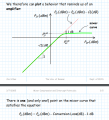
This document from U. of Kansas goes into details. In short, there's the IF and RF P1dB point, which are related by the conversion loss. The P1dB of the IF power level at 1 dB down from the P1dB RF power level minus the the conversion loss:

\[ P_{1dB}^{IF} = P_{1dB}^{RF} - C - 1 \]

Here, I'm using "C" to refer to the conversion loss value. According to the document, mixer manufacturers mean \(P_{1dB}^{RF}\) when they say P1dB, which is exactly the opposite of what we do for amplifiers. In this case, I had the P1db definition backwards in my initial response. So, the P1db value specified - 9 dBm - is the P1dB RF power. The datasheet does say that you can input up to 17 dBm of power (50 mW), but P1dB is at 9 dBm (the difference between saturation power and 1dB compression).
 

0ri0n

Joined Jan 7, 2025
161
Hello , So the maximal value before compression at the input (RF) is 9dB and for the output(IF) its 9-7=2dBm?
Correct?
Almost correct. ZCochran98 posted above a simple formula where you just have to put the numbers in.
By applying 9dBm at the input, the output is already 1 dB in compression. This means the mixer conversion loss now appears to be 1 dB higher than specified in the datasheet for normal/linear operation.
 
Top