Air compressor repair?

IMP002017

Joined Jan 28, 2017
192
So on this. There is ground from the motor that is going though the switch that your turning on and off... That goes to the Relay. Then from the Breaker that goes to the relay where it is connected to 2 pins via the PCB. Then the other one is out. It could be that the relay PCB on the other side is bad where it should be connected to the Coil and what not as to why it don't work... Again. If you took PIN 87 and 30 put them together as I stated in my first post that would be like the switch working and the pump should work...

James
 

Thread Starter

babweupatree

Joined Jul 22, 2017
17
You mentioned in post 6 that you have a blue wire that is redundant. Why is that? Was it hanging around? There is solder on terminal 86 which would indicate to me that something was connected to it. What make and model is this compressor. It seems so simple. I know how I would connect it but something is amiss here I am afraid.
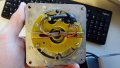
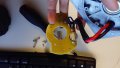
I've attached three photos and the blue wire is connected to a thermostat temperature control switch so I figure that removing it and just wiring the alligator leads directly to the brushes would run the compressor. The other side of the blue wire was connected to terminal 85 of the relay with a switch in the middle. So the connection between the motor and relay was the following (by blue wire):

RELAY(85) <- ROCKER SWITCH -> THERMOSTAT TEMPERATURE CONTROL SWITCH

I also see that it looks like terminal 86 has solder on it, and it really does seem that way but I honestly can see no indication that a wire was ever there. There is simply no trace that I can see?

WhatsApp Image 2017-07-25 at 11.07.36 PM.jpeg WhatsApp Image 2017-07-25 at 11.07.36 PM (1).jpeg WhatsApp Image 2017-07-25 at 11.07.36 PM (2).jpeg
 

Thread Starter

babweupatree

Joined Jul 22, 2017
17
O
So on this. There is ground from the motor that is going though the switch that your turning on and off... That goes to the Relay. Then from the Breaker that goes to the relay where it is connected to 2 pins via the PCB. Then the other one is out. It could be that the relay PCB on the other side is bad where it should be connected to the Coil and what not as to why it don't work... Again. If you took PIN 87 and 30 put them together as I stated in my first post that would be like the switch working and the pump should work...

James
Hi James, thank you, okay so great can I do the following (safely): remove everything (circuit breaker, relay, rocker switch and thermostat control switch) and just wire up the battery directly to the motor brushes?
 

IMP002017

Joined Jan 28, 2017
192
So if you buy a new RELAY and not this one from the maker of this relay. You will need to tie 87 and 86 together. 12v+ 85 ground from the switch and 30 to the Motor for 12v once you flip the switch...

James
 

Thread Starter

babweupatree

Joined Jul 22, 2017
17
So if you buy a new RELAY and not this one from the maker of this relay. You will need to tie 87 and 86 together. 12v+ 85 ground from the switch and 30 to the Motor for 12v once you flip the switch...

James
Okay great, um, not sure if you saw my reply to one of your previous posts? Here it is:

Hi James, thank you, okay so great can I do the following (safely): remove everything (circuit breaker, relay, rocker switch and thermostat control switch) and just wire up the battery directly to the motor brushes?

If that's the case then tomorrow I will test it out (it's dark now). Um, and then would it be safe to operate the compressor like this indefinitely? By that I mean can I just take the compressor with me on a trip and operate it like that - just wire it up directly to the car battery? Would that be safe?
 

IMP002017

Joined Jan 28, 2017
192
I get lost when you talk about going to the motor brushes. I don't know the motor... In most causes there is a - and + input and that would be fine. What I can say is the way it was wired. Taking 87 and 30 put together would be the same thing as the Relay turning on.
 

IMP002017

Joined Jan 28, 2017
192
There is no reason really besides over load and I would hope a Thermal shut down system in place. However if you are not worried much about the motor getting to hot. I would say a Switch with high current rating and a fuse of the rating for the motor is needed. This way if something shorts out in the motor it blows a fuse and don't cause a melt down on your battery.

Main reason for a Relay is to help pass High Current though a switch *The Relay is the switch* where the one that turns on the relay don't need to be of high current. If you wanted to go to battery without switch, Then there will be a spark on startup Or could be, and I would for no less think a inline fuse should be used at the rated motor not much higher then turn on current. I believe in better be safe then sorry...
 

Thread Starter

babweupatree

Joined Jul 22, 2017
17
Thank you very much for your help, much appreciated! Okay, what I can see here is the blue wire goes from the switch to the thermostat control which is connected to the positive terminal of the battery. So removing that should be fine for now (as long as the motor isn't run too long).

Then I did think of replacing the relay and circuit breaker with a fuse but the problem is I have no idea how to do the current calculations. I don't know how to identify this motor specification. It looks like a DC motor - that's all I can tell. There are no labels etc. on the motor. I do know that the original relay is this one: https://m.aliexpress.com/item/32726635296.html

So my guess is that the fuse should blow at >60 amps?

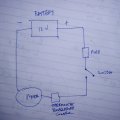
Then the revised configuration would consist of the following components:

Fuse
High current rated switch (the existing rocker switch that came with the motor should be fine?)
Thermostat Temperature Control
Motor

So basically the only changes would be removing the circuit breaker and the relay and putting a fuse in there. I've drawn the circuit out which is attached.

That should be alright?

But anyway tomorrow I will test the motor by wiring it directly to the 12V battery.

WhatsApp Image 2017-07-25 at 11.50.28 PM.jpeg
 

IMP002017

Joined Jan 28, 2017
192
I am going to go off what I can see...

1 First the rocker most likely wouldn't be more then 2 or 5amps so that would at the least become extremely hot and fail. On the switch there could even be info about it. Even one Cheap thing I took out of a China made power supply states info about the switch. I was far over rated seeing it said 6amps and failed at 3. took it apart and never seen something so cheap lol...

2 The fuse, If there is no data on the motor. It is hard to tell really what the current could be. The 60amp rating I am going to guess is rather high and is going to be closer to startup and not actual. I would say start with a 20amp fuse. If it blows then try 25amp. To be honest if the wires that were on the pump wasn't very large then it wouldn't be very likely that your pump would require to big a fuse. Seeing it would burn up the wire before the fuse....

Thermal switch, I am not sure how it was installed. If it was part of what turned on and off the relay then it may not work without the rest if you get my meaning.
 

bwilliams60

Joined Nov 18, 2012
1,450
You cannot run that motor directly off of that switch or the thermal switch because it is not rated for the current that the motor is rated for, hence the relay. There is a thermal switch built into the cover where the red and blue wire connect to. If it gets hot enough (145 degrees), that will open up the circuit but usually by that time it is too late. There is a purpose for that relay and somehow it is wired incorrectly. If there was nothing connected to 86, what is the purpose of the relay? It cannot work(properly) without being connected and it is not connected to anything internally, nor was it ever. The schematic on the outside is the relay schematic at rest. You said 50Amps so i would suspect the motor to be pulling 30-35 amps when running.
If I am wrong, so be it and I will eat crow, but somehow something ain't right in Who-ville.
I think all you need to do to make that circuit work is ground pin 86 from what I can see. If all your descriptions are correct on where the wiring is going, that should do it.
 
Last edited:

IMP002017

Joined Jan 28, 2017
192
@bwilliams60 if you look at the Picture of his Relay you will see there is a PCB that has the 12v shared on the PCB with the 86. That is why there was only 3 wires connected to the relay. 85 was ground though the toggle switch that would then power the Relay. Looking at 87 on the Relay and 86 there is a TRACE on the PCB they share. On his Post #16 you can see Relay better

So at first I thought ground or live missing. Then looking at the Relay again. I see the LEG where 86 has a glob of solder but could tell there was no wire still connected there like there was on other legs. So I then looked at PCB which I didn't look at before. Then confirmed that 87 and 86 are connected via PCB Trace. So while 85 passes ground via a Toggle switch that completes the Relay to move contact from 87 to close to 30 and now sends 12v to complete motor. Motor shows it is grounded.
 
My $.02.

There are at least two different automotive wiring schemes based on terminal numbers. I would need to did to find it.
50 A seems unrealistic, 5 normal with a 50 A surge maybe.

So, on the surface it seems one uses a lower rated switch to activate a relay. Common. It may NOT have a DC rating. You have a breaker and a thermal or some such overcurent protector.

So, 99% can be trouble shot with a multimeter.

Switch, relay coil, thermal.

The motor doesn't look burnt, but even that can initially be looked at with an ohmmeter. With he brushes in place, there would be blips of continuity as you rotate the motor.

For that matter, with the brushes out and taped away from stuff, you can put a bulb where the motor goes.
You can jump out the thermal, the breaker, the switch, the relay contacts.
You can move the bulb to the other side of the thermal.
bulb: A #194 and a suitable socket/jumpers.

With the brushes removed, the relay should still click when the switch is moved.

The "quality" of the relay and breaker and even the thermal is another matter and a bit more complex. Suppose he bulb doesn't glow bright. You can look at the voltage drop of the various elements.

So, the basic idea is to remove the motor from the loop and replace the motor load with a light bulb by using the brushes as your contact point,
 

bwilliams60

Joined Nov 18, 2012
1,450
You know, crow really tastes like crap. IMP002017, you are correct and I am but a fool. I see what you are talking about and I guess I dismissed it before because I asked him if there was continuity between 87 and 86 in an earlier post and the answer was no. So perhaps he has a bad relay. Anyways, you and KISS are on the right track. Check the relay and replace if necessary. Sorry, have to go finish crow. Feathers stuck in my teeth.
 

strantor

Joined Oct 3, 2010
6,875
As far as I can tell, that thermal switch is in series with motor power, not control power. It's rated only 10A. Everything else in the circuit is rated 50-60A. I think you could realistically expect it to draw 50+A; that's not even 1hp. My money is on the thermal switch. What's the resistance across the thermal switch?
 

IMP002017

Joined Jan 28, 2017
192
na no need to eat Crow lol.. I did see however I think in 14 I didn't see this before either. However they did say that 86 and 87 did have continuity. I think I missed that post with the new post of 16 and pictures. lol
 

waker

Joined Feb 21, 2018
12
According to the schematic on the relay, the coil needs power and ground to activate 30 and 87. With no connection on 86, I do not see how it would work. Another option would be that terminal 30 and 86 are tied together internally somehow, but that is not the indication on the relay. Take an ohmmeter and test for continuity between 30 and 86 and let us know what you find.
Right and Agree
 
Top