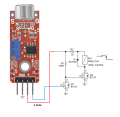
Not directly as the output from that module doesn't have enough drive.
A couple of added transistors will work to drive a relay.
BTW the circuit in post #9 is a modified version of this exact module.
That's what the TS wants.
Requesting latching relay contacts.
IC1B in my circuit provides the latch that keeps the relay activated but your right the sound from the buzzer would probably work as well and would auto reset.
If the circuit is not latching, what would a recommended schematic look like. I can see non-latching is a good idea in some cases.
BTW I am new at interacting on forums and I think may miss some comments. Is there a tutorial for forum use?
If you attach a buzzer or horn, the sound will be picked up by the microphone and it will not turn off.
I have the same hearing problem so I built a solution. I made a Bluetooth transmitter which is close to the smoke alarm. The receiver is on my bed-side table.
The transmitter has a band-pass filter centered around 3.3KHz. Sound from the alarm is amplified and transmitted via an off-the-shelf Bluetooth module. The Bluetooth receiver signal is rectified and used to activate a MOS FET which powers a 400Hz oscillator driving a speaker. Both units are powered with 10V wall-warts and have a diode isolated 9V battery for backup. The system has been running flawlessly for about six months.
If the TS wishes, I could tidy up the documentation and post it.
Not directly as the output from that module doesn't have enough drive.
A couple of added transistors will work to drive a relay.
BTW the circuit in post #9 is a modified version of this exact module. View attachment 356748
I plan to try this also. I have both the module and amplifiers ordered. I think I have enough input to stop bugging everyone until I get my parts and do some testing. I will update when that happens. Thanks again for all the great replies!
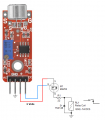
As noted previously the lower frequency buzzer sound will keep the relay activated.
Reset will be the ON-OFF power switch.
Using a P channel BS250 mosfet to drive the relay:
As noted previously the lower frequency buzzer sound will keep the relay activated.
Reset will be the ON-OFF power switch.
Using a P channel BS250 mosfet to drive the relay: View attachment 356759
Is there a portable battery powered circuit that can be placed close to any piezo alarm device and convert/translate to a lower frequency such as a buzzer for hearing impaired people?
Tying the output to the piezoelectric buzzer to a logic level MOS transistor (2N7000 or such) switch to enable a Larger/Louder annunciator would be a simple way to do it. The AT&T phone company used to provide the hard of hearing with amplified phones that had large and loud electric bells for annunciators. Electric bells like we had in school to announce class changes. Everyone in the neighborhood would hear it ringing when a call came in.
I investigated doing just that with the weak piezo alarm on my alarm clock. The immediate problem is that there are several volts of DC bias across that piezo element when it is not sounding, which only change a small bit when it is sounding, and about a volt of AC component is present while it is making noise.
That is what voltage dropping resistors are for... Tapping into the voltage to drive the piezo buzzer to get the ~5V by with a dropping resistor to the base of the 2N7000 (or any other switching transistor) should be fairly simple task and not presenting any significant current draw to affect the buzzer. Only one of many ways to approach the problem...
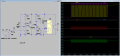
Another approach would be to use a coupling capacitor to remove the DC bias, leaving 1v AC and then using a comparator to drive a relay/sounder/light as appropriate. eg: the below. Also works well with a properly biassed electret mic with about 75mVp-p output - much more stable than the KY-073 boards previously discussed. I bought a pack of them, they are rubbish for long term stability of sensitivity, but can be, relatively easily, hacked to make the circuit shown (without transistor, relay and diode on board).
That diode across the relay coil is not needed BECAUSE CAPACITOR C2 will slow the turn off of the transistor, so there will not be any rapid change in current and thus no voltage spike. So although the comparator can switch rapidly, the base drive of that transistor will not decrease rapidly.
Force of habit... relay coil = diode! But you're right, for input freq >~100Hz. Below that the transistor does tend to follow the input cycle, as you can see just starting on the top trace, which results in the relay chattering if the level setting is a little off. Increasing C2 would solve that, or adding a little hysteresis, but in reality inputs that low freq are unlikely, esp with a mic. For the 1p/¢ the diode costs I'd leave it on the PCB with a DNP note for the end user to decide!

 Facebook
 Google
 GitHub
 Linkedin