Is there a portable battery powered circuit that can be placed close to any piezo alarm device and convert/translate to a lower frequency such as a buzzer for hearing impaired people?
Normanlly, for the hearing impaired, a visual cue is used. And, yes, there are devices made that will flash on high noise and they are adjustable. They placed one in the cafeteria where I once taught to alert on high noise to tell the kids to keep it down a bit. It didn't work! The kids thought it was hilarious and kept intentionally making noise just to set it off.
To produce such a device ones self is certainly quite possible, and fairly simple. The cheap trick is to use a cheap quad op-amp, such as the LM324, as both the amplifier and the trigger comparator. The actual cost will depend very much on what sort of parts and scrapped electronics you have sitting around. The biggest expense would possibly be whatever serves as the microphone to pick up the sound from the piezo alarm device. and the whole package could be powered by a wall-wart supply delivering from five up to about twelve volts.The buzzer could be from a retired smoke alarm device. And certainly the whole thing could also be powered by three or four 1 1/2 volt cells in series. AND somebody may have an idea for an even cheaper microphone substitute.
To all commenters, Thanks for the suggestions.
To MisterBill2: I like your thoughts on this. It seems like what I am looking for. I am capable of building what you suggest but I would need a schematic with component values. I have some components that might be used. Can you provide a schematic or point me to one? I'm surprised a device like this is not produced for sale as there are many people with high frequency hearing loss like me, but I cannot find one. I would like to place one close to several piezo alarm devices in my home to close latching relay contacts. Then I could add any low frequency buzzer or horn.
There certainly always is a problem that appears with any simple device that actually works to any degree, which is that going from prototype to production is a very big leap. It requires a major amount of money, and getting money requires investors, and almost without exception, those investors want a good return on their investment, usually, "right away". And the problem always is that the return, as well as the promise of such a return, does not happen that way. And with a low budget assembly line, you still get workers demanding skilled labor pay for unskilled labor that delivers a poor production yield because of unskilled production errors.
One person, building a few of them for friends, at home, in spare time, might work out well, but doing production at home in one's spare time gets old after a while.
Tying the output to the piezoelectric buzzer to a logic level MOS transistor (2N7000 or such) switch to enable a Larger/Louder annunciator would be a simple way to do it. The AT&T phone company used to provide the hard of hearing with amplified phones that had large and loud electric bells for annunciators. Electric bells like we had in school to announce class changes. Everyone in the neighborhood would hear it ringing when a call came in.
I would like to place one close to several piezo alarm devices in my home to close latching relay contacts. Then I could add any low frequency buzzer or horn.
If you attach a buzzer or horn, the sound will be picked up by the microphone and it will not turn off.
I have the same hearing problem so I built a solution. I made a Bluetooth transmitter which is close to the smoke alarm. The receiver is on my bed-side table.
The transmitter has a band-pass filter centered around 3.3KHz. Sound from the alarm is amplified and transmitted via an off-the-shelf Bluetooth module. The Bluetooth receiver signal is rectified and used to activate a MOS FET which powers a 400Hz oscillator driving a speaker. Both units are powered with 10V wall-warts and have a diode isolated 9V battery for backup. The system has been running flawlessly for about six months.
If the TS wishes, I could tidy up the documentation and post it.
That's what the TS wants.
Requesting latching relay contacts.
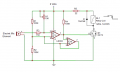
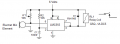
IC1B in my circuit provides the latch that keeps the relay activated but your right the sound from the buzzer would probably work as well and would auto reset.
An ultrasonic detector/reciever is possible, it often does a direct down-conversion.
An ultrasonic electret microphone (ultrasonic sensor) receives the emitted 40kHz.
An op amp high pass filter removes audible sound and a CD4040 divides by 16
This results in 2.5kHz that is amplified using an LM386 or equivalent op amp circuit.
The LM386 and other kits or modules work on battery supply.
I have this issue... above approx 2kHz my hearing rolls off about 30dB per kHz, by around 4kHz its down 60dB, and 100dB at 5kHz - tested with my Bose QC3 headphones and my Siglent SDG1032 signal generator! Like you I have various beeping things I cannot hear. The correct answer of course is a hearing aid, but I cant be arsed to sort one out (yet).
You may want a high-pass filter, 2 or 3kHz up, on the input of @sghioto's original design, so that low-frequency sounds don't set it off too much.

 Facebook
 Google
 GitHub
 Linkedin