Advice on Triac circuit for heater phase control

MaxHeadRoom

Joined Jul 18, 2013
30,693
I'll modify the circuit for hot-line switching (although I still don't understand the pros and cons of having the load on the live or neutral side).
A safety issue.
The logic is that the neutral is at earth ground potential, if you switch the live, this leaves the device at a safe N/GND potential, if you switch the N, the the device is always at 'Live' potential WRT earth/GND, which can present a hazard.
From an electrical stand point there is no difference.
Max.
 

MrAl

Joined Jun 17, 2014
13,722
Hi, would only positive half-waves (say) constitute DC? I suppose so. Unfortunately it will take me a while to get the information on the heater.

What I could do is to allow full waves to get over the possible issue.
Hi,

Yes you are right. Only positive half waves or only negative half waves have a very large DC component which could cause very high current in a device made for AC only. If you do one positive half, one negative half, it should be better but we should do some measurements too.

To start, can you do a cold resistance measurement with an Ohm Meter? That could tell us something about the AC or DC nature of the coil you are working with.
 

Thread Starter

ra5040

Joined Sep 26, 2018
42
A safety issue.
The logic is that the neutral is at earth ground potential, if you switch the live, this leaves the device at a safe N/GND potential, if you switch the N, the the device is always at 'Live' potential WRT earth/GND, which can present a hazard.
From an electrical stand point there is no difference.
Max.
Thanks Max ... this is what I concluded myself. For this application it doesn't matter because the heater is in inside an earthed enclosure, but still, for the sake of one resistor I'll go with the neutral load option.
 

Thread Starter

ra5040

Joined Sep 26, 2018
42
Hi,

Yes you are right. Only positive half waves or only negative half waves have a very large DC component which could cause very high current in a device made for AC only. If you do one positive half, one negative half, it should be better but we should do some measurements too.

To start, can you do a cold resistance measurement with an Ohm Meter? That could tell us something about the AC or DC nature of the coil you are working with.
The resistance is 45ohms ... same reversing the terminals.

To be safe I will only switch full waves
 

Attachments

Thread Starter

ra5040

Joined Sep 26, 2018
42
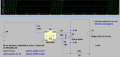
The guys in the LTSpice Yahoo group have fixed the problems with the MOC308x and also the triac, so I can now simulate the semi-burst mode quite well and the voltages and currents are pretty well bang on.

Here's an example of 100ms on and 400ms off, which will give a 20% power output:

moc3083.jpg

WIth this solution it would be possible to make it less granular: for example 20ms On, 80ms Off for 20%, giving 1 wave on 4 waves off. If this works then it might even be a solution for light control.

I think it's reasonable to aim for 2% control (so for instance, for 98%: 49 waves On, 1 wave Off ... or 98 waves On, 2 waves Off) which is pretty good (no doubt a lot better than can be achieved with phase control).

What is potentially very nice about this solution is that it requires no additional zero-cross circuitry as far as I can see: because of the MOC308x zero-cross circuit there is no need to synchronize the microcontroller control with mains. However some inaccuracy will creep in if the frequency drifts much outside 50Hz/60Hz. But as far as I can see, mains frequency is normally within +/- 0.2% which should be fine. Any slight errors can be dealt with by the PID algorithm.

Of course the other nice things about this solution (thanks Max!) are 1) that switching is always at zero and 2) it's very simple.

Robert
 
Last edited:

MrAl

Joined Jun 17, 2014
13,722
The resistance is 45ohms ... same reversing the terminals.

To be safe I will only switch full waves
Hi,

If this is a 1000 watt unit then that reading suggests it is resistive, however full waves are still better anyway due to the loading of the power line. It's better to load it equally on both half cycles.

That second wave of yours shows a good way to do it. If you start with a positive half cycle then end with a negative half cycle, and if you start with a negative half cycle then end with a positive half cycle, but stay consistent on how you start too (always with a positive half cycle for example).

Looks like it is turning out pretty good.
 

Thread Starter

ra5040

Joined Sep 26, 2018
42
Hi,

If this is a 1000 watt unit then that reading suggests it is resistive, however full waves are still better anyway due to the loading of the power line. It's better to load it equally on both half cycles.

That second wave of yours shows a good way to do it. If you start with a positive half cycle then end with a negative half cycle, and if you start with a negative half cycle then end with a positive half cycle, but stay consistent on how you start too (always with a positive half cycle for example).

Looks like it is turning out pretty good.
Thank you ... I will definitely go for the balanced positive/negative (this isn't something I had even considered, so thanks for pointing it out!)

Robert
 
Top