advice on stopping solenoid overheating/burning out

ian field

Joined Oct 27, 2012
6,536
About the only way you are going to overheat a DC solenoid is too high a voltage, the armature position does not matter as it does in a AC version.
Either that or the solenoid is intended for non-continuous operation.
What is the resistance of the coils?
Max.
With a DC solenoid, its OK to use a higher voltage if you need stronger pull in - but it takes a couple of tricks of the trade.

Use a dropper resistor so steady state it has the right voltage and doesn't cook. Arrange for the dropper to charge a capacitor to full voltage whenever the solenoid isn't drawing current.
 

Hymie

Joined Mar 30, 2018
1,347
Here's my circuit modified to operate from a relay output as I understand you have.

It uses an added N-MOSFET transistor to momentarily connect the full voltage across the solenoid until it pulls in.
The value of R2C1 determines how long the full voltage is applied.
The values shown give a pulse of some over 100ms, which should be sufficient.

Then the current drops as determined by resistor R1. For the shown value of 20Ω, it will be dissipating near 3W so should be a 5W resistor.
I also added a diode across the solenoid to protect the relay contacts and MOSFET from its inductive spike when turned off.

View attachment 150576
Based on the circuit values, the steady state voltage across the solenoid is circa 4Vdc – I doubt that a 12V solenoid will remain energised at this voltage.
 

crutschow

Joined Mar 14, 2008
38,672
Based on the circuit values, the steady state voltage across the solenoid is circa 4Vdc – I doubt that a 12V solenoid will remain energised at this voltage.
Have you had experience with such solenoids?

Okay, if that's not suffcient then just reduce the value of R1.
Thus 12Ω will give 50% hold voltage across the solenoid with 3W of dissipation in each.
 

ebp

Joined Feb 8, 2018
2,332
Given the typical force versus plunger position relationship in most solenoids, it probably produces higher force at 4 volts with the plunger all the way in than at 12 volts with the plunger in the out position. This is exactly why current reduction circuits are so useful for a broad range of devices that use electromagnets to move a ferromagnetic "thing" from "far to near" - relays, solenoids, stepper motors, etc.
 

Thread Starter

slatepipe

Joined Oct 2, 2017
23
hi again

once again, thanks for all this advice. my learning curve is still quite steep. apologies for not responding sooner.

anyway :

@MaxHeadRoom : latching solenoids look like being one possible solution. i assume they would therefore not get hot like with my current problem. i could make a latching button quite easily to operate them using my touchpanel.
from looking at the digikey website i can see that the following latch solenoid could be suitable : https://www.digikey.com/product-detail/en/delta-electronics/DSML-0224-12/1144-1322-ND/5214013 but it doesnt give the amount of amps that it uses, or have i missed something in the specs for it? it also says that it is a 'pull' type but i need the solenoid to 'push' the accordion keys, i assume that this wouldn't be a factor as if the solenoid latches then it should go in and then out? or am i reading this wrong? i am based in the uk and so may have difficulty sourcing from here, but hopefully there is a uk supplier somewhere around

- also this morning, my wife suggested making my own latching system that could be operated using the existing solenoids, if i adapted the code to have them pulse once when i press a button and pulse again when i release it. but making a system to put between the solenoids and the accordion buttons might be pretty complex, but that is another solution

-when you mention the 'maximum the relay contacts in the unit are actually rated for' are you referring to the CH-HREL8-D6's?. and i will need to read up a little on diodes as well


@ebp - thanks for that info, i actually understand it too :) you mention a 300mA version that could maybe use continuous operation but i can't find one similar - i only found a 300mA one that advised only powering on for a few seconds
i will try and source some resistors to do some tests like you suggest


@crutschow - thanks for this too, i will have to source a MOSFET transistor and diode and try and construct the circuit you have described. it seems i'll need to do quite a bit of testing with what force the buttons on the accordion need to be pushed down and generate a note, hopefully they'll be ok with any reduced voltage

i'm sure at some point one or more of the ideas that have been provided to me here will provide a solution

many thanks again
 

MaxHeadRoom

Joined Jul 18, 2013
30,772
latching solenoids look like being one possible solution. i assume they would therefore not get hot like with my current problem. i could make a latching button quite easily to operate them using my touchpanel.
from looking at the digikey website i can see that the following latch solenoid could be suitable : https://www.digikey.com/product-detail/en/delta-electronics/DSML-0224-12/1144-1322-ND/5214013 but it doesnt give the amount of amps that it uses, or have i missed something in the specs for it? it also says that it is a 'pull' type but i need the solenoid to 'push' the accordion keys, i assume that this wouldn't be a factor as if the solenoid latches then it should go in and then out? or am i reading this wrong? i am based in the uk and so may have difficulty sourcing from here, but hopefully there is a uk supplier somewhere around

-when you mention the 'maximum the relay contacts in the unit are actually rated for' are you referring to the CH-HREL8-D6's?. and i will need to read up a little on diodes as well
You require a latch/in-latch circuit/switches for the magnetic latch solenoids, they stay retained by way of a small magnet so they stay in the last position when the power is off.
I referred to the relays they are using in the CH-HREL8-D6 unit.
Max.
 

ebp

Joined Feb 8, 2018
2,332
I forgot I found some more info on the 300 mA version - yes, they are intended for intermittent use, too. Since you already have solenoids and a power supply, I would suggest experimenting with simple resistors and crutschow's circuit. The 300 mA coils probably produce only about a third of the force of the 1A version, so that gives you quite a lot of leeway with resistors.
 
hi again

once again, thanks for all this advice. my learning curve is still quite steep. apologies for not responding sooner.
/-/

i'm sure at some point one or more of the ideas that have been provided to me here will provide a solution
I think that you are closing in on a solution. In addition to the excellent advice that you have already received, I think that you would benefit from some background reading.

This is a decent PDF discussing some basics: http://docs-europe.electrocomponents.com/webdocs/001b/0900766b8001b732.pdf

So, to define the problem....
You have a solenoid (16 of them, I guess) sitting over an accordion button. You want to turn the solenoid on to press the button. In addition to voltage and wattage, here are some questions that you need to answer carefully before you choose a solenoid.

How far is the solenoid from the button?
How much force is required to press the button?
How fast does it need to be activated?
How long does it need to be activated?
What is the shortest duration before reactivating?

So, working in reverse, look at this solenoid and its datasheet. https://www.digikey.com/product-detail/en/delta-electronics/DSOS-0416-12D/1144-1399-ND/6599947 and https://media.digikey.com/pdf/Data Sheets/Delta PDFs/DSOS-0416-D.pdf

This device is a push or thrust solenoid. Turn it on and the plunger will extend. Turn it off, and the plunger retracts. From the data sheet, you can address the questions. The voltage, power, current and DC resistance are given in the table.

How far is the solenoid from the button? The distance that this solenoid will extend is given in the data sheet as M=.06 inch. So, you have an idea on the distance from the button.

How much force is required to press the button? See the graph of Force vs Stroke in the data sheet. That is what you will be able to get from this solenoid. If you need more than 20 grams of force to press and hold that button, at the full stroke, this is an important value.

How fast does it need to be activated? Activation time is not given. From data sheets that I have seen, this is typically very short (a few milliseconds). It may be quick enough for you, but it could be a consideration.

How long does it need to be activated? This is a big one for you. The duty cycle is stated as 50% with 1.5 sec on. That's what you have to go on and it may be (probably?) that you can exceed that 1.5 seconds on time, if you have a lengthy off time. I have seen data sheets that gave values for on time at various off times. Here, you only have that 50% with 1.5 seconds on.

What is the shortest duration before reactivating? This is also a big one for you. Given that 50% duty cycle, you can only reactivate this solenoid (according to specs) after it has been off for 1.5 seconds.

So, the first step is to gain some familiarity with how solenoids are described and the second step is for you to nail down the minimal characteristics for what you want.

The data sheet for the device that you just linked to is here: http://www.deltaww.com/filecenter/Products/download/04/0409/DSML-0224.pdf

It does give the power specifications. It is a latching solenoid. So, a pulse will turn it on (pull the plunger in) and another pulse will turn it off (return the plunger). It is not a push solenoid, it is a pull solenoid. These are good for things like an electronic lock, where the "resting" state has the plunger acting like a deadbolt. Activation pulls the plunger in and allows the door (or whatever) to be unlocked and opened.

It is probably not what you want.

Edit: I almost forgot, you also need to consider how close together the solenoids can be mounted. That is, how much clearance is allowable between solenoids so that you can still press adjacent buttons. The maximum allowable width of the solenoid is another one of those questions.
 
Last edited:

Audioguru

Joined Dec 20, 2007
11,248
The solenoids burn out because they are Chinese. ebay sellers know nothing about the junk they sell so they did not say to activate the solenoid only for a few seconds at the most.
 
You may get a kick out of this guy's project and it may even have some relevance for what you want to do: https://www.eecs.tufts.edu/~cgregg/typewriter/

The solenoids that he used are available and very inexpensive: https://www.allelectronics.com/item/sol-102/miniature-12vdc-push-type-solenoid/1.html

This reminded me that many years ago, when dot matrix was all anybody could get and they were expensive, the holy grail (for hackers) of printers was managing to interface your computer to an IBM Selectric :)
 
Are the keys and buttons that you want to press electronic switches (analogous to electric typewriter keys) or are they purely mechanical (and would require a lot more force).

BTW: I have no legitimate reason for posting that video, other than it made me smile.
 

Thread Starter

slatepipe

Joined Oct 2, 2017
23
hi again - i've been out of town for a few days over the last week and so have only just managed to check bck on this thread. many thanks for all this help, there's plenty for me to go on here. :)

i'll be doing further research and purchases, based on what i've been shown in these replies, at some point it'll end up working. i knew there'd be complications along the way, as there always is with the projects i undertake, so when some of the solenoids burnt out the other week i kind of expected it.

in response to some of the questions asked above :

How far is the solenoid from the button? the frames i have built for them can be adjusted, the frames are slightly different on each end of the accordion and were initially made at the right distance for the solenoid to hit the button
How much force is required to press the button? not much force at all, when the accordion is moving in and out the pressure required to press a button is quite light, the solenoids i used which burnt out could handle it easily. the accordion buttons are merely mechanical
How fast does it need to be activated? quite quickly, so there isn't a significant delay from pressing a button on the touchpanel and a button being pressed
How long does it need to be activated? this is where the current problem is, as to play chords and drones they wold need to be pressed for quite a time, which is why i am now thinking of trying the latching solenoids as i think i can adapt the code in the touchpanel to 'latch on' and latch off'
What is the shortest duration before reactivating? this would need to be quite a short time, especially if playing arpeggio loops or something, which is what i am envisaging

regarding what you mention about the latching solenoid - if i understand it correctly then i think it could be what i want, as i think it only needs a pulse to both turn it on and also off and therefore there would not be a problem with overheating while it is 'pushed' and holding down a button as it only receives power via a pulse and then it latches on or off until it receives another pulse?

i found this type online but it's discontinued so i'll have to search further :
https://docs-emea.rs-online.com/webdocs/0109/0900766b80109efd.pdf

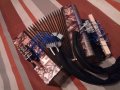
many thanks again. here's a picture of the accordion with the solenoids mounted on either end (sixteen of them). on one end they're attached to a bent copper strip and on the other side they're attached to a piece of wood using copper pipe wall clips. i've smartened up the appearance with the joiner blocks since by housing them in small wooden boxes
 

Attachments

MaxHeadRoom

Joined Jul 18, 2013
30,772
You will need to alternate the polarity on push & pull to set and release, so either two button per solenoid or some other way to swap the supply.
Max.
 

crutschow

Joined Mar 14, 2008
38,672
@crutschow - thanks for this too, i will have to source a MOSFET transistor and diode and try and construct the circuit you have described. it seems i'll need to do quite a bit of testing with what force the buttons on the accordion need to be pushed down and generate a note, hopefully they'll be ok with any reduced voltage
The solenoid will still operate initially with the same force, since full voltage is applied for a short period of time.
Then the reduced voltage keeps it from overheating while remaining activated.
 

ebp

Joined Feb 8, 2018
2,332
My opinion is that latching devices will just make things complex. I would experiment with your existing solenoids with simple series resistors first and if that does not produce satisfactory results, use crutschow's circuit. The simple resistor circuit could be improved by putting a capacitor of something in the range of 2200 to 4700 microfarads (16 volt rating) across the resistor. The problem with this is the caps are quite bulky (typically about 16 mm diameter and 25-30 mm long for 4700 µF) and you get a rather fast decay of current, whereas crutschow's circuit gives better-defined and "cleaner" pull-in current. The resistor plus capacitor circuit is easier to build.
 
Top