Advice about digital (WS2811) signal amplifier

Thread Starter

TokyoDave

Joined Nov 9, 2024
13
Can someone give me any idea what the IC marked HL50F (shown as arbitrary symbol) is, and what it is being used for? Any other comments on this circuit are also welcome.

With my multimeter, I am reverse engineering a small form-factor WS2811 LED signal repeater, because the form factor and pig-tail packaging doesn't work for me and I want to see how such things work. (I've bought a bunch of these already).
As far as I can see, the data signal is conditioned with a 32.7Ohm resistor and then sent to the input pins of a buffer IC.

The part I don't understand is the circuit for the buffer IC power (shown as VDD, I've redacted the rest of the circuit to respect copyright ):
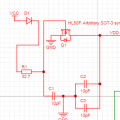
1736321906662.png
To this noobie, it looks to me like R1 and C1 are doing some conditioning and C2,C3 are decoupling. Diode is probably there to protect against reverse polarity connection. But I can't find any specs on the IC marked HL50F (SOT-3), so I put it as an arbitrary symbol.
 

BobTPH

Joined Jun 5, 2013
11,480
What is the configuration of your strips that you need a repeater? I have driven up to 4 strips with a single microcontroller output, and have spanned 12 ft gap in one strip with no repeaters and no problems.
 

Thread Starter

TokyoDave

Joined Nov 9, 2024
13
What is the configuration of your strips that you need a repeater? I have driven up to 4 strips with a single microcontroller output, and have spanned 12 ft gap in one strip with no repeaters and no problems.
I am splitting the signal (drops to a series of props, 0-2 meters distance apart), and sad experience has shown me that I do actually need repeaters. If you want the sordid but no doubt interesting details, you'll have to wait for my book.

Back to my question: I am now thinking because of the '50', that the HL50F may be a 5V voltage regulator, and the datasheet for the buffer it is supplying shows nominal supply at 5V (from what I can understand of the Chinese without translating it).
 

BobTPH

Joined Jun 5, 2013
11,480
Could be this:

HL5
2SC1623-Y
Foshan Blue Rocket Electronics
SOT-23
NPN transistor
GP, 60V, 100mA, 200mW, 250MHz, B=135..270
 

Thread Starter

TokyoDave

Joined Nov 9, 2024
13
Back to my question: I am now thinking because of the '50', that the HL50F may be a 5V voltage regulator, and the datasheet for the buffer it is supplying shows nominal supply at 5V (from what I can understand of the Chinese without translating it).
Well, its not a voltage regulator. I put it on the bench PSU and varied the voltage, but no regulation happened.
 

Thread Starter

TokyoDave

Joined Nov 9, 2024
13
Well, its not a voltage regulator. I put it on the bench PSU and varied the voltage, but no regulation happened.
Oops, it *is* a buck converter regulator, outputting 5V max. I didn't hit it with enough voltage (the repeater is actually rated 5-24V) to see the regulation occurring. So, I now know what it is an what it is for.
 

Sensacell

Joined Jun 19, 2012
3,773

I have done a few projects with these chips - best is to go differential for long lead-ins before the driver chain.
This video explains- near the end.

"Boosting" or "Amplifying" the signal can introduce even more nasty troubles.
 

Thread Starter

TokyoDave

Joined Nov 9, 2024
13

I have done a few projects with these chips - best is to go differential for long lead-ins before the driver chain.
This video explains.
Nice video, interesting and inspiring. Thanks.
I have received best practice advice of differential wiring before. I don't think the short distances involved in this project warrant it. However I am designing a different lighting installation with ModBus over RS485 for another project.
 

BobTPH

Joined Jun 5, 2013
11,480
Oops, it *is* a buck converter regulator, outputting 5V max. I didn't hit it with enough voltage (the repeater is actually rated 5-24V) to see the regulation occurring. So, I now know what it is an what it is for.
I really doubt that. Although it is possible to make a 3-terminal buck regulator device, It would require and inductor and capacitor that could not possibly fit.

Can you please link to the datasheet for the repeater that you referred to?
 
Top