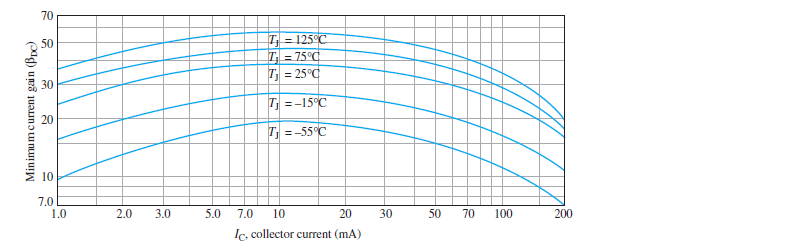
The gain of a BJT is proportional to temperature (below) so, at low temperatures, the op amp input bias current (which is the input transistor base current) will tend to increase significantly, which may cause your problem.
When the temperature drops, the leakage of Schottky's diodes decreases. And at some temperature, these leaks become smaller than the escaping, input current of the operating amplifier. Also, when the temperature drops, the input current of the operating amplifier increases (the transistor gain decreases). This increases the voltage at the input. Look at my drawings and the voltages in the circuit nodes (at the direct input of the operating amplifier). Don't you see that an additional resistor solves the problem?
When the temperature drops, the leakage of Schottky's diodes decreases. And at some temperature, these leaks become smaller than the escaping, input current of the operating amplifier. Also, when the temperature drops, the input current of the operating amplifier increases (the transistor gain decreases). This increases the voltage at the input. Look at my drawings and the voltages in the circuit nodes (at the direct input of the operating amplifier). Don't you see that an additional resistor solves the problem?
Hi,
Thanks for solution.
I used LMC6064aimx / nopb instead of lm324 and problem solved.
According to datasheet LMC6064 has ultra Low Input Bias Current: 10 fA.
Hello,
This is the ADC schematic.
I've tested this circuit at -40C.
At - 40C, the ADC value of read by MCU is 5V.
Second picture is about B340A diode forward voltage-forward current graphic
The Operating Temperature Range of diode is -55 / +155.
I think that at -40C, D35 does not forward biased but I dont know why .
But At - 40C, the ADC value of read by MCU is 5V, if so how D36 forward biased? View attachment 181913 View attachment 181915
Thanks to all for an entertaining and lucid discussion! Why is TS's circuit an improvement over simply connecting R2, with appropriate pull-up resistor (or current source?), to the CPU ADC input? Also, in my experience, most ADCs don't like inductors in series with their inputs.

 Facebook
 Google
 GitHub
 Linkedin


 .
.