Facebook
 Google
 GitHub
 Linkedin
I am seeing a lightweight mobility scooter, but they are very expensive. However, I have purchased a lightweight folding 3-wheel E-bike. (see attached picture).
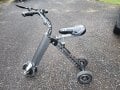
I want to make some changes to it, by adding two motors to the back, that taken from a hoverboard. But, I am having difficulty with adapting a controller. I want to just put an unpowered wheel in the front, and then two powered wheels in the back. These are BLDC hub motors with Hall effect sensors. I can use a speed controller like the $16 ones on Ebay BLDC Motor controller
I imagine I could purchase two of these, and give input for speed from one potentiometer. However, I need the wheels to have some freedom as they spin, so that a tight turn is possible. I am wondering if these BLDC motors will behave like stepper motors with these types of controllers. If so, the pair will tend to want to stay in sync. So, they will fight against a tight turn. Am I correct? I somehow need it to function like it had a physical differential gear. Perhaps one of the wheels to behave more like a DC motor. If it experiences a heavier load, it just slows down.
Here is my current strategy. Set one of them to be the master wheel. It is controlled normally. But the other wheel needs to be just a helper. Perhaps it is controlled to apply a similar amount of traction that is being applied to the master wheel. If I were to try using an Arduino (which I am trying to avoid), I imagine I might monitor the current draw of the master motor, and then run the speed of the slave motor however fast it needs to be, to equal that same current draw. Though, perhaps it should be more complex. If it knows I am at a higher speed, then keep the two wheels at near the same speed. At low speeds, a permit greater speed difference.
Any other ideas or advice about creating this virtual differential gear?
For a bit more background, here are the issues I have with the stock e-trike
I want to make some changes to it, by adding two motors to the back, that taken from a hoverboard. But, I am having difficulty with adapting a controller. I want to just put an unpowered wheel in the front, and then two powered wheels in the back. These are BLDC hub motors with Hall effect sensors. I can use a speed controller like the $16 ones on Ebay BLDC Motor controller
I imagine I could purchase two of these, and give input for speed from one potentiometer. However, I need the wheels to have some freedom as they spin, so that a tight turn is possible. I am wondering if these BLDC motors will behave like stepper motors with these types of controllers. If so, the pair will tend to want to stay in sync. So, they will fight against a tight turn. Am I correct? I somehow need it to function like it had a physical differential gear. Perhaps one of the wheels to behave more like a DC motor. If it experiences a heavier load, it just slows down.
Here is my current strategy. Set one of them to be the master wheel. It is controlled normally. But the other wheel needs to be just a helper. Perhaps it is controlled to apply a similar amount of traction that is being applied to the master wheel. If I were to try using an Arduino (which I am trying to avoid), I imagine I might monitor the current draw of the master motor, and then run the speed of the slave motor however fast it needs to be, to equal that same current draw. Though, perhaps it should be more complex. If it knows I am at a higher speed, then keep the two wheels at near the same speed. At low speeds, a permit greater speed difference.
Any other ideas or advice about creating this virtual differential gear?
For a bit more background, here are the issues I have with the stock e-trike
- It does not have the ability to change speed ranges. It is difficult to keep it at a slow walking speed.
- It doesn't go up hills well, because the front drive wheel loses most of its traction on even a gentle slope.
- It really is difficult to control in many situations. The spread of the back wheels is so narrow, that it really wants to be handled like a bicycle. But, you can't lean into a turn because of the 3 wheels. Nor are the wheels apart enough to be treated like a trike. Even a very slight side slope makes it difficult to stay upright.