AC to DC converter

Thread Starter

Ahmet Asım

Joined Apr 23, 2020
22
You showed the photo of a power supply that produces 9VDC when its input is almost any country's voltage. But you took it apart and did not write down where its 3 wires were connected. Then you guessed wrong and it blew up. The circuit for the clock also might nave been blown up.
The clock has 2 input for power one with battery and other is plug so I didn't know that it was 110v and plugged it and smokes came out. 3 wires goes for the plug with a transformer and the other is for the battery. I plugged it to 220v before and after 3 month I decided to fix it.
 

Thread Starter

Ahmet Asım

Joined Apr 23, 2020
22
You showed the photo of a power supply that produces 9VDC when its input is almost any country's voltage. But you took it apart and did not write down where its 3 wires were connected. Then you guessed wrong and it blew up. The circuit for the clock also might nave been blown up.
So?
 

ebeowulf17

Joined Aug 12, 2014
3,307
The clock has 2 input for power one with battery and other is plug so I didn't know that it was 110v and plugged it and smokes came out. 3 wires goes for the plug with a transformer and the other is for the battery. I plugged it to 220v before and after 3 month I decided to fix it.
It sounds to me like there's a pretty good chance that when you plugged the clock into 220V, you didn't just damage the transformer, but you probably damaged other parts of the clock too. There's no reason to think the transformer would've totally protected the clock's DC internals. It might if you're lucky, but you can't count on it.

Is the old, damaged transformer still connected to those three wires? If so, there's a slim chance that cutting those wires and taping them off (or insulating and sealing them some other way) would help. If the damaged transformer has shorts in it now and is still connected, that could affect the operation of the remaining circuit.
 

Thread Starter

Ahmet Asım

Joined Apr 23, 2020
22
That may be the case because when i contact the 9v dc to 3 input some random things show up on the clock so what I should do is to unsolder the 3 wires right?
It sounds to me like there's a pretty good chance that when you plugged the clock into 220V, you didn't just damage the transformer, but you probably damaged other parts of the clock too. There's no reason to think the transformer would've totally protected the clock's DC internals. It might if you're lucky, but you can't count on it.

Is the old, damaged transformer still connected to those three wires? If so, there's a slim chance that cutting those wires and taping them off (or insulating and sealing them some other way) would help. If the damaged transformer has shorts in it now and is still connected, that could affect the operation of the remaining circuit.
 

ebeowulf17

Joined Aug 12, 2014
3,307
That may be the case because when i contact the 9v dc to 3 input some random things show up on the clock so what I should do is to unsolder the 3 wires right?
It's certainly worth a shot. I think the odds are against you on this one - it's probably fried. However, you've got nothing to lose but a little time at this point.

If you're interested in trying stuff out and learning from it, then you can certainly remove those three wires and try applying power there. I'm not sure I expect it to work, but I don't see any real harm in trying.
 

Thread Starter

Ahmet Asım

Joined Apr 23, 2020
22
It's certainly worth a shot. I think the odds are against you on this one - it's probably fried. However, you've got nothing to lose but a little time at this point.

If you're interested in trying stuff out and learning from it, then you can certainly remove those three wires and try applying power there. I'm not sure I expect it to work, but I don't see any real harm in trying.
I did but I get the same result the clock lights up randomly but if it would be fried it wouldn't light up at all right?
 

ebeowulf17

Joined Aug 12, 2014
3,307
I did but I get the same result the clock lights up randomly but if it would be fried it wouldn't light up at all right?
Hard to say. Depends which component(s) was(were) damaged.

You might have a mostly-functional clock that just needs minor repairs to some LED output drivers. Or the "brains" of the clock might be scrambled to the point of being irreparable. Really hard to tell without doing serious, in depth diagnostics. So far, we're not even sure the correct way to apply power, so it's way too early to know the extent of the damage.
 

Thread Starter

Ahmet Asım

Joined Apr 23, 2020
22
Y
Hard to say. Depends which component(s) was(were) damaged.

You might have a mostly-functional clock that just needs minor repairs to some LED output drivers. Or the "brains" of the clock might be scrambled to the point of being irreparable. Really hard to tell without doing serious, in depth diagnostics. So far, we're not even sure the correct way to apply power, so it's way too early to know the extent of the damage.
Hmm okay Thank You for your help you were very helpful have a nice day
 

ebeowulf17

Joined Aug 12, 2014
3,307
Y
Hmm okay Thank You for your help you were very helpful have a nice day
For what it's worth, I am a little surprised that connecting your power supply to the red and black wires doesn't make anything happen.

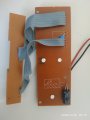
I'd be curious to see if I can trace out enough of the circuit to at least understand the power inputs better. If you can post good, clear photos of the entire board, both front and back, I'll try to trace the circuit and make sense of the power connections. It might be several days, cause I'm still somewhat busy with other things, and it's a slow process.

Nevertheless, if you're interested, upload the pictures and I'll see what I can do. If not, no worries.
 

Thread Starter

Ahmet Asım

Joined Apr 23, 2020
22
For what it's worth, I am a little surprised that connecting your power supply to the red and black wires doesn't make anything happen.

I'd be curious to see if I can trace out enough of the circuit to at least understand the power inputs better. If you can post good, clear photos of the entire board, both front and back, I'll try to trace the circuit and make sense of the power connections. It might be several days, cause I'm still somewhat busy with other things, and it's a slow process.

Nevertheless, if you're interested, upload the pictures and I'll see what I can do. If not, no worries.
 

Attachments

trebla

Joined Jun 29, 2019
599
Probably this clock needs AC pulses from transformer for running and battery is used only for backup time counters memory, not for powering LED display. There are other problem with 50/60 Hz AC standards which let your clock running too fast or too slow. In this case you need new transformer with primary windings for 220V and secondary windings for 2x 7..9V (those three wires). Also you must then find out specifications for IC used there and make right connections for power grid frequency setting pins (usually shorting right pins).
 

mmcginty

Joined Feb 4, 2010
57
Isn't it more likely the transformer has two secondary windings that output two different voltages? What would be the advantage of two secondaries with the same output voltage, that would two rectifiers? If it's an old clock that predates all the cheap, high-efficiency LDO's we enjoy now... I would look for any part number markings on the transformer, try to find a data sheet, and look for a 220 equivalent. Or better still, pick up a digital clock DIY kit for $7USD, that will have more functions, will look more modern, and will come with a reasonable expectation that none of its parts have already been smoked. :)
 

Delta Prime

Joined Nov 15, 2019
1,311
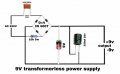
Hello Im Ahmet Im 15 so I have a digital table clock it needs 9v I have a power supply that converts 220v to 9v but its AC and the clock needs DC I have 4 diodes and a capacitor. The diodes value is 1N4007 and the value of capatsitors is 100 mF 50v and 10 mF 50v with these components how can I get a 9v dc outpuy please help
Well you said please...& You do have a transformer.

1588170897956.jpg
 
Top