AC Power to run a 130v DC motor with speed control

Status
Not open for further replies.

Thread Starter

Elvota

Joined Oct 12, 2017
7
I am undertaking this project to try and learn a bit more about electronics, wiring and motors. I am competent mechanically and have a rudimentary understanding of electrical systems, but I am very much a beginner.

I currently have a DC motor that I wish to connect to AC power in a way which will allow me to control it's speed. I will be running the motor on average about 20 to 30 minutes, hour tops. I am not that concerned with achieving absolutely smooth RPM's but do not want to burn the motor out or cause other problems that could be dangerous.

The motor badge reads as follows...
Bodine electric motor
Volts: 130
HZ: DC
FF: 1.0
A: .91
HP: 1/8
Time: CONT
Ratio: 65.5:1
RPM: 38
Torq: 143 lb-in

I think I need to run a bridge rectifier between AC and the motor. I think I may need a capacitor if I wish to have smoother operation. Not sure if speed controller is best before or after the rectifier. Obviously I am new at all of this...

Anybody willing to breakdown what I might need to make this work? Including capability requirements of the controller and rectifier?

Again... I am trying to and willing to learn, so whatever help you might suggest I am open to listening.
 

Alec_t

Joined Sep 17, 2013
15,111
Welcome to AAC!
Given your newness to this subject I would strongly advise you to cut your electronics teeth on low voltage circuits to start with, since 130VAC can be lethal.
The same principles, e.g. rectification and pulse-width-modulation (PWM), would be involved if you were to build, say, a 12V motor control system supplied by a step-down transformer.
 

tcmtech

Joined Nov 4, 2013
2,867
For your basic setup a 200+ volt 2+ amp bridge rectifier would work just fine. The capacitor would not be necessary either but for RF noise suppression a small.1 - 1 uf on the motor side would be good.

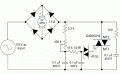
If you need speed control a common light dimmer on the AC side ahead of the rectifier would do fine too. I've made many simple variable speed controllers for similar voltage rated motors that way and it's pretty reliable.
 

Thread Starter

Elvota

Joined Oct 12, 2017
7
You could look for a treadmill controller such as the MC-60 or one of the KB controllers that are suited to this type of motor, ebay is one source.
Max.
Thanks for the help... a controller such as this would be designed for AC input and DC output? I am guessing since you suggested it such controllers can handle the requirements of the motor I listed?
 

Thread Starter

Elvota

Joined Oct 12, 2017
7
For your basic setup a 200+ volt 2+ amp bridge rectifier would work just fine. The capacitor would not be necessary either but for RF noise suppression a small.1 - 1 uf on the motor side would be good.

If you need speed control a common light dimmer on the AC side ahead of the rectifier would do fine too. I've made many simple variable speed controllers for similar voltage rated motors that way and it's pretty reliable.
Great! Thanks. For clarification... AC through light dimmer, suggested rectifier and then wired to motor. Correct? Sounds simple enough...
 

MaxHeadRoom

Joined Jul 18, 2013
30,570
Thanks for the help... a controller such as this would be designed for AC input and DC output? I am guessing since you suggested it such controllers can handle the requirements of the motor I listed?
Easily at 1/8th HP, another alternative is a PWM controller such as http://www.discovercircuits.com/DJ-Circuits/simplepwm2.htm
You would need a small DC 130v DC power supply for the motor and a higher rating Mosfet for the output.
If you don't need smooth control as you say, then the Triac method would be the alternative.
Max.
 

oldman74

Joined Mar 20, 2019
1
I really like the simplicity of Dodgydave's circuit diagram but would really appreciate a diagram that uses a 220 - 240vAC as the input.
I am assuming that certain component electrical values would be different.

I ask this because I am an older enthusiast living in a country outside the USA.
 

MaxHeadRoom

Joined Jul 18, 2013
30,570
That circuit is pretty component tolerant, the power device need to be correct current/voltage rated.
It also help to place a simple choke or inductance in between triac and bridge.
Max.
 

Alec_t

Joined Sep 17, 2013
15,111
I am assuming that certain component electrical values would be different.
Welcome to AAC, Oldman74! You have hijacked a dead thread. Regardless, Max is better qualified to comment on this, but I would have thought running a 130VDC motor from 230VAC mains (if that is your intention?) would require a quite different circuit than the post#7 one, not just tweaking component values.
 

Pmanhart

Joined Aug 4, 2023
3
I am undertaking this project to try and learn a bit more about electronics, wiring and motors. I am competent mechanically and have a rudimentary understanding of electrical systems, but I am very much a beginner.

I currently have a DC motor that I wish to connect to AC power in a way which will allow me to control it's speed. I will be running the motor on average about 20 to 30 minutes, hour tops. I am not that concerned with achieving absolutely smooth RPM's but do not want to burn the motor out or cause other problems that could be dangerous.

The motor badge reads as follows...
Bodine electric motor
Volts: 130
HZ: DC
FF: 1.0
A: .91
HP: 1/8
Time: CONT
Ratio: 65.5:1
RPM: 38
Torq: 143 lb-in

I think I need to run a bridge rectifier between AC and the motor. I think I may need a capacitor if I wish to have smoother operation. Not sure if speed controller is best before or after the rectifier. Obviously I am new at all of this...

Anybody willing to breakdown what I might need to make this work? Including capability requirements of the controller and rectifier?

Again... I am trying to and willing to learn, so whatever help you might suggest I am open to listening.
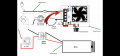
Hi Elvota. I have recently build a variable speed controller for a 4.25 HP, 130 VDC Leili treadmill motor. I used the design developed by Dazecars on YouTube.
You run AC into an on/off switch. Then to a SCR that modulates the signal. Out of the SCR you go to an AC toroidal inductor to smooth things out. Then go to a circuit breaker and to a bridge rectifier. I use a 200 amp BR for welding. After the BR, the + line goes to a DC choke. This is important for extending the life of your motor. Then you go to a DPDT toggle switch for forward and reverse. Then to the motor.
I suggest you check out his whole line of videos on this subject. He’s really quite good.
 

Attachments

MaxHeadRoom

Joined Jul 18, 2013
30,570
Hi Elvota. I have recently build a variable speed controller for a 4.25 HP, 130 VDC Leili treadmill motor. I used the design developed by Dazecars on YouTube.
You run AC into an on/off switch. Then to a SCR that modulates the signal..
For that size motor, the PWM versions now used in TM's beats the early style Triac bridge etc hands down, and the cost is not that great a difference, if DIY.
 

WBahn

Joined Mar 31, 2012
32,730
MOD NOTE: Let's keep in mind that this thread died a natural death more than four years ago. Unless there's a real good reason to resurrect it, let's let it rest in peace.
 
Status
Not open for further replies.
Top