AC mesh analysis with dependent sources

Thread Starter

PK1248

Joined Aug 19, 2012
6
http://imgur.com/QJ2Xf

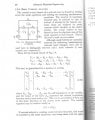
Just looking for some confirmation for my method in regards to solving the problem above, both part a and b.

For part A, i took a mesh around the left hand loop equal to 0 and rearranged to solve for V(x) in terms of I(x)

For part B,
To solve for I(x), i first found the voltage V(x) in terms of rightmost loop, which i called I(3) and found it to be (6+j8)*I(3)

I then equated the two solutions for V(x) (1 from Part A) and then rearranged to get I(x) in terms I(3).

From here, i substituted that value of I(x) into my mesh equation for the central loop. This is where i feel i am most likely to have messed up somewhere.

My mesh equation for the middle loop was;
-30*I(x)-10000(-30*I(x)-I(3)) = 0

however, should it just be that the current in the central loop is -30*I(x)?

Afterwards, it was a matter of substituting to find V(x) and I(x).

Any help would be greatly appreciated, cheers.
 
Last edited:

WBahn

Joined Mar 31, 2012
33,186
I don't have time now to look your work over, but if you got an answer, you can check to see if it is correct by just seeing if KCL and KVL are satisfied everywhere. Give that a try. I'm sure someone will look over your work pretty soon, as well.
 

Thread Starter

PK1248

Joined Aug 19, 2012
6
thats ok. have rechecked and i made a big mistake so going over it again to see if i get a better/more reasonable answer.

But it would be brilliant also if someone could come up with an answer as there are 4 of us doing this problem separately and none of our answers match. A beast of a problem it would seem :)
 

t_n_k

Joined Mar 6, 2009
5,455
It's certainly a challenge.

I have

\( I_x=58 \angle{49.34^o} \ \mu A\)

\( V_x=-9.97 \angle{78.84^o} = 9.97 \angle{-101.16^o} \ Volts \)
 

Thread Starter

PK1248

Joined Aug 19, 2012
6
well, i was almost through the problem for a 4th time and i realised i made another small mistake.

i have I(x) as 33.3μA at an angle of 20 degrees
and
i have V(x) as 10.8mV at an angle of -16 degrees.

I am just going to wait till the answer comes out next week. Sick to death of this problem.

Cheers for the help anyway :)
 

The Electrician

Joined Oct 9, 2007
2,986
It's certainly a challenge.

I have

\( I_x=58 \angle{49.34^o} \ \mu A\)

\( V_x=-9.97 \angle{78.84^o} = 9.97 \angle{-101.16^o} \ Volts \)
I get:

\( I_x=57.92526 \angle{49.33997^o} \ \mu A\)

\( V_x=9.95037 \angle{-101.1593^o} \ Volts \)

Using a calculator with built-in 12-digit complex arithmetic capability makes it fairly easy. The HP50G allows one to enter numbers in either polar form or rectangular form as needed.

Changing the dependent current source in parallel with 10k Ω to a dependent voltage source in series with 10k Ω turns it into a two mesh problem.
 

WBahn

Joined Mar 31, 2012
33,186
well, i was almost through the problem for a 4th time and i realised i made another small mistake.

i have I(x) as 33.3μA at an angle of 20 degrees
and
i have V(x) as 10.8mV at an angle of -16 degrees.

I am just going to wait till the answer comes out next week. Sick to death of this problem.

Cheers for the help anyway :)
Part A actually gives a BIG hint on how to tackle Part B.

Notice that, although Vx affects Ix, this doesn't prevent you from assuming an Ix and calculating what Vx is, given that Ix.

To get this equation, you only have to look at the right hand side of the circuit. Futhermore, you can immediately do a source transformation to replace the dependent current source and the 10kΩ resistor with its Thevenin equivalent. Having done that, you have a simple voltage divider circuit to analyze.

With that equation in hand, you can turn to the left hand side and replace the dependent voltage source with a black box impedance. The impedance is simply the ratio of Vx/Ix from the equation relating the two. Now you once again have a simple series circuit in which you can calculate the current (Ix) directly and analyze it as a voltage divider (or just use the equation) to get Vx.
 
With that equation in hand, you can turn to the left hand side and replace the dependent voltage source with a black box impedance. The impedance is simply the ratio of Vx/Ix from the equation relating the two.
That ratio is:

\( \frac{ 9.95037 \angle{-101.1593^o} \ Volts}{57.92526 \angle{49.33997^o} \ \mu A} = 171779.5\angle{-150.4993^o\ Ohms}\)

Now you once again have a simple series circuit in which you can calculate the current (Ix) directly and analyze it as a voltage divider (or just use the equation) to get Vx.
Unless I have misunderstood it, this procedure doesn't give the correct result for Ix.

If the dependent voltage source is replaced with an impedance of the above value, the additional 3k ohms already in the loop will give a total series impedance of \( 169174.9\angle{-149.9989^o\ Ohms}\)

The applied voltage of \( .1\angle{20^o\ Volts}\) will give a current Ix of \(.591104 \angle{169.9989^o} \ \mu A\)

This is considerably different from the correct value of \( {57.92526 \angle{49.33997^o} \ \mu A\)
 

WBahn

Joined Mar 31, 2012
33,186
Reviving this, I have this problem on my Electrical systems assignment, I have barely any understanding of what the posts above me are talking about, I failed this unit last semester, and it looks like i will again this semester, that's how bad I am at it. Is anyone able to basically step by step explain what to do :(
You need to make your best effort to at least set up the equations. That will give use some insight into what you are doing right and what you are doing wrong so that we can guide you on your way.
 

WBahn

Joined Mar 31, 2012
33,186
You don't need to go combining anything -- in fact you really don't want to because you lose Vx when you do.

The first step in doing mesh analysis is to define your meshes. Think of your circuit diagram as a pane window. Each pane constitutes one mesh.

Q1) How many meshes do you have?

Q2) Draw a mesh current (usually draw as an arc in the middle of the pane) with an arrow head indicating which way the mesh current is flowing and label each current. This is typically done simply as I1, I2, etc.

Q3) Now just go around each mesh and apply KVL, writing each voltage in terms of the mesh currents and the component values. For the mesh that goes through a current source, you can often just write down the relationship between the mesh currents and the current source current.

Try to get that far and post what you get. Then we can take it from there.
 
Top