AC circuit big confusion after all these

Reloadron

Joined Jan 15, 2015
7,893
Let me see, You can amuse yourself with the following posts if you will.
#47 started it all.
#54
#56
#57 ( this one shows I was pretty much getting bewildered/toasted.)
#58
#65
and there is I think more after that and in-betweens. I don't know if you can see the trajectory of what was happening.
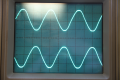
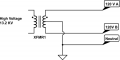
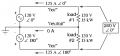
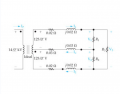
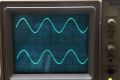
OK I don't have to go beyond post #47 but there is a problem with things. Let's first look at the drawings from post #47, the neutral current will be the sum of the currents. Here is what the transformer output will look like and matter of fact here is what US residential power looks like, both traces with respect to neutral.:

Phase 1.png

Now to post #47 images:
Phase 2.png
Phase 3.png

and lastly the last image you posted.
Phase 4.png

The first 3 images I posted will all have a neutral current of zero. Your image will not. The big difference is the phase relationship. Note how on your image the phase shift is zero while in the first 3 images the phase shift is 180 degrees exactly like my scope image shows. In my image as time passes at any point in time there will be a plus and minus current and at any point in time the algebraic sum will be zero while in your image with zero phase shift the algebraic sum will be a positive number twice either phase. I can run a sim to demonstrate that but there is no sense in doing so.

In your drawing the resultant wave forms would look like the below image:
Phase 5.png

So while the drawings look similar what is actually going on as to the current is about the phase relationship. Yeah, it was amusing and didn't require much effort or work. When you see a transformer and the dots or phase relationships take note of them. They are important.

Ron
 

Thread Starter

Alchemy One

Joined Oct 5, 2019
217
OK I don't have to go beyond post #47 but there is a problem with things. Let's first look at the drawings from post #47, the neutral current will be the sum of the currents. Here is what the transformer output will look like and matter of fact here is what US residential power looks like, both traces with respect to neutral.:

View attachment 187917
 
Last edited:

Thread Starter

Alchemy One

Joined Oct 5, 2019
217
So you have no 3 pin sockets anywhere? Or if you do they do not have a ground conductor?
Measure (meter) the voltage from your neutral and any ground conductor such as a water supply pipe, are you on a main water service, or a well?
Also measure any 120v conductor to the same point.
Max.
I can't remember if I replied to couple of your comments.
 
Last edited:

Thread Starter

Alchemy One

Joined Oct 5, 2019
217
You still have to connect like colors together. otherwise you get a short. Call them what you like.
HOT is blk and White - Neutral. Who knows where they came from except that back wire is easier to make? In larger current capacities where individual wires are run in conduit, they can be taped the colors that they are defined to be.

In fact, you should tape black, white wires that are HOT. If power is run to a ceiling light fixture and then a 2 conductor cable + ground run to the switch, the white gets colored black. https://www.reddit.com/r/electricia..._come_you_can_use_white_wire_with_black_tape/

That said, we have the problem of a reference.

In reality, wiring to a house was initailly non-polarized and had two pins the same size. I may have an example at home somewhere. So, it started out that way. Lighting was the major application for electric power in the home

What we have now is equally bad, but it's a compromise. Hospitals and transmitters will likely have two conductors connected to ground.

"Orange" outlets are used for "isolated grounded" outlets.

What is an "isolated ground"?

It means that the center pin of a 120 V receptacle connects to the Refererence and the box containing the receptacal can meander and get to that same place. So, a fault to the electrical box does not disturb the reference.

When you daisy chain outlets, the reference gets disturbed for every ground on that daisy chain. Computers that used ground as a reference could get into trouble. e.g. long cable and parallel printer in basement. Lightning strikes upstairs and poof. You also get ground loops.

Ethernet offers some protection against ground loops. It's isolated with a transformer.

We had metal appliances and the outer case was connected to ground. Thus any fault would blow a fuse. Now we have GFCI (Ground fault)
s and AFCI's. (Arc fault) circuit interrupters. The arc fault CI's try to listen" for a loose connection.

Your plumbing should also be connected to ground. Now we have isolated plumbing.

Your cable gets connected to a reference. The telephone and cable gets supression or one side is grounded because lightning strikes are highly probable.

Now the most important part, Ground, Earth and Neutral come together at only one point. This is the reference for the house. If there is a fault, that reference can change potential, but the house is not really affected except the daisy-chained outlets.

That reference is MAINTAINED with sub-panels. Neutral is isolated from ground in those panels and ground lugs are added.
Panels that are "detatched" from the service structure get their own ground rod too.

So, ideally, you should have hot, neutral, protective ground, and ground(reference), but we usually don't.

Now, here's a fun part, EARTH's potential changes too. It matters for sidewalks around swimming pools. They are bonded carefully, so the cement and the water are the same potential.

In a computing center where I worked, a storm took out a lot Ethernet going from one side to the other because the ground potential changed. They replaced that ethernet with fiber.

The power station is generating a high voltage, thus low current with respect to earth. When it gets to the transfomer it's single phase maybe 9.6 kV or so. P=VI= 200A*230=9600*I; So, 200A at the house is only 5A on the primary.

It's important to note that the neutral carries the DIFFERENCE current. You can have 200 A fully loaded on both sides of the split phase and have zero neutral current. Panels would not be fully loaded. Circuits are designed not to be fully loaded. Your looking at 80% of a "continuous" load. "continuous" has a special meaning. It's not 100% of the time.

There is a "sign" to that current, but it really doesn't matter.

The power company generates 3 phase power. A residence may get a piece of one of those phases.

Thank you.
 
Just because I hae nothing better to do and most wiring seem to come directly from the crawling space up the wall, I might get ants in my pants and upgrade them. I don't know if it is that important.
Let's hope you don't have any non-polarized receptacle in the house. Both sides would be the same length.

I don't think you can buy receptacle without the ground terminal.

You can replace ungrounded outlets with properly labeled GFCI recetacles. "No Equipment ground"

The GFCI does OK with protecting against ground faults.

It may not do OK when using 3-prong equipment with line filters inside of them. The filter's leakage raises the local ground potential. Not sure if it would be detected. In a non-GFCI circuit, it killed a computer. The ground was raised to 60 VAC and I know how that happens. Symmetric leakage in the RFI filter in the computer's power supply.

My house is about 60 years old, but all the receptacles had the grounds run to the boxes. Receptacles did not accommodate the ground prong.
A few years ago when a bedroom was painted, the outlets in that room got replaced with tamper-proof (kid proof). With tamper-proof, you can't insert an object into one side. You need to remember, that with metalic boxes, the outlets and the box needs to be grounded separately. These boxes did not have the tapped ground hole in the bottom.

https://fredsappliance.com/service/3-prong-vs-4-prong-dryer-outlets-whats-the-difference/
 
Last edited:

Reloadron

Joined Jan 15, 2015
7,893
I understand what you are saying. Certainly I am aware of your details. My point is, the subject was changed without my knowing it or anybody detecting that I have never seen the wiring in terms of neutral being used as an equilibrium balancing of circuits and such. And more than that. The conversation took on a life of its own as if such wiring is a matter of everyday common circuit wiring system. As if every house is wired in that manner. Suddenly I was thrown a wiring system that I was not talking about, to begin with, nor have I never seen it anywhere. Was I living in the early 19th century or something?
My question was simply and basically in regard to my contention about terminologies which never jived and had no parallel to what I had learned 3 decades ago in some classroom. These terms never mentioned. "neutral, hot, ground". I felt bamboozled and my associations..... I don't even want to go there. So go figure. And them instructors are as stupid assholes as the rest. It is rare to find someone who actually sees and knows and cares.
I came here only to be thrown into something more opposing or so it seemed. I didn't know what to make of.
Well, if we focus on as your example then every house in the US (and most of N. America) should be wired the same. They should all be wired in accordance with the NEC (National Electric Code. That said even wired to code leaves openings. I "think" the NEC code is updated every 3 years and there are changes. Some changes only effect industry while some residences. When change does happen some older things, which have changed are still permitted or grandfathered in. Changes may only apply to "new construction". The end result in all of this would be that all residential wiring and industrial wiring will not be the same. Here is an example:

"What year did NEC start requiring grounded 3 prong outlets"?
"The National Electric Code (NEC), which specifies the standards for electrical installations, is dedicated to safety and fire prevention. Every three years the code is revised and updated, and the 1962 edition of the code was the first to require that all 120-volt electric receptacles in a home be three-slot".

Older homes all had the old two prong outlets. Heck as my wife and I have renovated this old house I have removed old Knob & Tube wiring and replaced it with two wire W/ Ground. Wall by wall and as each wall is ripped out I remove and replace all the electric bringing it up to current code. Your 60 year old home likely complied to code 60 years ago just fine as my even older home did. My wife was 12 when her parents moved into this house and she will be 72 in a few months. Even when the code changed going to 3 prong W/ Ground it only applied to new construction. Then in addition to the NEC we have local state, county and city codes. Anyway, don't expect uniformity.

As to a thread changing? Yes, they do that. Normally the thread starter should try to keep a thread on topic as well as moderation. Threads do tend to drift off topic, it just happens. This is also where the thread starter needs to reintroduce their question and keep the thread focused on topic.

Ron

Ron
 

Thread Starter

Alchemy One

Joined Oct 5, 2019
217
Let's hope you don't have any non-polarized receptacle in the house. Both sides would be the same length.

I don't think you can buy receptacle without the ground terminal.

You can replace ungrounded outlets with properly labeled GFCI recetacles. "No Equipment ground"

The GFCI does OK with protecting against ground faults.

It may not do OK when using 3-prong equipment with line filters inside of them. The filter's leakage raises the local ground potential. Not sure if it would be detected. In a non-GFCI circuit, it killed a computer. The ground was raised to 60 VAC and I know how that happens. Symmetric leakage in the RFI filter in the computer's power supply.

My house is about 60 years old, but all the receptacles had the grounds run to the boxes. Receptacles did not accommodate the ground prong.
A few years ago when a bedroom was painted, the outlets in that room got replaced with tamper-proof (kid proof). With tamper-proof, you can't insert an object into one side. You need to remember, that with metalic boxes, the outlets and the box needs to be grounded separately. These boxes did not have the tapped ground hole in the bottom.

https://fredsappliance.com/service/3-prong-vs-4-prong-dryer-outlets-whats-the-difference/
When I encounter a metal box
 
Last edited:

shortbus

Joined Sep 30, 2009
10,049
Not a good idea when it is a 240v circuit, probably because of higher voltage cause too much spark at the switch.
You would and are wrong about this whole stuff in so many ways.
Try using your head again and examine your statements. Start practicing read them couple of times and see if they make sense, slowly you will get good at saying things that you don't have to regret afterward, that you have then tell yourself, "what was I thinking when I said that?"
Very good advice for you to follow.
 

Reloadron

Joined Jan 15, 2015
7,893
https://forum.allaboutcircuits.com/...-change-in-direction-of-current.163811/page-3

My apologies. Since your other thread is now locked, to answer your question. You did not say 30 years in the field, my bad. What you said was:

Okay, try it again. Where did I mention such a thing (30 years in the field)? Go head, respect yourself this time, it won't hurt if you did and show the post #, copy and past it here.
Here is what you said:
My question was simply and basically in regard to my contention about terminologies which never jived and had no parallel to what I had learned 3 decades ago in some classroom. These terms never mentioned. "neutral, hot, ground". I felt bamboozled and my associations..... I don't even want to go there. So go figure. And them instructors are as stupid assholes as the rest. It is rare to find someone who actually sees and knows and cares.
I came here only to be thrown into something more opposing or so it seemed. I didn't know what to make of.
So you have been miserable for 30 years and your instructors were.... So when you do not understand something it is of course the fault of another. You simply want to hear what you want to hear and admire those who agree with your thinking. Cool with me as I am done here. The smart money bailed out early in your threads.

Ron
 

Thread Starter

Alchemy One

Joined Oct 5, 2019
217
https://forum.allaboutcircuits.com/...-change-in-direction-of-current.163811/page-3

My apologies. Since your other thread is now locked, to answer your question. You did not say 30 years in the field, my bad. What you said was:


Here is what you said:


So you have been miserable for 30 years and your instructors were.... So when you do not understand something it is of course the fault of another. You simply want to hear what you want to hear and admire those who agree with your thinking. Cool with me as I am done here. The smart money bailed out early in your threads.

Ron
 
Last edited:

nsaspook

Joined Aug 27, 2009
16,362
His entire question IMO was a misdirection from frequency 'Hz' to zero-crossings. The definition of units for the change in direction specification of the question was actually cycles (what Hz was called long ago)
"How many times the direction of current change in one second in our so-called 60 Hz AC system?"

Sine wave cycle.


The cycle origin is zero in this example but for the origin and back at any phase is one change (oscillation) from the original direction.

https://www.allaboutcircuits.com/textbook/alternating-current/chpt-1/ac-waveforms/
 

Reloadron

Joined Jan 15, 2015
7,893
Fond memories of "Cps (cycles per second) is the measure of how frequently an alternating current changes direction. This term has been replaced by the term hertz (Hz)". My early receivers had dials marked in Cycles well more like Mega Cycles and even Kilo Mega Cycles.
Cycle per second

The naming conventions have changed over the years for several things. Prior to retiring I was reviewing and marking up several drawings with one of our newly hired and very bright young engineers. Here and there when annotating a voltage reference I would pencil in E = and finally the new engineer looks at me and says "Ron, I am real sure I know what you are labeling the units but why an E and not a V"? Well when you have been doing something a certain way for 40 years change does not come easy. :) I learned Ohms Law as E (the unit of electromotive force) was equal to the current expressed as I times the resistance expressed as ohms.

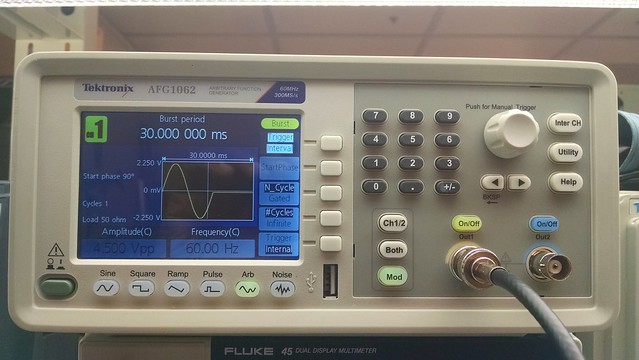
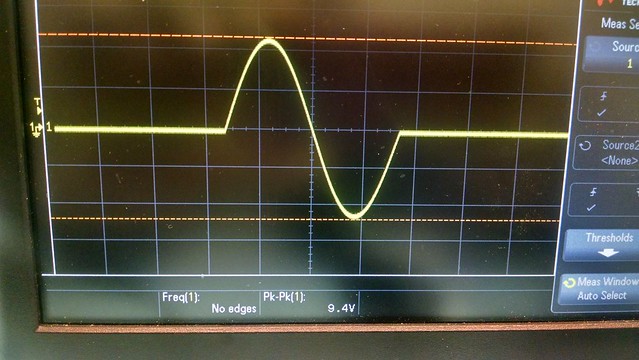
Anyway, I see 1 CPS as 1 Oscillation, an oscillation being just like the above scope images.

Ron


atferrari

Joined Jan 6, 2004
5,017
Fond memories of "Cps (cycles per second) is the measure of how frequently an alternating current changes direction. This term has been replaced by the term hertz (Hz)". My early receivers had dials marked in Cycles well more like Mega Cycles and even Kilo Mega Cycles.
Cycle per second

The naming conventions have changed over the years for several things. Prior to retiring I was reviewing and marking up several drawings with one of our newly hired and very bright young engineers. Here and there when annotating a voltage reference I would pencil in E = and finally the new engineer looks at me and says "Ron, I am real sure I know what you are labeling the units but why an E and not a V"? Well when you have been doing something a certain way for 40 years change does not come easy. :) I learned Ohms Law as E (the unit of electromotive force) was equal to the current expressed as I times the resistance expressed as ohms.

Anyway, I see 1 CPS as 1 Oscillation, an oscillation being just like the above scope images.

Ron
Then, ask Audioguru what he thinks of a resistor measuring 4K7 ohms! :p
 

Thread Starter

Alchemy One

Joined Oct 5, 2019
217
The clarity the article yields is it is very clear we were taught with a collection of misnomers from people who did and still do not care about precision wording and proper concepts into students.
¿ When is it a power supply, or a voltage supply, an energy supply, a current supply ? :rolleyes:
 
Last edited:
Top