About transformer connection

Thread Starter

Narayanan RG

Joined Mar 4, 2017
5
Hello everyone,
I connected a CFL lamp in series with the primary side of a 220/6 v,1A transformer. The secondary side is giving 6v but the lamp is not glowing. Can anyone tell my why?
 

ErnieM

Joined Apr 24, 2011
8,415
You don't supply many details...

Try sketching out your schematic, write down the voltages you know so you can then infer the other voltages till you can see how many volts the CFL is getting.
 

Thread Starter

Narayanan RG

Joined Mar 4, 2017
5
The voltage across the cfl is only 30v but the primary side of the transformer is showing 210v.
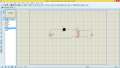
In this circuit the lamp is the load and the resistor is used to short the secondary.
I tried to use the transformer as a current transformer across the load and take the corresponding readings from the secondary side.
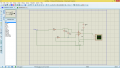
The secondary voltage from the transformer will be given to the zero crossing detector circuit.
 

Attachments

Last edited:

ErnieM

Joined Apr 24, 2011
8,415
There you go, can you see why this is the wrong transformer to use to measure the current?

(It only gives you 30V to drive your CFL.)
 

LesJones

Joined Jan 8, 2017
4,511
You need to sense the voltage not the current for a normal zero crossing detector. (By normal I mean for a use such as triggering an SCR or triac.)

Les.
 

Thread Starter

Narayanan RG

Joined Mar 4, 2017
5
I am using 2 zcd circuits. one for voltage and the other for current. By which I can find the phase difference between them. I use 7486 XOR gate to find the difference between them. The zcd can only take a maximum of 32v. But the supply is 220v so i used a transformer. But the circuit is not working. Can you please provide me the exact way to find the result
 

LesJones

Joined Jan 8, 2017
4,511
As you realy are looking for current zero crossing your original circuit could work but the windings must be the other way round. The 6 volt winding is series with the load and the 220 volt winding to your sense circuit. YOU MUST HAVE A SUITABLE VALUE RESISTOR ACROSS THE 220 VOLT WINDING. The current through the 220 volt winding will be 6/220 (= 0.027) times the current in the 6 volt winding. (The current taken by the load). Thinking about what you want to do instead of the load resitors across the 220 volt winding a bridge rectifier with a 5.1 volt zener diode connected dirrectly across it's output would give you the signal that you want . (The bridge rectifier and the zener diode must be rated for at least 0.027 times the maximum load current.)The voltage across the zener will be 5.1 volts for most of the time dropping to zero for a short time at the zero crossing point.

Les.
 

Thread Starter

Narayanan RG

Joined Mar 4, 2017
5
I haven't connected the load in the secondary side(6v) it is in primary side(220v). I shorted the secondary with a 50k resistor. I can directly give the 6v to the zcd circuit. But the lamp connected in series with the 220v side is not glowing and that's what make me to think more. I thought there will be a closed circuit formation if the lamp is connected from source then to the lamp, then to one end of the primary and then to the other primary end and back again to the source. The respective changes in the waveform due to the load will be given to the zcd. The voltage across the lamp is not 220v, it is only 30v. I don't know the reason for the drop in voltage. It may be due to the winding resistance of the primary( I think so...). Without the consumption of current by the load the phase angle of the supply waveform won't change. I simulated the circuit with the resistor in series with the primary side. It gives the rated voltage across the resistor but when I use a lamp or an inductor the voltage across the lamp is very low.

My circuit is the load will be connected in series with the high voltage side of the transformer and the low voltage side will be give to the zcd circuit. When the supply is on the lamp is not glowing so the lamp doesn't consume any current. What I have to do to make the lamp glow?

Note: the screenshot is the zcd circuit which I use.
 

Attachments

LesJones

Joined Jan 8, 2017
4,511
The way you have it connected with a 10 K resistor across the 6 volt secondary the current through the resistor is 0.6 mA. As the transformer has a ratio of 220 :6 then (For a perfect transformer.) would be 0.6 mA * 6/220 = 0.014 mA. If it was not for the magnetising current for the REAL transformer you would net even see 30 volts across the lamp. When you said you simulated a resistor in series with the load did it have the equivelent resistance to the 10 K load seen through the transformer ? It would be 10K * (220/6)^2 = 13.4 MEG ohms (Remember the impedance ratio of a transformer is the square of the turns ratio.) If you reverse the transformer as I suggested in post #08 with the bridge rectifier and zener and and a 10 K resistor in parallel with the zener diode and feed it into your circuit in post #09 you should get the result that you want.

Les.
 
Top