about led brightness and angle

Thread Starter

emalper

Joined Aug 4, 2016
24
Hi guys i want to build an exprosure box for pcb and i am planing to use a 365nm led with 120 wieving angle and the brightness is not on the website so i dont know about it but can you guys tell me please how can i calculate the led light on the surface. Like how many centimeters between leds or how many centimetrs should i put between the leds and the glass/surface?

p.s sorry about my english. it is not my natuve language

Thank you
 

hp1729

Joined Nov 23, 2015
2,304
Hi guys i want to build an exprosure box for pcb and i am planing to use a 365nm led with 120 wieving angle and the brightness is not on the website so i dont know about it but can you guys tell me please how can i calculate the led light on the surface. Like how many centimeters between leds or how many centimetrs should i put between the leds and the glass/surface?

p.s sorry about my english. it is not my natuve language

Thank you
How bright is each LED? How much brightness do you need? How big is the box? This will tell you the distance required.
 

Thread Starter

emalper

Joined Aug 4, 2016
24
well i dont know about the brightness because there is no information about that. it is a 365 nm 3w 120degree led which is mostly common on ebay. and i dont know how much brightness i need either i just need it to be enough to exposure the pcb.
 

GopherT

Joined Nov 23, 2012
8,009
Hi guys i want to build an exprosure box for pcb and i am planing to use a 365nm led with 120 wieving angle and the brightness is not on the website so i dont know about it but can you guys tell me please how can i calculate the led light on the surface. Like how many centimeters between leds or how many centimetrs should i put between the leds and the glass/surface?

p.s sorry about my english. it is not my natuve language

Thank you
If you are smart enough to keep the LED off until the lid is closed, You are best off buying a very bright "point source" to expose your pcb. That minimizes undercutting of the light and narrowing your traces. An array of LEDs can cause bleed-through at multiple angles.

Warning: high energy UV LEDs can cause eye injury or blindness.
 

Thread Starter

emalper

Joined Aug 4, 2016
24
If you are smart enough to keep the LED off until the lid is closed, You are best off buying a very bright "point source" to expose your pcb. That minimizes undercutting of the light and narrowing your traces. An array of LEDs can cause bleed-through at multiple angles.

Warning: high energy UV LEDs can cause eye injury or blindness.
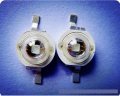
well yes i think i am smart enough to do that)) but the led i found is the one i attached so there is no information about how bright is the led. so what can you tell me about the spacing between the leds and spacing between the leds and glass?
 

Attachments

GopherT

Joined Nov 23, 2012
8,009
well yes i think i am smart enough to do that)) but the led i found is the one i attached so there is no information about how bright is the led. so what can you tell me about the spacing between the leds and spacing between the leds and glass?

So, it depends on a few things...

Glass with out UV absorbing pigments. That is, no picture frame glass. Use cheap window glass.

Size of PCB you plan to expose. Don't expect more than 45-degrees left or right of center line (90-degree total) because the last 15-degrees in each direction are usually questionable (for a 120-degree claim).

Start with a 2" X 1" strip of pcb. Remove all films and put it under the light (2" from the light). Cover all but 1/4" X 1" with a piece of aluminum foil. Expose for 2 minutes, pull the foil to expose additional 1/4" and so on until 16 minutes have passed and all 2" are exposed. Then develop to see how well it worked and what exposed time works.

If you need bigger boards than the LED will illuminate, pull the LED away from the PCB and square the time every time you double the distance. Write things down so you don't forget.
 

Thread Starter

emalper

Joined Aug 4, 2016
24
So, it depends on a few things...

Glass with out UV absorbing pigments. That is, no picture frame glass. Use cheap window glass.

Size of PCB you plan to expose. Don't expect more than 45-degrees left or right of center line (90-degree total) because the last 15-degrees in each direction are usually questionable (for a 120-degree claim).

Start with a 2" X 1" strip of pcb. Remove all films and put it under the light (2" from the light). Cover all but 1/4" X 1" with a piece of aluminum foil. Expose for 2 minutes, pull the foil to expose additional 1/4" and so on until 16 minutes have passed and all 2" are exposed. Then develop to see how well it worked and what exposed time works.

If you need bigger boards than the LED will illuminate, pull the LED away from the PCB and square the time every time you double the distance. Write things down so you don't forget.
thank you for you detailed reply but i dont understand the first part. can you please explain what does it mean `Don't expect more than 45-degrees left or right of center line (90-degree total) because the last 15-degrees in each direction are usually questionable (for a 120-degree claim). ` and also i understood your point about the height but how can i arrange the spacing between the leds? how to prevent them from overlapping?
 

GopherT

Joined Nov 23, 2012
8,009
thank you for you detailed reply but i dont understand the first part. can you please explain what does it mean `Don't expect more than 45-degrees left or right of center line (90-degree total) because the last 15-degrees in each direction are usually questionable (for a 120-degree claim). ` and also i understood your point about the height but how can i arrange the spacing between the leds? how to prevent them from overlapping?
Oh, one 3W LED should be quite enough for small PCBs.

If you insist on multiple LEDs, then you are kind of stuck on a single distance because you will have a overlap or underlay (gap) depending how far the target PCB is from the light. Trigonometry can be used to help you calculate the "radius of influence" the LED will make. If we assume your LED has a 90-degree emission radius (which is a good guess if the manufacturer claims 120-degrees). Then, it will light up a 2" diameter when 2" from the PCB. If you go to 4", it will light a 4" circle and so on.

It is best to arrange and array as a equalateral triangular array (6 equal LEDs evenly spaced surrounding a central LED and array continuing as needed) to get even lighting.

Also, over exposure is not normally a problem if your photomask is very dark.
 

Thread Starter

emalper

Joined Aug 4, 2016
24
Oh, one 3W LED should be quite enough for small PCBs.

If you insist on multiple LEDs, then you are kind of stuck on a single distance because you will have a overlap or underlay (gap) depending how far the target PCB is from the light. Trigonometry can be used to help you calculate the "radius of influence" the LED will make. If we assume your LED has a 90-degree emission radius (which is a good guess if the manufacturer claims 120-degrees). Then, it will light up a 2" diameter when 2" from the PCB. If you go to 4", it will light a 4" circle and so on.

It is best to arrange and array as a equalateral triangular array (6 equal LEDs evenly spaced surrounding a central LED and array continuing as needed) to get even lighting.

Also, over exposure is not normally a problem if your photomask is very dark.
so since manufacturer says its 120 degrees my led is actually 90 degrees right? and also what happens if i got some overlap? will it effect the sharpness or the result to much?
 

GopherT

Joined Nov 23, 2012
8,009
so since manufacturer says its 120 degrees my led is actually 90 degrees right? and also what happens if i got some overlap? will it effect the sharpness or the result to much?
Normally the intensity on the last bits is not great enough to be an issue. That said, undercutting is an issue and I would go with a single LED at 1-amp.
 

Thread Starter

emalper

Joined Aug 4, 2016
24
Normally the intensity on the last bits is not great enough to be an issue. That said, undercutting is an issue and I would go with a single LED at 1-amp.
yes i get it but i am working with eagle and the circuits i am doing is usually using the full area of free version of eagle which is 100*80 cm so 1 led wouldnt be enough for my project so i am open for every suggestion)
 

GopherT

Joined Nov 23, 2012
8,009
yes i get it but i am working with eagle and the circuits i am doing is usually using the full area of free version of eagle which is 100*80 cm so 1 led wouldnt be enough for my project so i am open for every suggestion)
Yes, one 3-watt LED 6" from a surface will easily illuminate a 140 mm diameter circle.
 

hp1729

Joined Nov 23, 2015
2,304
well i dont know about the brightness because there is no information about that. it is a 365 nm 3w 120degree led which is mostly common on ebay. and i dont know how much brightness i need either i just need it to be enough to exposure the pcb.
If you don't know the brightness, Lumen, of the LEDS or how much you need, you can't answer your design question. Build it and see if it works.
 
Top