Thats not what your thinking LOW is off HIGH is on.
Id go with the PRO mini its cheap small And dead simple to load code
You want make this work the arduino is the easy way to go
You can ask chatAI to write you code it find some that you could make work.
Thats not what your thinking LOW is off HIGH is on.
Id go with the PRO mini its cheap small And dead simple to load code
You want make this work the arduino is the easy way to go
You can ask chatAI to write you code it find some that you could make work.
Many people state that to program an ATTiny, you can use an Arduino Uno. There is another option that works with the Arduino IDE, all versions. It is a 17.50 USD programmer by Sparkfun. It replaces the Arduino as a programmer. Load its drivers and board definitions into the IDE, plug it into a USB port and upload the Arduino code to the ATTiny.
Many people state that to program an ATTiny, you can use an Arduino Uno. There is another option that works with the Arduino IDE, all versions. It is a 17.50 USD programmer by Sparkfun. It replaces the Unitas a programmer. Load its drivers into the IDE, plug it into a USB port and upload the Arduino code.
I have just one more thing to say about the atinny one more time the 2.3.2 arduino ide don't like them. You have to use older ide like 1.6.2
The atinny you can trim the clock to get the error lower but then my programmer wouldn't work for reprogramming because of avedude couldn't find the chip.
This because of changes in the newer software. If you use a crystal osc there gos your two of ADC pins only leaves A1
Long story short you'll have a lot to learn with this.
There lot more to programing a attiny now with arduino ide the programer I used doesn't work with it and the arduino as ISP if you forget to set clock to 8 mH
the ardiuno as isp will not program it the second time
True But many people even me leave parts out like oh I did this with ide 1.x.x years ago and now i got links on my website trying to still your money LOL
You have people trying to sale you USBasp with 12 year old firmware that to make work would take days to find the right bin file and more time getting window to use it.
With CMOS gates, it is generally accepted that the threshold voltage separating LOW and HIGH is one-half the supply voltage.
For example, if Vcc is 5 V, then the switching threshold is 2.5 V.
But it is not that simple.
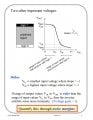
At the switching threshold there is a gray area that you want to avoid. For the proper answer, you need to check the manufacturer's device data sheet. For example, for CD4081 AND gate, powered at 5 V, the LOW level input is 1.5 V max and the HIGH level input is 3.5 V min. In other words, you need to stay away from voltage levels between 1.5 V and 3.5 V.
Why do we want to do this?
Because there is noise in every system. We define a noise margin and we stay clear from the noise region. That is just simply good engineering practice.
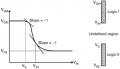
Example, hypothetical transfer function of an inverter:
With CMOS gates, it is generally accepted that the threshold voltage separating LOW and HIGH is one-half the supply voltage.
For example, if Vcc is 5 V, then the switching threshold is 2.5 V.
But it is not that simple.
At the switching threshold there is a gray area that you want to avoid. For the proper answer, you need to check the manufacturer's device data sheet. For example, for CD4081 AND gate, powered at 5 V, the LOW level input is 1.5 V max and the HIGH level input is 3.5 V min. In other words, you need to stay away from voltage levels between 1.5 V and 3.5 V.
Why do we want to do this?
Because there is noise in every system. We define a noise margin and we stay clear from the noise region. That is just simply good engineering practice.
Example, hypothetical transfer function of an inverter:
It appears that V_IH is being defined as the point where the slope of the curve is -1.
Okay, but then why isn't the V_IL defined as the point where the slope is -1 at the beginning. And what IS it being defined as?
I've never seen a definition of the input voltage level thresholds that ties them to the slope of the transfer function before. Not saying that this isn't how it's done -- I've actually never seen anything that described why the specific values for the threshold voltages for the various logic families where chosen and I guess I assumed it was done by committee and handed to the world as a proclamation or fait accompli that everyone now had to design devices to. Do you have any reference that talks about tying the threshold voltages to the slops of the (presumably typical) transfer curve?
…And I’m saying that with the Sparkfun USB programmer, the newer version on the Arduino IDE will work. With this programmer, you aren’t using the Uno as a programmer…
It appears that V_IH is being defined as the point where the slope of the curve is -1.
Okay, but then why isn't the V_IL defined as the point where the slope is -1 at the beginning. And what IS it being defined as?
I've never seen a definition of the input voltage level thresholds that ties them to the slope of the transfer function before. Not saying that this isn't how it's done -- I've actually never seen anything that described why the specific values for the threshold voltages for the various logic families where chosen and I guess I assumed it was done by committee and handed to the world as a proclamation or fait accompli that everyone now had to design devices to. Do you have any reference that talks about tying the threshold voltages to the slops of the (presumably typical) transfer curve?

 Facebook
 Google
 GitHub
 Linkedin



 ohh do you have that link to download IDE version that is need for the tiny85?