a system to measure the precision of the signal from the satellite, help

Thread Starter

MikeHutao

Joined Aug 2, 2024
11
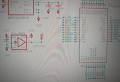
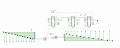
Hello. right now im trying to design a system to measure the precision of the signal from the satellite for example like 10MHz using a counter and a shift register. im using the two cascaded 12bit ripple counter and also three 8bit parallel in 74HC166 shift register. to calculate the precision, i will be connecting the signal of 1pps to the load of the shift register. can someone helps me connecting the components. i have problems. thank u in advance
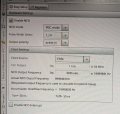
1722583149212.png
 
Last edited by a moderator:
Ya’akov

Joined Jan 27, 2019
10,226
Welcome to AAC.

As a courtesy, your thread has been moved to the Homework Help forum. AAC rules limit the help that members can provide to students to guidance related to attempts at creating their own solutions.

For this reason it is required that all questions related work that will get academic credit be posted here to ensure that members are aware of their nature.

For best results post the actual problem description or assignment, or explain it in detail. Include what you have done to solve it yourself, and where you are having difficulty.

In the future, please post your questions here, and with enough information at the beginning.
 

Thread Starter

MikeHutao

Joined Aug 2, 2024
11
Hello. right now im trying to design a system to measure the precision of the signal from the satellite for example like 10MHz using a counter and a shift register. im using the two cascaded 12bit ripple counter and also three 8bit parallel in 74HC166 shift register. to calculate the precision, i will be connecting the signal of 1pps to the load of the shift register. can someone helps me connecting the components. i have problems. thank u in advance

View attachment 328423
It might help if you explain how you expect the circuit to work.
Hello,

Sure, I'd be happy to explain how the circuit is expected to work. Here's the overview:

  1. Counters and Shift Registers:
    • 12-bit Ripple Counters: These are used to count the high-frequency signal, in this case, the 10MHz signal. The counters will increment with each pulse of the 10MHz signal.
    • 74HC166 Shift Registers: These are used to capture and store the count value from the ripple counters.
  2. 1PPS Signal:
    • The 1 pulse per second (1PPS) signal is used as a reference to sample the count value from the ripple counters. This means that every second, the current count of the 10MHz signal (stored in the ripple counters) will be transferred to the shift registers for processing.
  3. Load Connection:
    • The 1PPS signal is connected to the load pin of the shift registers. This will trigger the shift registers to load the current count value from the ripple counters when the 1PPS pulse occurs.
  4. Precision Measurement:
    • By capturing the count value of the 10MHz signal at each 1PPS pulse, you can calculate the precision and frequency stability of the 10MHz signal. The stored counts will be used to determine if there are any deviations or fluctuations in the signal frequency.
If you have any specific questions or if there's a particular part of the circuit that's causing confusion, please let me know!
 

MrChips

Joined Oct 2, 2009
34,626
What you desire is called a frequency counter. This is a common exercise in many digital design courses. There are many examples of a frequency counter on the internet.
 

Alec_t

Joined Sep 17, 2013
15,101
By capturing the count value of the 10MHz signal at each 1PPS pulse, you can calculate the precision and frequency stability of the 10MHz signal.
That implies an extemely accurate period for the 1PPS pulse. How do you plan to achieve that?
 

MrChips

Joined Oct 2, 2009
34,626
Since you want to capture and analyze the data collected, another option is to use a microcontroller (MCU).
High clocking MCUs can measure 10MHz inputs directly with the use of internal counters. No external hardware is required. Data collected and analyzed can be uploaded to a PC relatively easily, once you know how to do this.
 

nsaspook

Joined Aug 27, 2009
16,249
Since you want to capture and analyze the data collected, another option is to use a microcontroller (MCU).
High clocking MCUs can measure 10MHz inputs directly with the use of internal counters. No external hardware is required. Data collected and analyzed can be uploaded to a PC relatively easily, once you know how to do this.
You will still need a high precision clock source (highly-stable TCXO) as the MCU clock/time reference. As a standard for the calculation of offsets and drifts for the MCU clock and capture calculations or as the MCU clock source.
https://www.microchip.com/en-us/products/clock-and-timing/components/oscillators/tcxo
 

Ya’akov

Joined Jan 27, 2019
10,226
You will still need a high precision clock source (highly-stable TCXO) as the MCU clock/time reference. As a standard for the calculation of offsets and drifts for the MCU clock and capture calculations or as the MCU clock source.
https://www.microchip.com/en-us/products/clock-and-timing/components/oscillators/tcxo
Or… https://forum.allaboutcircuits.com/threads/deal-alert-10-mhz-ocxo-cheap-as-dirt.196124/ (still available for about the same price if you buy at least 5 to defray shipping).
 

nsaspook

Joined Aug 27, 2009
16,249
With a precision 10 MHz OCXO you can build a phase detector using a D-type flip-flop.
Sure, you could build a PLL circuit but as you say, a modern controller is up to the job and some controllers have general NCO modules to greatly simplify that job.

https://zipcpu.com/dsp/2017/12/09/nco.html
https://onlinedocs.microchip.com/ox...UID-A505800B-15FF-45FA-80AA-0439977D98BB.html

1722790294130.png
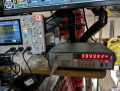
Measure the CFPS-72 frequency.
1722790639526.png
1722790853768.png
https://www.iqdfrequencyproducts.com/products/details/cfps-72.pdf Fine for general CPU clock use but not for a precision RF frequency standard.
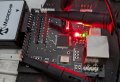
10 MHz cpu clock, PLL to 40 Mhz FOSC
1722790410341.png
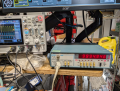
Measure the NCO 9995 kHz output
1722790492984.png
 

Attachments

MrChips

Joined Oct 2, 2009
34,626
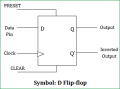
If you feed the 10 MHz signal and 10 MHz OCXO reference into the D and CLK inputs of a D-type flip-flop, you can measure the frequency difference on the Q output.

1722791605689.png
 

MrChips

Joined Oct 2, 2009
34,626
Sure but something still needs to measure it.
The Q output of the D-type flip-flop will be a square-wave signal at exactly the difference frequency.
Hence a 1 ppm difference will be 10 Hz. You can measure this with a low cost frequency counter. Or you can convert this to a voltage and measure analog voltage with a DMM. In any case, many DMM can measure frequency directly.
 

nsaspook

Joined Aug 27, 2009
16,249
The Q output of the D-type flip-flop will be a square-wave signal at exactly the difference frequency.
Hence a 1 ppm difference will be 10 Hz. You can measure this with a low cost frequency counter. Or you can convert this to a voltage and measure analog voltage with a DMM. In any case, many DMM can measure frequency directly.
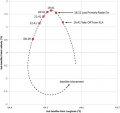
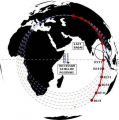
It depends on the measurement requirement precision for the task. For the OP, that's likely to be adequate. 50 years ago we could identify specific transmitter (up to radar) sources and locations by their EM signal characteristics using atomic clocks to qualify drift, modulation chirp and a few other parameters from only seconds of emissions. A few years ago they used the slight RF changes from the old INMARSAT satellite movements (wobble from saving station-keeping thruster fuel) and other factors on orbit to DF the path of the missing plane in the IO.

https://en.wikipedia.org/wiki/Malaysia_Airlines_Flight_370_satellite_communications

1722797351359.png

Burst frequency offset
[edit]
BFO contributing factors
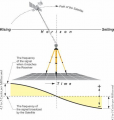
While the BTO is able to determine the distance between the satellite and the aircraft at the time of each handshake, it was still necessary to determine where along the BTO arcs the aircraft was. To accomplish this, an analysis was performed on another attribute of received signals that was recorded by the ground station: the burst frequency offset (BFO)—the difference between the expected and actual frequencies of the signal received from the aircraft. The BFO is primarily caused by the Doppler shift—a shift in frequency caused by the relative movement of the aircraft, satellite, and ground station—along with several other factors which can be calculated and removed, allowing the Doppler shift between the aircraft and satellite to be isolated. The Doppler shift between the aircraft and satellite indicates the relative motion of the aircraft relative to the satellite, although multiple combinations of aircraft speed and heading exist that match a given Doppler shift value.

https://www.physicsforums.com/threa...for-missing-flight-mh370.745000/#post-4698830

1722798172506.png
 
Last edited:

MrChips

Joined Oct 2, 2009
34,626
I have an SDR receiver which I use for tracking satellites. It is interesting to watch the doppler shift as the satellite passes by.
This shows up as an "S-curve" shift on the SDR screen.

1722799910697.png
 
Top