A question.

LDC3

Joined Apr 27, 2013
924
The web site has a good description of how to derive these equations. What do you not understand?

Do you have a problem understanding Kirchhoff's Current Law?
Do you have a problem understanding Kirchhoff's Voltage Law?
 

LDC3

Joined Apr 27, 2013
924
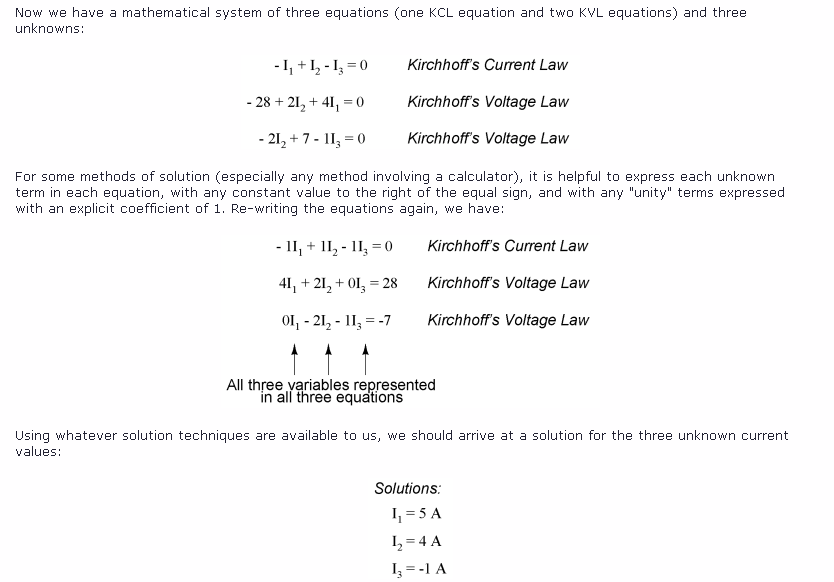
He did some algebraic manipulations on the 3 equations:

-1I1 + 1I2 - 1I3 = 0
4I1 + 2I2 + 0I3 = 28
0I1 - 2I2 - 1I3 = -7

Rearranging the first equation gives:

-1I3 = 1I1 - 1I2

Substituting into the third equation gives:

0I1 - 2I2 + (1I1 - 1I2) = -7
---> 1I1 - 3I2 = -7

Multiply by 4 gives:

4I1 - 12I2 = -28

Subtract that equation from the second equation gives:

0I1 + 14I2 = 56
---> 14 I2 = 56
---> I2 = 4

Replacing 4A for I2 in the second equation gives:

4I1 + 2(4) + 0 = 28
---> 4 I1 = 28 - 8
---> 4 I1 = 20
---> I1 = 5

Substituting I1=5A and I2=4A in the first equation gives:

- 5A + 4A - I3 = 0
---> -1A = I3
 

WBahn

Joined Mar 31, 2012
32,893
There is no name because he specifically didn't specify a method at all. The generic description would be something like "solving a system of simultaneous equations" because you are looking for a single set of values that solve each of the equations at the same time.

There several methods to actually go about finding the solution. One common technique is called Gaussian elimination. You might look that up. Another is simply to do what LDC did, which is use one equation to write one of the unknowns in terms of the other unknowns, and then use that to eliminate that unknown from the remaining equations. This pick one of those equations and do the same. At each step of the way you reduce the number of equations and the number of unknowns by one until you eventually get to the last equation and have one equation and one unknown, meaning that it is no longer an unknown. Then you work backwards substituting the known value into the previous equation in two unknowns and solve for the second unknown and so on.
 

amilton542

Joined Nov 13, 2010
497
Linear Algebra! :)

As already mentioned, you could always look up the Gaussian elimination algorithm or even the Gauss-Jordan algorithm.

Your system is upper triangular so the solution is compatible and unique with no free variables.
 

Thread Starter

interesting_dude

Joined Jul 28, 2013
20
Hi all again! I'm trying to analyze my circuit with this method, but I can't spot what's wrong!


-I1-I2+I3=0
-E1+0+ER3+ER1=0
-ER3+0+E2-ER2=0

-I1-I2+I3=0
-10+2I3+4I1=0
-8I3+2-2I2=0

-I1-I2+I3=0
4I1+0I2+2I3=10
0I1-2I2-8I3=-2

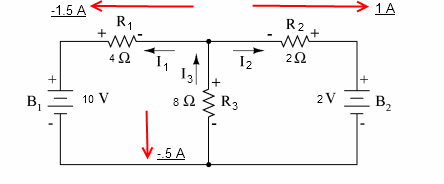
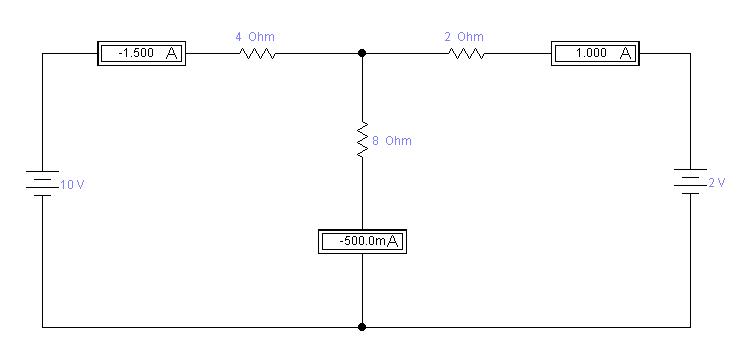
But if check it out with the real answers that I should receive (I1 = -1.5A, I2 = 1A, I3 = -.5A), then only the upper linear equation (KCL) is right.

-(-1.5)-1+(-.5)=0; means that 1.5-1-.5=0 — correct!
4(-1.5)+0+2(-.5)=10; means that -6-1=10 — incorrect!
0-2(1)-8(-.5)=-2; means that 0-2-4=-2 — incorrect!

Why? What were I doing wrong? I just applied such technique which were positioned in the book.


LDC3

Joined Apr 27, 2013
924
Hi all again! I'm trying to analyze my circuit with this method, but I can't spot what's wrong!


-I1-I2+I3=0 ---> eq 1
-E1+0+ER3+ER1=0 ---> eq 2
-ER3+0+E2-ER2=0 ---> eq 3

-I1-I2+I3=0 ---> eq 1
-10+2I3+4I1=0 ---> eq 4
-8I3+2-2I2=0 ---> eq 5
What did you do to go from eq 2 to eq 5? Why did you use 2I3 and 4I1?
 

Thread Starter

interesting_dude

Joined Jul 28, 2013
20
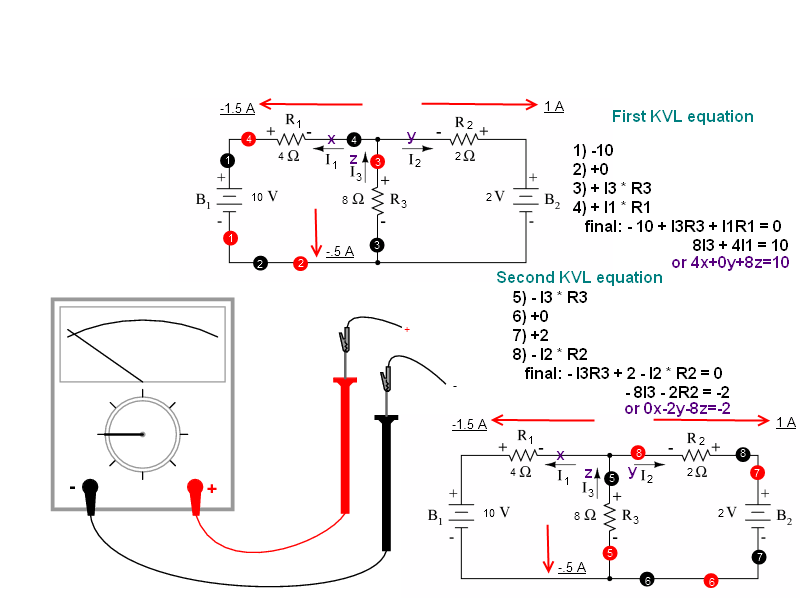
I just followed the instructions, and assumed that I "circling" the loop with a multimeter... Well, I can't explain it very good on simple English, but will try.
Also, ER1 means "the voltage of resistor R1", not "the voltage multiplied by the resistor R1". Since E equals I multiplied by R, so E of R1 equals I1 multiplied by R1.
Also, there a little mistake in my previous post... 4I1+0I2+8I3=10. Now not matters.
Here is the picture, I hope you will understood what have I done.
 

LDC3

Joined Apr 27, 2013
924
Also, ER1 means "the voltage of resistor R1", not "the voltage multiplied by the resistor R1". Since E equals I multiplied by R, so E of R1 equals I1 multiplied by R1.
Also, there a little mistake in my previous post... 4I1+0I2+8I3=10. Now not matters.
Now that you are using 4I1+0I2+8I3=10, solve the equations.
 

Thread Starter

interesting_dude

Joined Jul 28, 2013
20
oh my gosh
maybe my mistake were caused by the ewb (electronics workbench programm)?
because im using electron flow , not charge flow ;(

-1x-1y+1z=0
4x+0y+8z=10
0x-2y-8z=-2

answers are
x 1.5
y -1
z .5
 

WBahn

Joined Mar 31, 2012
32,893
Your problem is that you are ignoring the sign of the voltage drops when you apply Ohms Law.

The voltage across a resistor is the product of the resistance and the current flowing through the resistor from the positive terminal to the negative terminal. Since all three of you currents are shown flowing through the resistor from the negative terminal to the positive terminal, you have to add in a minus sign when you do the multiplication.

You would be well served by observing the passive sign convention wherever possible.

You would also be well served by tracking your units through out your work. It's not that hard, takes very little time, and will catch most of the mistakes you make right when you make them.
 

WBahn

Joined Mar 31, 2012
32,893
oh my gosh
maybe my mistake were caused by the ewb (electronics workbench programm)?
because im using electron flow , not charge flow ;(

-1x-1y+1z=0
4x+0y+8z=10
0x-2y-8z=-2

answers are
x 1.5
y -1
z .5
Forget about electron flow and use conventional current. They are the same thing. The problem is that people that insist on using electron flow almost never do it correctly and so they end up having to apply a whole slew of rules about when to change the sign because they want to pretend that electrons are positively charged while not changing the voltages accordingly, which only have the sign they do because electrons were defined as being negatively charged.
 
Top