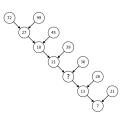
Well I was able to find the answer, one rule creates all of the values (including the last 7) and 15 is not the answer, definitely not. This is a good example to show DeBono's lateral thinking stuff!
What defines when the missing number is "correct"?
What is the metric by which one number is considered somehow more correct than another?
You can pick ANY number you want and come up with a "rule" that produces that number as the missing number.
Hence, it becomes an exercise less in pattern recognition or deductive reasoning, but more an exercise in mind reading in order to guess which algorithm the person that devised the sequence used to generate it from an infinite number of algorithms that do generate it.
You know it when you see it. We all knew 15 was wrong because the rule that worked to get all the previous answers and gave us 15 did not work for the next one.
You know it when you see it. We all knew 15 was wrong because the rule that worked to get all the previous answers and gave us 15 did not work for the next one.
More accurately, the particular rule that you used to get 15 didn't work for a later number in the sequence. But you can just craft a much more complicated rule that will yield 15 for the missing number and also produce all of the other numbers in the sequence. There really is no basis upon which to insist that that rule, no matter how complex, is incorrect, unless the metric by which the acceptability of the rule is disclosed. As it stands, the metric is "if you read my mind and happened to choose the rule that I chose."
What defines when the missing number is "correct"?
What is the metric by which one number is considered somehow more correct than another?
You can pick ANY number you want and come up with a "rule" that produces that number as the missing number.
Hence, it becomes an exercise less in pattern recognition or deductive reasoning, but more an exercise in mind reading in order to guess which algorithm the person that devised the sequence used to generate it from an infinite number of algorithms that do generate it.
That's true. I don't disagree, but that same criticism can be levelled at many such questions, an IQ test for example. The usual answer here is to apply Occam's razor, what is the simplest rule/algorithm that generates all the known values and adopt that rule to determine the unknown value.
More accurately, the particular rule that you used to get 15 didn't work for a later number in the sequence. But you can just craft a much more complicated rule that will yield 15 for the missing number and also produce all of the other numbers in the sequence. There really is no basis upon which to insist that that rule, no matter how complex, is incorrect, unless the metric by which the acceptability of the rule is disclosed. As it stands, the metric is "if you read my mind and happened to choose the rule that I chose."
This is what science seeks though, what is the simplest theory that's consistent with all of the observations. Given two explanations for something, each of which yields correct predictions, how do we select one of them?
Consider the geocentric model vs the heliocentric model, up to a point the geocentric model fits observations but is far more complex than Ptolemy's and later Newton's model of planetary motion.
The geocentric system was still held for many years afterwards, as at the time the Copernican system did not offer better predictions than the geocentric system, and it posed problems for both natural philosophy and scripture.
The usual answer here is to apply Occam's razor, what is the simplest rule/algorithm that generates all the known values and adopt that rule to determine the unknown value.
Think of epicycles to explain planetary orbits. It is correct, in the sense that, given enough terms it can describe the orbit to any degree of accuracy. But the equation for the ellipse is far simpler.
On the other hand, the artificial puzzle presented in this thread was designed such that an obvious answer failed on the last of the series. And once you see the rule that actually produces all of the series, adjusting the original theory by additional rules is just adding epicycles.
What this puzzle reminded me of is how reluctant we can be to abandon a theory that almost works.
That's true. I don't disagree, but that same criticism can be levelled at many such questions, an IQ test for example. The usual answer here is to apply Occam's razor, what is the simplest rule/algorithm that generates all the known values and adopt that rule to determine the unknown value.
I agree -- and that's a huge (and well-acknowledged) problem with such tests. Which is not to say that those same tests aren't routinely blindly administered and the results blindly accepted.
It's fine to throw out Occan's razor and say that the "simplest" rule is the correct one -- but that is doing nothing more than kicking the can down the road. What is the metric by which one rule is deemed "simpler" than another? At the end of the day, you are still left with the same exact situation.
This is an issue that rears it's ugly head in real-life engineering all the time. Customers want "the best" solution without being willing or able to describe how to evaluate whether solution A is "better" than solution B.
A common place where we see it manifested in engineering, particularly, but not exclusively by any means, in engineering education is in logic optimization -- students are told to optimize a logic circuit without being told what the metric is that they are trying to optimize against. If they ask, they are told to find "the simplest" solution, which hasn't changed a thing, except to reveal that the person asking the question hasn't bothered to give it anything beyond the most superficial thought.
I agree -- and that's a huge (and well-acknowledged) problem with such tests. Which is not to say that those same tests aren't routinely blindly administered and the results blindly accepted.
It's fine to throw out Occan's razor and say that the "simplest" rule is the correct one -- but that is doing nothing more than kicking the can down the road. What is the metric by which one rule is deemed "simpler" than another? At the end of the day, you are still left with the same exact situation.
This is an issue that rears it's ugly head in real-life engineering all the time. Customers want "the best" solution without being willing or able to describe how to evaluate whether solution A is "better" than solution B.
A common place where we see it manifested in engineering, particularly, but not exclusively by any means, in engineering education is in logic optimization -- students are told to optimize a logic circuit without being told what the metric is that they are trying to optimize against. If they ask, they are told to find "the simplest" solution, which hasn't changed a thing, except to reveal that the person asking the question hasn't bothered to give it anything beyond the most superficial thought.
Well following that line of reasoning to its inevitable conclusion you'd never be able to answer questions like that puzzle, if there were multiple solutions, you'd simply be unable to commit to an answer. IQ tests are littered with these where we are tasked with some sequence of shapes or numbers and asked to determine the "next" one, I've done tests like that before and sometimes there is more than one reasonable solution but it's a timed test and so you have to choose or likely fail to get a decent score.
As you know there are different ways to measure "simplicity" or its converse, one such measure is Kolmogorov complexity. Crudely in this case we'd look at the steps required to compute the answer and the one with the fewer steps would be the "simplest".
Now having said all that - did anyone actually find another solution? another way to generate an answer that also matches all the other values?
Well following that line of reasoning to its inevitable conclusion you'd never be able to answer questions like that puzzle, if there were multiple solutions, you'd simply be unable to commit to an answer. IQ tests are littered with these where we are tasked with some sequence of shapes or numbers and asked to determine the "next" one, I've done tests like that before and sometimes there is more than one reasonable solution but it's a timed test and so you have to choose or likely fail to get a decent score.
Which just underscored my point -- as you say, sometimes there is more than one reasonable solution, but you have to choose exactly one of them. So you are left with no option but to play the mind-reading game and try to guess which one that the person that wrote the question most likely intended.
As you know there are different ways to measure "simplicity" or its converse, one such measure is Kolmogorov complexity. Crudely in this case we'd look at the steps required to compute the answer and the one with the fewer steps would be the "simplest".
Given two solutions, it is often easy to say that one of them is going to be "simpler" than the other regardless of what the metric for simplicity happens to be. Where this fails is for the cases where different, but reasonable, measures of "simplicity" yield different results.
For instance, you are given the following list of animals: {jaguar, cougar, panther, rabbit, lion, tiger} and are asked to identify the one that "doesn't belong". One person chooses "rabbit" since all of the others are felines. Yet someone else picks "lion" because it is the only name in the list that doesn't have an 'r'. Which rule is "simpler"? Keep in mind that one rule requires the person to bring to the table knowledge about each animal in that list, while the other only requires an examination of the information presented in the question.
Now having said all that - did anyone actually find another solution? another way to generate an answer that also matches all the other values?
For each circle that has arrows coming into it, the one coming in from the upper-left is 'A' and the one coming in from the upper-right is 'B'. Circles that don't have numbers coming into them are taken to be givens (and how reasonable is this assumption?).
The value in the circle is then
C = (B-A) - (A<14)
where, as is common in many programming languages, relational expressions yield 1 if True and 0 if False.
Which just underscored my point -- as you say, sometimes there is more than one reasonable solution, but you have to choose exactly one of them. So you are left with no option but to play the mind-reading game and try to guess which one that the person that wrote the question most likely intended.
Given two solutions, it is often easy to say that one of them is going to be "simpler" than the other regardless of what the metric for simplicity happens to be. Where this fails is for the cases where different, but reasonable, measures of "simplicity" yield different results.
For instance, you are given the following list of animals: {jaguar, cougar, panther, rabbit, lion, tiger} and are asked to identify the one that "doesn't belong". One person chooses "rabbit" since all of the others are felines. Yet someone else picks "lion" because it is the only name in the list that doesn't have an 'r'. Which rule is "simpler"? Keep in mind that one rule requires the person to bring to the table knowledge about each animal in that list, while the other only requires an examination of the information presented in the question.
Here's a pretty simple, brute force way:
For each circle that has arrows coming into it, the one coming in from the upper-left is 'A' and the one coming in from the upper-right is 'B'. Circles that don't have numbers coming into them are taken to be givens (and how reasonable is this assumption?).
The value in the circle is then
C = (B-A) - (A<14)
where, as is common in many programming languages, relational expressions yield 1 if True and 0 if False.
You make some good points. The C = (B-A) - (A<14) too when coded in C is likely simpler than the sum of digits would be written in C. But in some other language the sum of digits might be simpler, also the sum of digits involves only the + operator it doesn't use the - operator. Apparently the the originator Nob, regarded it as his best puzzle but frankly it isn't that profound, IMHO anyway.

 Facebook
 Google
 GitHub
 Linkedin