A Mobility Scooter Motor Controller issue(s)!!

PackratKing

Joined Jul 13, 2008
847
Brief mention / attention was given on pg. 1 regarding the condition of the fields, armature, commutator / brush integrity. Will the fields - armature and comm. pass a growler and Hi-pot test ??

If when the motor is run open - unladen by the scooter, do the brushes spark ?? very little is allowable. Are the insulations between the commutator bars undercut and free of copper detritus from sanding between them ?? do thge brush springs have equal tension, and not show signs of blueing or scorching ------are they free in the holders, or we dealing with wilted plastic here.

If not, the fanciest control circuit you can imagine, is going to get you a grand total of nowhere.
 
Last edited:

Thread Starter

iONic

Joined Nov 16, 2007
1,662
Brief mention / attention was given on pg. 1 regarding the condition of the fields, armature, commutator / brush integrity. Will the fields - armature and comm. pass a growler and Hi-pot test ??

If when the motor is run open - unladen by the scooter, do the brushes spark ?? very little is allowable. Are the insulations between the commutator bars undercut and free of copper detritus from sanding between them ?? do thge brush springs have equal tension, and not show signs of blueing or scorching ------are they free in the holders, or we dealing with wilted plastic here.

If not, the fanciest control circuit you can imagine, is going to get you a grand total of nowhere.
Some attention was given as mentoned. I'm not sure what a growler and Hi-pot test is though. The motor was running fine both on a 24V variable bench supply and on a cheap motor driver before I pulled a stupid move and hooked up the driver on reverse power and smoked it. Don't know if this rules out any of the above testing or not.
 

debe

Joined Sep 21, 2010
1,419
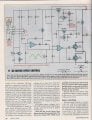
Hi iONic, Here in Australia a Kit is avalable from oatleyelectronics.com K275 for only $24 non rev model or $39 for rev model & is complete with PCB. Fairly cheep i thaught. Pic of the PWM part of the project. (Growler is a device you put the armature on & check for shorted windings, Hipot is test for leakage from windings to ground)
 

Attachments

tom66

Joined May 9, 2009
2,595
That circuit is one of the most overcomplicated I have seen.

For example, why is a voltage regulator being used to supply 8V to the PWM circuit? Why is another being used to supply 15V to the op-amps?

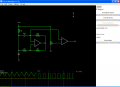
See attached circuit for a PWM modulator. This one doesn't do VFD, just straight PWM. It has 8 components, plus the potentiometer input for the accelerator. You can still use the relays to add reversing in if you want.

The 18nF cap sets the frequency. A lower value cap gives a higher frequency and vice versa.

It's slightly nonlinear. This will probably not be an issue. Speed tends to curve off near the top. Some resistors in-line with the potentiometer could help trim it so maximum accelerator is higher on the scale. At the moment it is around 2/3rd scale.

For a MOSFET, what current does the motor require?

If you want, I can design a PCB for you and you can get three PCBs made with DorkbotPDX for about $15.

Rich (BB code):
$ 1 5.0E-6 4.43302224444953 61 10.0 50
a 256 288 384 288 0 10.5 0.0 1000000.0
w 256 272 256 224 0
r 256 224 384 224 0 100000.0
w 384 224 384 288 0
w 384 288 384 352 0
r 384 352 256 352 0 1000000.0
w 256 304 256 352 0
r 256 352 160 352 0 1000000.0
c 256 224 160 224 0 1.5000000000000002E-8 0.14958813590343034
r 160 224 160 144 0 3300.0
g 160 416 160 432 0
R 160 144 160 112 0 0 40.0 12.0 0.0 0.0 0.5
w 160 336 160 352 0
w 160 240 160 224 0
w 320 176 256 176 0
w 256 176 256 224 0
z 160 416 160 352 1 0.805904783 5.6
w 160 240 160 336 0
a 496 272 608 272 1 12.0 0.0 1000000.0
174 432 240 464 336 0 5000.0 0.7475 Acceleration
w 496 288 464 288 0
w 496 256 496 176 0
w 496 176 320 176 0
w 160 144 432 144 0
w 432 144 432 240 0
g 432 336 432 352 0
w 608 272 640 272 0
o 15 16 0 43 10.0 9.765625E-5 0 -1
o 26 16 0 35 20.0 9.765625E-5 1 -1
Click here to simulate: http://falstad.com/circuit/#%24+1+5.0E-6+4.43302224444953+61+10.0+50%0Aa+256+288+384+288+0+10.5+0.0+1000000.0%0Aw+256+272+256+224+0%0Ar+256+224+384+224+0+100000.0%0Aw+384+224+384+288+0%0Aw+384+288+384+352+0%0Ar+384+352+256+352+0+1000000.0%0Aw+256+304+256+352+0%0Ar+256+352+160+352+0+1000000.0%0Ac+256+224+160+224+0+1.5000000000000002E-8+0.197458177262404%0Ar+160+224+160+144+0+3300.0%0Ag+160+416+160+432+0%0AR+160+144+160+112+0+0+40.0+12.0+0.0+0.0+0.5%0Aw+160+336+160+352+0%0Aw+160+240+160+224+0%0Aw+320+176+256+176+0%0Aw+256+176+256+224+0%0Az+160+416+160+352+1+0.805904783+5.6%0Aw+160+240+160+336+0%0Aa+496+272+608+272+1+12.0+0.0+1000000.0%0A174+432+240+464+336+0+5000.0+0.7475+Acceleration%0Aw+496+288+464+288+0%0Aw+496+256+496+176+0%0Aw+496+176+320+176+0%0Aw+160+144+432+144+0%0Aw+432+144+432+240+0%0Ag+432+336+432+352+0%0Aw+608+272+640+272+0%0Ao+15+16+0+43+10.0+9.765625E-5+0+-1%0Ao+26+16+0+35+20.0+9.765625E-5+1+-1%0A
 

Attachments

Last edited:

Thread Starter

iONic

Joined Nov 16, 2007
1,662
@Tom66,
At this point I am going with the following Motor Driver: 24v23 CS by Pololu
I just need the controlling circuitry...PWM, Current overload protection...etc. My friend was working on a PIC/LCD interface that would not only perform the necessary controls, but display Speed, Operating Current, and Batt. Voltage. The circuit you provided on the falstad.com site seems to offer only the PWM circuit. I also will need to add some sort of reverse voltage circuitry.

The motor is rated at 15A and the fuse @ 25A. The Motor Driver is rated at 23A without Heat-sink although I may opt to add a small 5V or 12V cooling fan. I could also add a heat-sink to the top of the 4 OptiMOS MOSFET's. That would probably be a bit more efficient. I'm not ruling you out as far as the circuit boards, though. The price seems right. And I thank you for the offer.

Medicare is not apt to authorize me for another scooter, especially since Obama has sold us out by allowing cuts. So the scooter I have really has to get going as I am limited inside my home, but am virtually unable to do anything outside my home.
 

PackratKing

Joined Jul 13, 2008
847
Debe covered the growler / hi-pot issues, so if the motor ran ok before the control went south...........
The solid states should have died first almost instantly with the polarity snafu, so unless the brush leads or any related parts were smoking or excessively hot as well........you should be fine...........Hope you get the beast going again.
 

tom66

Joined May 9, 2009
2,595
@Tom66,
At this point I am going with the following Motor Driver: 24v23 CS by Pololu
I just need the controlling circuitry...PWM, Current overload protection...etc. My friend was working on a PIC/LCD interface that would not only perform the necessary controls, but display Speed, Operating Current, and Batt. Voltage. The circuit you provided on the falstad.com site seems to offer only the PWM circuit. I also will need to add some sort of reverse voltage circuitry.

The motor is rated at 15A and the fuse @ 25A. The Motor Driver is rated at 23A without Heat-sink although I may opt to add a small 5V or 12V cooling fan. I could also add a heat-sink to the top of the 4 OptiMOS MOSFET's. That would probably be a bit more efficient. I'm not ruling you out as far as the circuit boards, though. The price seems right. And I thank you for the offer.

Medicare is not apt to authorize me for another scooter, especially since Obama has sold us out by allowing cuts. So the scooter I have really has to get going as I am limited inside my home, but am virtually unable to do anything outside my home.
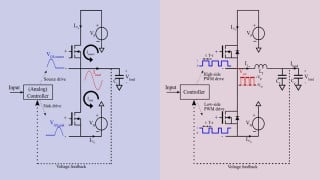
I can think of how to add reversing relatively easily using a simple change-over switch. A H-bridge has S1 and S4 for forwards switched on, and S3 and S2 for backwards: the PWM is delivered to either one so a simple SPDT could do the job. What kind of switch do you have on the scooter at present for reversing?

As for current overload protection a fuse is the simplest, and probably best solution. You could also get a thermal fuse and secure it onto the MOSFETs or motor so that it shuts down on overload. Or you could use a temp sensor and modify the circuit to clamp the PWM on overload. But think about it: how will an overload happen? Is the motor prone to stalling e.g. during hill climbs? If so, a simple analog ammeter mounted in a convenient place (I can buy a 30A one for about $10 on eBay) could tell you if you are overloading something and that slowing down might be a good idea.

For battery voltage - a digital multimeter can be picked up for $2 in many places in the US and a dedicated panel meter (smaller and integrates a backlight) can be found for $4.

I share your sentiment about politicians as the Conservatives in the UK have done a lot of the same to us, especially wrt university funding. I don't like any of the other parties much though either.

If you want a PCB done, let me know what parts you have on hand or can order, and I can put one together. I'll use through hole stuff which shouldn't be difficult to solder. With DorkboxPDX you get three copies of your board for ~$15 (possibly less, depends if it's smaller), so don't worry about messing one up.

But seriously, $63 for that motor controller? Maybe $5 for four good MOSFETs and a nice heatsink (or you could take a heatsink from a dead computer power supply or similar.) It would be easier to use one MOSFET (so only one cheap gate driver) and a good 30A automotive relay to change over the motor contacts.
 
Last edited:

Thread Starter

iONic

Joined Nov 16, 2007
1,662
I can think of how to add reversing relatively easily using a simple change-over switch. A H-bridge has S1 and S4 for forwards switched on, and S3 and S2 for backwards: the PWM is delivered to either one so a simple SPDT could do the job. What kind of switch do you have on the scooter at present for reversing?
The motor driver I have not has the ability for Forward and reverse either via a Pot or Hall-Efects sensor. I would not need a switch to enable switching. Did not need this with the old controller as it used a center held pot.

As for current overload protection a fuse is the simplest, and probably best solution. You could also get a thermal fuse and secure it onto the MOSFETs or motor so that it shuts down on overload. Or you could use a temp sensor and modify the circuit to clamp the PWM on overload. But think about it: how will an overload happen? Is the motor prone to stalling e.g. during hill climbs? If so, a simple analog ammeter mounted in a convenient place (I can buy a 30A one for about $10 on eBay) could tell you if you are overloading something and that slowing down might be a good idea.
The scooter doesn't stall, it only goes slower on hills. The overload protection
can occur when attempting to climb a small step or curb, or even when pressed against a wall.

For battery voltage - a digital multimeter can be picked up for $2 in many places in the US and a dedicated panel meter (smaller and integrates a backlight) can be found for $4.

I share your sentiment about politicians as the Conservatives in the UK have done a lot of the same to us, especially wrt university funding. I don't like any of the other parties much though either.

If you want a PCB done, let me know what parts you have on hand or can order, and I can put one together. I'll use through hole stuff which shouldn't be difficult to solder. With DorkboxPDX you get three copies of your board for ~$15 (possibly less, depends if it's smaller), so don't worry about messing one up.

But seriously, $63 for that motor controller? Maybe $5 for four good MOSFETs and a nice heatsink (or you could take a heatsink from a dead computer power supply or similar.) It would be easier to use one MOSFET (so only one cheap gate driver) and a good 30A automotive relay to change over the motor contacts.
My friend thinks that the previous circuit he build was blowing MOSFET's possible because he did not program in "dead-time" into the PWM routine so as to insure that one MOSFET was off before the other one started. That's his theory anyway.
 

tom66

Joined May 9, 2009
2,595
The motor driver I have not has the ability for Forward and reverse either via a Pot or Hall-Efects sensor. I would not need a switch to enable switching. Did not need this with the old controller as it used a center held pot.
Such a control will be difficult to emulate, but it is possible. Would you truly need this kind of control? Could you adapt to just having a switch for forward and reverse? Otherwise the circuit becomes far more complex.

The scooter doesn't stall, it only goes slower on hills. The overload protection
can occur when attempting to climb a small step or curb, or even when pressed against a wall.
So you want a trip-reset over-current protection circuit? That's not difficult either, a temperature sensor can do that if you mount it on some component that gets hot under load (MOSFET, motor, or a power resistor.)

My friend thinks that the previous circuit he build was blowing MOSFET's possible because he did not program in "dead-time" into the PWM routine so as to insure that one MOSFET was off before the other one started. That's his theory anyway.
Sounds possible, although simulataneous switching usually doesn't blow the MOSFETs straight away, it just tends to get them hot and reduce the efficiency of the circuit.
 

Thread Starter

iONic

Joined Nov 16, 2007
1,662
@TOM66,
Did you take a good look at the motor driver board I plan to use?
High-Power Motor Driver 24v23 CS
This has the MOSFET Driver IC and Current Sense IC built on the board. This is ideal for interfacing with a uC. Programming the variable PWM and monitoring the current, displaying other info are a snap with the uC. Not for me as I don't have the program knowledge, but they are somewhat basic for someone who does.
 

tom66

Joined May 9, 2009
2,595
@TOM66,
Did you take a good look at the motor driver board I plan to use?
High-Power Motor Driver 24v23 CS
This has the MOSFET Driver IC and Current Sense IC built on the board. This is ideal for interfacing with a uC. Programming the variable PWM and monitoring the current, displaying other info are a snap with the uC. Not for me as I don't have the program knowledge, but they are somewhat basic for someone who does.
Yeah, but for 63 bucks...

It's not particularly easy to do what you want in a short amount of time, developing software for MCUs is tricky. That's kinda why I like analog (I use MCUs only when I have to.) But I digress.
 

Thread Starter

iONic

Joined Nov 16, 2007
1,662
Yeah, but for 63 bucks...

It's not particularly easy to do what you want in a short amount of time, developing software for MCUs is tricky. That's kinda why I like analog (I use MCUs only when I have to.) But I digress.
An analog solution would still have to interface with the Motor driver board. I does need to operate as a PWM variable speed controller and preferably forwards and backwards without a SPDT switch. Current sense and protection is also a must. An LCD readout is not necessary. Pulse freq. must be a minimum of 30KHz.
 

tom66

Joined May 9, 2009
2,595
An analog solution would still have to interface with the Motor driver board. I does need to operate as a PWM variable speed controller and preferably forwards and backwards without a SPDT switch. Current sense and protection is also a must. An LCD readout is not necessary. Pulse freq. must be a minimum of 30KHz.
Okay, I'll have a look. I think I have some way of doing what you want... but it is much more complicated.

Are you are certain you want to use that motor board and not a single low-side MOSFET (<$2) with two relays for reversing ($2 ea.)? I'm making an order with my favourite electronics supplier shortly, I can order two relays for you. The relays are rated at 30A and are designed for automotive uses. They are SPDT. It would make my solution simpler.
 

Thread Starter

iONic

Joined Nov 16, 2007
1,662
Okay, I'll have a look. I think I have some way of doing what you want... but it is much more complicated.

Are you are certain you want to use that motor board and not a single low-side MOSFET (<$2) with two relays for reversing ($2 ea.)? I'm making an order with my favourite electronics supplier shortly, I can order two relays for you. The relays are rated at 30A and are designed for automotive uses. They are SPDT. It would make my solution simpler.

I have been under the assumption that an H-Bridge setup was the best solution for a motor controller with forward and reverse. You are saying, I think, that you can do the forward and reverse, variable speed, with a couple of relays, a SPDT switch and a single MOSFET.

Since I am looking for the quickest solution (lord know it hasn't been quick thus far...my fault) and you are offering your services to me I am inclined to
let you do as you wish.

Absolutes:
It does need to operate as a PWM variable speed controller
Pulse Freq. should be between 30kHz - 50kHz
Current sense and protection is also a must.
MOSFET should have a min of 60A rating, to reduce the size of the heatsink.

Ideally: Forward and reverse without switching.

I can save the other Motor Driver for another project or one day have my friend setup the PIC interface.

I'll honor your parts purchase one way or another. Post a circuit when you get the chance...

Thanks
 

tom66

Joined May 9, 2009
2,595
I have been under the assumption that an H-Bridge setup was the best solution for a motor controller with forward and reverse. You are saying, I think, that you can do the forward and reverse, variable speed, with a couple of relays, a SPDT switch and a single MOSFET.

Since I am looking for the quickest solution (lord know it hasn't been quick thus far...my fault) and you are offering your services to me I am inclined to
let you do as you wish.

Absolutes:
It does need to operate as a PWM variable speed controller
Pulse Freq. should be between 30kHz - 50kHz
Current sense and protection is also a must.
MOSFET should have a min of 60A rating, to reduce the size of the heatsink.

Ideally: Forward and reverse without switching.

I can save the other Motor Driver for another project or one day have my friend setup the PIC interface.

I'll honor your parts purchase one way or another. Post a circuit when you get the chance...

Thanks
Actually, you might not even need to use an SPDT switch. I've figured out how to put forward and reverse on the same control; now to figure out how to select forward and reverse.

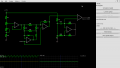
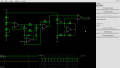
The circuit uses two LM324 op-amps (7/8 used.) The PWM uses 2, the input circuit use 3 and the reverse/forward selection uses 2 (reverse/forward selection is not shown.)

With this motor driver, reverse can go at about 60% full power, forward is 100%. The 5.8V - 6.2V variable voltage lets you tune this precisely (at 6V they are even), but the board will probably use a 5.6V zener so maximum reverse will be around 50% full power... I trust this will not be an issue?

Note it oscillates at 700 Hz but should be fine at 30 kHz, I just needed a quick simulation.

Confirm to me this: what supply voltage does the motor board have available? 12V or 24V?
 

Attachments

Thread Starter

iONic

Joined Nov 16, 2007
1,662
Actually, you might not even need to use an SPDT switch. I've figured out how to put forward and reverse on the same control; now to figure out how to select forward and reverse.
In electronics, isn't "select" synomous with switch?

50% for reverse is fine.
 

tom66

Joined May 9, 2009
2,595
In electronics, isn't "select" synomous with switch?

50% for reverse is fine.
No; the selection is done by comparing which position the accelerator is in. There isn't a switch per se, just a few comparators. A circuit needs to be developed which controls which relay combination is switched in, but I think I have a good idea how to work it. (During the dead band between forward and reverse, both relays are off, to prevent the motor briefly shooting forwards when going into reverse speed.)

I was originally considering these relays, but they have a lead time of 2 months. These are immediately available in stock. 25A contact rating. Mouser are in the US too, so you could probably buy them, or I could send some to you.

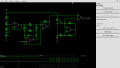
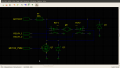
A diagram of how the motor control works is attached.

You will also need a power MOSFET and one or two power diodes (undecided as of yet but both 40A rated), you can probably get these yourself or I can send some to you with the relays. Both should be on a heatsink, although they could be mounted down it wouldn't be particularly good.

What battery voltage does the scooter have?
 

Attachments

tom66

Joined May 9, 2009
2,595
This MOSFET: http://uk.mouser.com/ProductDetail/NXP-Semiconductors/PSMN2R8-40PS127/?qs=sGAEpiMZZMvECErq9cesgJ6%2fixFOW%2fnLazbCm4yNzMo%3d

With two of these diodes: http://uk.mouser.com/ProductDetail/...EpiMZZMtvcUztdGSumGdBfMxMH%2bQtb%2bjJH3aoIuM=

I'm not sure that we will need two diodes but it might be prudent to include them - no harm done without them.

Can you get these in US or do you need me to send you some?

Also can you get a good heatsink for these? Try ripping one out of an old power supply. I might have one available but it's slightly charred from when the PSU went pop (both MOSFETs decided to simultaneously explode.) You will also need some thermal compound and some mica insulators.
 

tom66

Joined May 9, 2009
2,595
I have 3 of the following relays. Tyco Electronics 0-1432795-1 They are a blade type mount, but I had dremmel'd similar ones down to fit the existing PCB(aprox. 1/8' hole.) I believe I also have some MOSFET's already.

For starters:
MBR40250G, 40A, 250V Schottky Diode

RFP50N06 50A, 60V, .022 Ohm

I also have LM324's

The Scooter supply is 24V, thus the need for 24V Relays.
Okay, would it be possible to mount the relays away from the control board and just solder wires to the right positions on the PCB and relay? It would make the PCB smaller (=cheaper).

Are there mount holes for the PCB which need to be in specific positions?

I would advise you to choose a lower Vbreakdown diode, as it will dissipate less heat because of a lower Vf.

Also, do you have a source for 7812 or 7815 linear regs?
 
Top