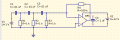
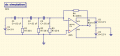
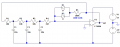
The connection from the non-inverting input to power common should be a resistor similar to the value of the feedback resistor. Also, verify that both of the supply voltages are actually present on the op amp pins.
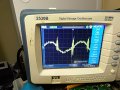
Your circuit is a differentiator, so any crossover distortion in the incoming signal will be amplified with higher gain than the sine wave. That may be part of the trouble. A problem with this particular circuit -there is nothing to limit the gain at high frequencies - is that loop gain, and hence "fidelity" decreases as frequency increases.
Edit: Here, the cross-over distortion includes the cross-over of the LM741 in addition to any cross-over distortion in the incoming signal because at very high frequencies such as those present in cross-over distortion the circuit will have very high voltage gain -the feedback path being shunted by the series of input capacitors and the source resistance of the signal generator..
If you just want to make a three pole high pass filter, drive your amplifier as a non-inverting amplifier.
Cross-over distortion will still be accentuated but there should be less ringing at the zero crossings.
Another solution is to limit the high frequency gain by placing a resistor between the inverting input and the incoming signal (C3-R3), but changing to a noninverting configuration will probably give much better results. It all depends on what function you want to have -a high pass filter or a differentiator.
You may improve a couple different aspects of circuit performance by moving the resisitor on the inverting input from ground to become in series with the feedback through that last capacitor. That way you avoid high frequency peaking and you will get the 60 degree phase shift in eack RC stage. Your DC offset will also improve a lot.
Maybe you could try the low pass version of this kind of circuit instead of the high pass version which is what you have now.
However, if i remember right the root locus of this kind of oscillator is similar to other oscillators in that the gain (usually referred to as K) has to be EXACTLY set to some value, where that value is exactly the same as the attenuation of the RC stages. The require gain is very easy to calculate, however, there is no way to set it to a value that exactly matches the RC stages attenuation. Even with a pot once you set it, it drifts off again.
The problem with the gain is that too low and it wont oscillate for long, and too high and it causes complete output saturation. The usual fix is to introduce some non linear gain such as with diodes.
What you might be able to do is try setting the gain so that the output saturates just very little, and that will effectively act as the non linear element, as long as it doesnt cause DC offset.
What you might have to do is add diodes to cut back the gain as the signal level increases. If the gain is adjusted close, this non linear clipping is very very minimal and after all it's the way it is usually done.
If i can get a chance today i will run a root locus on this oscillator and we can see how bad it gets or how good we can get it. In the mean time you might want to look into the low pass version of this thing as that will be less noisy.
For lower distortion, take the output at C3 with a non-inverting buffer opamp.
That's the lowest distortion point in the circuit since it's after the signal has passed through a 3-pole LP filter.

 Facebook
 Google
 GitHub
 Linkedin