A confusion with graphs

Thread Starter

AlwaysNumber1

Joined Dec 4, 2016
52
Hi everyone !

I am studying transistors right now and when looking at graphs of their behavior I am confused...
Why are similar regions are called with different names ?
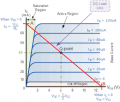
images.png Unknown.png
 

JUNELER

Joined Jul 13, 2015
183
Hi,
Since you already a member of the forum ,you need to read the education chapter and locate
about the transistor theory. This will explain to you in a detailed manner.

Your question can be answer in a wide range.
 

Thread Starter

AlwaysNumber1

Joined Dec 4, 2016
52
Hi,
Since you already a member of the forum ,you need to read the education chapter and locate
about the transistor theory. This will explain to you in a detailed manner.

Your question can be answer in a wide range.
Hi
I do read it, but I prefer answers from real people, as I can ask questions straight afterwords
 

Jony130

Joined Feb 17, 2009
5,598
And LvW put it very nicely.
"
Perhaps it helps to give some explanation to the term "saturation". Yes - there are two different meanings of the term "saturation" - dependent on the transistor type: BJT or FET. In this context, we should answer the question: Where is this term coming from - that means: Which quantity is "saturated?

1.) BJT (with collector resistor): Increasing Vbe (or Ib) leads to rising collector current Ic, which causes a continuous decrease of the collector-emitter voltage Vce - until a lower limit is reached at app. (0.4...0.6)volts. A further increase in input voltage/current does not cause a further increase of Ic. Thus, Vce has reached it´s lower limit and cannot become smaller. We say: The voltage Vce has reached the state of "saturation"(and - at the same - time the current Ic cannot assume larger values).

2.) In contrast to this effect, for FET´s and MOSFET's the term "saturation" means something else. For small drain-source voltages Vds we have approximately a linear relationship between Vce and the current Id (for a fixed control voltage Vgs). This region is called "linear region" or "resistor region". However, for further increasing the voltage Vds beyond a certain threshold (pinch-off) the current Id does not increase anymore (in fact, a slight increase due to channel width modulation can be observed). That means: The current Id has reached the state of "saturation".

Summary: It is an unfortunate situation that two different meanings of the term "saturation" are in use (for BJTs and for FETs), but - due to historical reasons - we have to be aware of these two different definitions".
 

Thread Starter

AlwaysNumber1

Joined Dec 4, 2016
52
And LvW put it very nicely.
"
Perhaps it helps to give some explanation to the term "saturation". Yes - there are two different meanings of the term "saturation" - dependent on the transistor type: BJT or FET. In this context, we should answer the question: Where is this term coming from - that means: Which quantity is "saturated?

1.) BJT (with collector resistor): Increasing Vbe (or Ib) leads to rising collector current Ic, which causes a continuous decrease of the collector-emitter voltage Vce - until a lower limit is reached at app. (0.4...0.6)volts. A further increase in input voltage/current does not cause a further increase of Ic. Thus, Vce has reached it´s lower limit and cannot become smaller. We say: The voltage Vce has reached the state of "saturation"(and - at the same - time the current Ic cannot assume larger values).

2.) In contrast to this effect, for FET´s and MOSFET's the term "saturation" means something else. For small drain-source voltages Vds we have approximately a linear relationship between Vce and the current Id (for a fixed control voltage Vgs). This region is called "linear region" or "resistor region". However, for further increasing the voltage Vds beyond a certain threshold (pinch-off) the current Id does not increase anymore (in fact, a slight increase due to channel width modulation can be observed). That means: The current Id has reached the state of "saturation".

Summary: It is an unfortunate situation that two different meanings of the term "saturation" are in use (for BJTs and for FETs), but - due to historical reasons - we have to be aware of these two different definitions".
But if we call the point, where the increase stops happening, saturation in BJT, why is the whole region before to called the saturation, if there the increase still happens ?
 

Jony130

Joined Feb 17, 2009
5,598
Because the saturation voltage ( Vce(sat) ) is not constant and it will depend on base current and the load resistance. The large the collector current the large the saturation voltage.
 

Thread Starter

AlwaysNumber1

Joined Dec 4, 2016
52
Because the saturation voltage ( Vce(sat) ) is not constant and it will depend on base current and the load resistance. The large the collector current the large the saturation voltage.
Okay, the saturation region is the whole set of those points up to a certain limit ?
 
Top