A circuit that closes twice in small intervals when powered on and then stays open

danadak

Joined Mar 10, 2018
4,057
But don't flash memories store information the same way -- using the floating gate capacitance?
Depends how you define "behind us".
My understanding is that flash drives are only good up to about 10 years of reliable storage.
That may be sufficient for most electronics, but not all. :rolleyes:
Its complicated, Typically EE is limited to 1M read/write cycles. Flash to 100K.

But then there is lifetime of a cell due to static leakage, ability to hold a charge.
Typical in industry datasheets is 10 years. Thats a conservative value based on
characterization data, which is heavily guard banded. Of course elevated T aggravates
this, where the data is acquired at.

Then you have metal migration that limits all components, as well as crystal
damage due to high energy particles that all earth objects endure. And then there are
package issues, all components, that components have to endure. Also stuff
like bulk caps experience over time.

I think you can find, for FLASH, in NASA papers some work where wear leveling techniques
were applied to code stores to refresh charge in cells, but thats above my pay grade.

Short answer is the universe constantly increases its entropy.


Regards, Dana.
 

MisterBill2

Joined Jan 23, 2018
28,517
When I made the remark about fragile toy micros it was referencing to the hardware, including the larger number of connectors. I was not talking especially about the cheaper electrolytic caps, or the other cheap parts, but about the boards in general and that everything seems to be an add-on. Now as for flexibility, mostly a circuit is picked to provide a specific function and that function only. "Feature Creep" is usually the enemy of reliability and stability, at least in the instances that I see.
Now the whole thread does seem to have wandered away, and includes comments about tubes in audio amps. Instrument amplifiers, especially guitar amplifiers, were never intended to be "Hi Fi" devices, but instead they are part of the instrument. So there are thousands of add-on devices to produce some particular "sound" that a musician wants to have. And tubes do often have kinds of non-linear distortion that are much harder to produce with semiconductors.
 

AnalogKid

Joined Aug 1, 2013
12,290
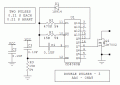
Back to the thread, here is a version based on a CD4060 oscillator/counter. Wally referred to this in post #3. One R-C time constant sets both the pulse widths and their separation. 25 soldered pins.

Note that there is a 0.21 s delay before the start of the first output pulse.

ak
Double-Pulses-3-c.gif
 
Last edited:
Top