A 2 electrode chemiresistive sensor using baking cups

Thread Starter

Tammy507

Joined Dec 5, 2016
6
I am no electronics student. So pardon me if i asking a lame question.

For a science fair project, I am trying to build a simple two electrode sensor with a chemiresistive film connecting the electrodes which will absorb volatile organic compounds in the human breath.

The goal is to measure resistance change before and after exhaling breath on different subjects and draw a conclusion.

To make chemiresistive film, we will using carbon and tetracosane hydrocarbon powder and bake in the 100 c baking oven for 30 seconds to make a thin film connecting the electrodes.

Also we will need to make lot of sensors (atleast 100) for testing on different subjects.

So we got this weird idea to use baking cups instead of PCB to perform our test. So the idea is we poke two parallel copper wires into a baking cups (non-conductive and can withstand 100c for 30 seconds and cheap) with 2 electrodes 3 mm apart and make chemiresistive film about 10mm x 6 mm joining those electrodes and connect multimeter to the ends of the copper wire and measure resistance before and after blowing air on to it.

I am planning to put the sensor under bottom opening 125 ml bottle and blow air from mouth using a straw using the top opening.

The bottom of the bottle are going to have 2 holes for the 2 copper electrodes so i can connect digital multimeter to both ends to check resistance change while blowing air.

This way i can prepare multiple home based sensors for my high school science fair project.

Please let me know if this would work as an alternative to a PCB.
 

wayneh

Joined Sep 9, 2010
18,087
Please let me know if this would work as an alternative to a PCB.
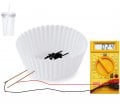
Can you provide a drawing? I'm having trouble picturing this.

But, if you think you can solve the mechanical issues, the silicone cup should be fine. There's nothing special about a PCB. It's just a slab for holding the circuit components. Strong, low conductivity, cheap.

Do you have any idea what resistance ranges you will be measuring? You may need a better-than-cheapo meter to reliably measure above 100,000Ω.
 

jpanhalt

Joined Jan 18, 2008
11,087
Hi Tammy,

1) I would not be discouraged about your approach using paper baking cups. It is a nice twist.

2) I am more concerned about the matrix you propose. Tetracosane (C24) is basically a wax. That is, it repels water and polar molecules. Ask yourself, what common molecules in breath will increase conductivity? They are volatile and polar, like water, alcohol (usually from drinking), carbon dioxide, acetone ( diabetes), aldehydes (none or very low concentrations, different conditions or drugs), and many minor chemicals. They may not penetrate the tetracosane at all to affect the carbon. Most, but not all, salts are non-volatile and will not be in your exhaled air. I would suggest as a first try a more polar matrix. Some chemicals to consider: dextran (soluble in water), sugars (soluble in water), nitrocellulose (organic solvent, used in some adhesives), lacquers (similar to cellulose), or even a water-based polyurethane or epoxy. That list is not exhaustive. With a polar matrix, you might add small amounts of a salt (i.e., dope it). Some salts to consider that don't smell too bad are quaternary ammonium chlorides as are used in many household disinfectants or even some ordinary detergents. Of the things in expelled air most likely to affect resistance, water vapor is probably the most important.

3) Will it work? Can't say, but that is what experimentation is all about. You may need a very large amount of carbon to get something that is conductive enough for you to measure. If carbon doesn't work, consider a fine metal powder like is used in some silver paints or a so-called conductive paints. In fact, a conductive paint may be all you need to use with your electrodes at both ends. If you still want to use a coating, you could paint the cup bottom, then put a second layer of dextran or whatever over it. Your coating, if water based, might work better, if it is left just a little wet (sticky).

4) For electrical connection to your sensor, I would suggest two strips of a metal (copper or brass) in the bottom of the cup to which you solder the wires. The larger contact area of the strip will help. And the strip will be mechanically stronger.

Good luck and let us know how it progresses.

John
 
Last edited:

marcf

Joined Dec 29, 2014
299
I suppose it would also be possible to use a cheap dvm ($5.00) at harbor freight. My Fluke 87 is really just a 20Meg Resistor on the "volts" range. With a known voltage (say 20volts), a reading of 10 Volts would indicate a resistance of 10M from the sensing device.

I do not know, but I suspect that the 'ohms per volt' on such a meter is fairly well stable and would be easy to confirm with appropriate resistors and voltage source.
 

jpanhalt

Joined Jan 18, 2008
11,087
Edit to post #4
Decided to make a separate post so you would read it.

Don't be surprised if some of the exhaled air, say one with alcohol, increased the resistance compared to one without alcohol. I am not suggesting that HS students be the subjects for that. Maybe a parent or local bar will cooperate. Oh, be sure to record the room temperature when making your measurements.

John
 

Thread Starter

Tammy507

Joined Dec 5, 2016
6
Thanks John for your detailed reply.

My Science Fair project is to make a home based low cost lung cancer sensor.

The project is based on a research article which identified unique lung cancer clinical markers in human breath.Some of the unique biomarkers identified include benzene and toluene .Then i researched on the biomarkers. Most of these biomarkers are soluble in alcohol, diethyl ether, acetone, acetic acid but they don’t operate at room temperature and require special lab procedures. So I tried to research on higher alkanes that are solids and can operate at room temperature.

The following article on Wikipedia helped me research to evaluate the alkanes selection
https://en.wikipedia.org/wiki/Higher_alkanes

Also, my chemi-resistive film sensor should only absorb the biomarkers identified for lung cancer and my results should differentiate from other types of respiratory and other types of cancers. I chose tetracosane because it is very soluble in benzene, toluene. It is not soluble in water. Since human breath contains water vapor, i didn't want resistance increase from the water vapor of breath except through those unique clinical markers identified for lung cancer. I chose tetracosane as it has a higher melting point from the table above room temperature.

Since Tetracosane is also soluble in alcohol , my requirement for the test is that subject hasn't had alcohol at least 48 hours before the test.

As for the film, i am planning to make tetracosane film first and on the top put carbon film for conductivity.

I am planning to use 20 gauge copper wires as electrodes.

I haven't bought a multimeter yet but i am planning to buy one that measures resistance up to 10000 ohms.

The feedback from the forum has been great. I feel confident that i am going in the right direction. Please let me know if there are any other suggestions

Hi Tammy,

1) I would not be discouraged about your approach using paper baking cups. It is a nice twist.

2) I am more concerned about the matrix you propose. Tetracosane (C24) is basically a wax. That is, it repels water and polar molecules. Ask yourself, what common molecules in breath will increase conductivity? They are volatile and polar, like water, alcohol (usually from drinking), carbon dioxide, acetone ( diabetes), aldehydes (none or very low concentrations, different conditions or drugs), and many minor chemicals. They may not penetrate the tetracosane at all to affect the carbon. Most, but not all, salts are non-volatile and will not be in your exhaled air. I would suggest as a first try a more polar matrix. Some chemicals to consider: dextran (soluble in water), sugars (soluble in water), nitrocellulose (organic solvent, used in some adhesives), lacquers (similar to cellulose), or even a water-based polyurethane or epoxy. That list is not exhaustive. With a polar matrix, you might add small amounts of a salt (i.e., dope it). Some salts to consider that don't smell too bad are quaternary ammonium chlorides as are used in many household disinfectants or even some ordinary detergents. Of the things in expelled air most likely to affect resistance, water vapor is probably the most important.

3) Will it work? Can't say, but that is what experimentation is all about. You may need a very large amount of carbon to get something that is conductive enough for you to measure. If carbon doesn't work, consider a fine metal powder like is used in some silver paints or a so-called conductive paints. In fact, a conductive paint may be all you need to use with your electrodes at both ends. If you still want to use a coating, you could paint the cup bottom, then put a second layer of dextran or whatever over it. Your coating, if water based, might work better, if it is left just a little wet (sticky).

4) For electrical connection to your sensor, I would suggest two strips of a metal (copper or brass) in the bottom of the cup to which you solder the wires. The larger contact area of the strip will help. And the strip will be mechanically stronger.

Good luck and let us know how it progresses.

John
 

Thread Starter

Tammy507

Joined Dec 5, 2016
6
To maintain accuracy , I plan to use same size electrodes and same qty of tetracosane and carbon powder for all my sensors.

Since i need one sensor for each subject, i don't plan on soldering anything but connect directly connect to copper wire and the banana plugs
 

Thread Starter

Tammy507

Joined Dec 5, 2016
6
Can you provide a drawing? I'm having trouble picturing this.

But, if you think you can solve the mechanical issues, the silicone cup should be fine. There's nothing special about a PCB. It's just a slab for holding the circuit components. Strong, low conductivity, cheap.

Do you have any idea what resistance ranges you will be measuring? You may need a better-than-cheapo meter to reliably measure above 100,000Ω.
bakingcup.jpg
 

wayneh

Joined Sep 9, 2010
18,087
The cheap meter might not be able to work in the range you need. Or it might be fine. You have nothing to lose if you can get one free with a coupon, but be prepared for its limitations. Your science teachers may have a better one to try.
 

Thread Starter

Tammy507

Joined Dec 5, 2016
6
The cheap meter might not be able to work in the range you need. Or it might be fine. You have nothing to lose if you can get one free with a coupon, but be prepared for its limitations. Your science teachers may have a better one to try.
Thanks for the suggestion. Do you have any recommendation?
 

jpanhalt

Joined Jan 18, 2008
11,087
Hi Tammy,

Let's assume you just want to detect benzene or toluene vapor in a mixture with humid air. I agree with your theory that tetracosane would be permeable to those two compounds.

My concerns are:
1) The resistance may be too high for you to measure reliably and detect a difference.
2) Benzene and toluene may not affect the resistance since they are also hydrocarbons and quite poor conductors (in the absence of other compounds).
3) Aside from softening the wax and allowing the carbon particles to get closer together, I don't see a good mechanism for them to affect the resistance. And, softening the wax may require much higher concentrations than are expected.

I think you need to try it to see what happens -- perhaps create a standard test gas with a uL or two of toluene in a few liters of air. Then, if that approach doesn't seem encouraging, let me suggest that you revise your strategy to detect the pi-electron structures of those two aromatic compounds.

1) Aromatic compounds can form pi-complexes with a large number of agents. In fact, early studies of organic conductors/semiconductors were based on such complexes, e.g., with chloranil (tetracyanoquinone), iron, and numerous other "pi-acceptors." We don't know how much access you have to such chemicals, so I will suggest a very simple one to start with: iodine.

Iodine vapor forms complexes with aromatic compounds and any unsaturated hydrocarbon. It may stick a little to tetracosane, but its binding to pure alkanes is very weak. You can detect that binding with a UV lamp, as the bound iodine quenches (darkens) fluorescence. That method has been used to detect such compounds on thin-layer chromatography plates for many decades. If there is not enough background fluorescence in your tetracosane (i.e., from impurities) you can add a little bit of some fluorescent compound. I would recommend using an inorganic compound.

2) Will the iodine complex cause a change in conductivity? I don't know. It might, but you may still be limited by what you are able to measure.

3) Iodine and other pi-acceptor complexes can be detected by color or fluorescence. If you search on colored complexes with aromatic compounds, you will find a lot of examples. In theory, you could dissolve your detector chemical (pi-electron acceptor) in tetracosane, coat the cups, then expose to vapor and see what change, if any, occurs. Generally speaking, fluorescence is far more sensitive than color. You may still be limited by the ability to quantitatively measure the amount of aromatic hydrocarbon in the air.

Regards, John
 

wayneh

Joined Sep 9, 2010
18,087
I agree this is a big challenge and I'm skeptical you can detect tiny amounts of the relevant molecules this way.

You're building an electronic nose to detect something it might be hard for a real nose to accomplish. Not easy.
 

marcf

Joined Dec 29, 2014
299
Are the components in your sensor 'polar' ?. If so, you may want to consider AC rather than DC excitation to avoid creating an unintentional voltage source created by the sensor itself.
 
Top