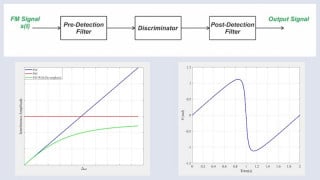
Do we know anything about the input frequency rate of change within the band? Or a minimum rate of change at the output when responding to a step frequency change at the input?
The "integrator/AGC scheme would be about 50 times more complex and be less reliable, cost more, and use a lot more power. PLUS it would need adjustments after being built.
None that come to mind.
An integrator will give a constant phase-shift, and an AGC can be designed to have a constant amplitude based on a fixed reference voltage.
Really, for the common applications, the choice has been to create both lead and lag 45 degrees phase shifts. AND IT IS ALWAYS A COMPROMISE. AND, I would point out that my visualization of an integrator plus an AGC system would be complex and need adjustment. Perhaps others can do it more simply.
AND the statements at the beginning of the thread seem a whole lot like a college level take-home test. Especially since there was no hint of any application.
So now, what I would do, is use the incoming sine wave to synchronize a direct digital synthesizer programmed for both sine and cosine generation. For waveform cleanup, variable band-pass filters
A differentiator needs fewer components than integrator, as it doesn't need anything to keep the DC voltage from drifting, and still gives the 90° phase shift. (see post #4)
With square waves and a PLL it is quite simple: The oscillator runs at 4X the input, and so there are rising and falling edges every 90 degrees in the dual FF doing the divide by four. Then use the square waves to synchronize four sine wave oscillators.
With square waves and a PLL it is quite simple: The oscillator runs at 4X the input, and so there are rising and falling edges every 90 degrees in the dual FF doing the divide by four. Then use the square waves to synchronize four sine wave oscillators.
. . . that have a constant amplitude over a 10-to-1 frequency range. Nothing complex about that.
Actually, that could be a handy thing for some other project - a circuit that synchronizes a sinewave oscillator to a 10:1 variable-frequency squarewave - without having t learn a programming language. I'd like to see that schematic.
A differentiator needs fewer components than integrator, as it doesn't need anything to keep the DC voltage from drifting, and still gives the 90° phase shift. (see post #4)
But does it make any difference overall? The overall system gain must be unity, so if the phase shift element has a gain which increases by 6dB/octave, then the AGC must have a gain characteristic that falls by 6dB/octave, and vice versa.
Maybe there might be more noise on the control input to the AGC, but VCAs are not the quietest of things at high frequency.
You are all probably wasting your time speculating on a possible solution. The TS did not bother to supply any more information and appears to have left the discussion.
This did seem like a college course question. For practical applications in real world systems the approach for several decades has been to deliver both 45 degree shifts leading and lagging, which is less demanding , evidently. Especially with real world signals such as voice for communications.
I don't have much information.The information I have is alreay shared.What I was told is first make circuit which can phase shift an incoming signal of frequency 5Khz to 50Khz,Amp 1V by 90.So I am planning to make a proto first.
At this point, with no more information, the concept of a sine/cosine PLL tracking the input and providing ONLY the 90 degree shifted input is what sounds reasonable. No adjustment in angle provided.
At this point, with no more information, the concept of a sine/cosine PLL tracking the input and providing ONLY the 90 degree shifted input is what sounds reasonable. No adjustment in angle provided.

 Facebook
 Google
 GitHub
 Linkedin