I need to design a 90 degree phase shifter.My input is a sine wave frequency varies from 5Khz to 50Khz.
Amplitude of the sine wave is 1.5V.
Need constant amplitude at all frequencies.
To do it with square waves is simple: Use a PLL and two FFs to produce the two phases dividing the 4X signal Straight out of the "Radio Amateur's handbook of decades ago.
I need to design a 90 degree phase shifter.My input is a sine wave frequency varies from 5Khz to 50Khz.
Amplitude of the sine wave is 1.5V.
Need constant amplitude at all frequencies.
Differentiate, which would give a cosine wave, but with amplitude proportional to frequency, which would therefore vary by a factor of 10 over the frequency range,
Put the output signal through a compressor circuit to give a constant amplitude output.
Differentiate, which would give a cosine wave, but with amplitude proportional to frequency, which would therefore vary by a factor of 10 over the frequency range,
Put the output signal through a compressor circuit to give a constant amplitude output.
Is your starting signal REALLY a sine wave? Or is that a simplifying approximation??? The quest for a simple scheme to provide two signals with a 90 degree phase difference is at least as old as the "phasing" method of producing single sideband transmission and reception. Since 1941.
There are massive volumes of information about the different schemes that can be used. The bad news is that none of them are simple, and most of them cover a more limited frequency range, and almost all of them vary the shift with the frequency.
The current scheme that can work very well across a wide frequency range is Direct Digital Synthesis, but that is a way to generat the frequencies in phase quadrature.
So really, the TS needs to provide much more detail about just what the rest of the requirements are.
I need to design a 90 degree phase shifter.My input is a sine wave frequency varies from 5Khz to 50Khz.
Amplitude of the sine wave is 1.5V.
Need constant amplitude at all frequencies.
First, like I have already mentioned, providing a frequency independent quadrature wave over any wide range is not simple, even in theory. The fact is that the RC network to achieve that is very large and requires rather high accuracy components. Doing it at one specific frequency is possible, but that takes a bit of adjustment for each specific frequency.
Indeed, the quest for any such scheme covering even a much smaller frequency band has been going on for many decades..
What I suggest is that the TS research the "Weaver method" of producing quadrature waveforms. For an actual ELECTRONIC design engineer that will be simple to understand.
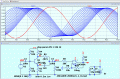
Sort of interesting , and I see no errors, but the wandering off into "phased array radar" sort of drifts off the topic. The demonstration of the 180 degree phase splitter was good, but what was ignored was that the amplitude varied with the selected amount of shift. Also, that same scheme is at least as old as octal vacuum tubes.
What was not really mentioned was that the initial phase shifting between emitter and collector was an active device function, not an RC function, and was 180 degrees. The summing of the two signals becomes frequency dependent, and that makes keeping a different phase shift complicated for voice signals.
The yootoob video did not even mention either 90 degree shifting nor a much about the use of applications. BUT, i it's favor,I saw nothing that looked faked.
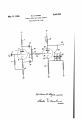
That circuit was patented by Keck in 1942. It is the core of the crosstalk separation method in a classic 2-wire intercom and an electronic telephone hybrid.
Here it is with the pot added for phase control, by Sayer (1943). Click for a larger image.
Totally aside from providing the cancellation, the 180 degree phase inversion, without any phase adjustment, has also been used to drive "push/pull" amplifier stages as a much simpler and cheaper alternative to a transformer. It works very well if done correctly.
Totally aside from providing the cancellation, the 180 degree phase inversion, without any phase adjustment, has also been used to drive "push/pull" amplifier stages as a much simpler and cheaper alternative to a transformer. It works very well if done correctly.
The ”concertina” or “cathodyne” phase splitter, so named, I believe, as a play on the word “anodyne” - unlikely to cause offence! (The “offence” being unequal phase shifts)
Totally aside from providing the cancellation, the 180 degree phase inversion, without any phase adjustment, has also been used to drive "push/pull" amplifier stages as a much simpler and cheaper alternative to a transformer. It works very well if done correctly.
Conceptually you could use an integrator to get a 90° phase shift independent of frequency, and then use an AGC circuit to keep the output voltage constant as the integrator output voltage varies with frequency.
The integrator output voltage will drop by a factor of 10 from 5kHz to 50KHz, which the AGC circuit will need to handle.

 Facebook
 Google
 GitHub
 Linkedin