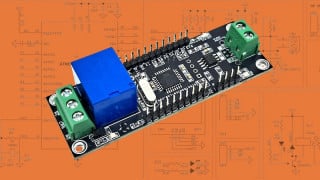
Hmm, this TVS diode won't pass voltage. I have it between the +vcc and the rail on the board right? I'm not sure where it's supposed to go based on the diagram.
ebeowulf - what I meant was tapping directly to the battery instead of going through an existing +12V VCC that is probably ran through all sorts of relays and other electronic components in the car.
Ah, I understand now. That's a fair question, but I suspect the answer is still the same. Having said that, I have relatively little experience with automotive wiring issues, and could easily be wrong.
Hmm, this TVS diode won't pass voltage. I have it between the +vcc and the rail on the board right? I'm not sure where it's supposed to go based on the diagram.
The TVS doesn't go in series with the 12V supply, it goes between the supply and ground.
The downward pointed triangles throughout the schematic that don't connect to anything else all represent ground (or negative, DC common, the negative rail on your breadboard, etc.)
Your power supply should still go straight into the positive rail, and the TVS should have one leg in the positive rail and one leg in the negative rail. Its purpose is to short circuit any voltage above a certain threshold in order to prevent extraneous, unwanted high voltage noise from damaging the circuit. It should not conduct except when the threshold voltage is exceeded (which should not happen when testing with a 9V, or even a 12V, battery.) It's there because of noise spikes that might exist in a car. Any other time, it does nothing.
Unless you connect it as shown in the schematic, with one leg going to the cathode of D6 and the other leg going to ground, it won't achieve its intended function (which is to short-circuit voltage spikes above ~15V). I doubt you can safely test its function in your breadboard layout. It will only survive if voltage spikes are brief. If you don't have R9 and D6 in place there is no point using the TVS on the breadboard.
Unless you connect it as shown in the schematic, with one leg going to the cathode of D6 and the other leg going to ground, it won't achieve its intended function (which is to short-circuit voltage spikes above ~15V). I doubt you can safely test its function in your breadboard layout. It will only survive if voltage spikes are brief. If you don't have R9 and D6 in place there is no point using the TVS on the breadboard.
I'm embarrassed to say that I hadn't really realized what R9 was doing until you brought it up just now. Think I get it now. I'm learning new stuff all the time. Apologies if I ever jump in with explanations prematurely (like describing a way to hook up TVS without its related components.) I'm learning lots from this thread. Thanks!
+Vcc goes to F1 > 10ohm resistor in that same row, the other leg goes one row down, which also shares one leg with the 14001N diode, which then jumps over to the +Vcc rail. One row down on that rail, the + / - is jumped together with the TVS diode. I still have to put in the 220u capacitor and the 100ohm resistor somewhere.
About the resistor - I asked a few pages back, but the only 220u capacitor I have is 16V (not 25V), will that work?
A 16V cap could be running very close to its limit, especially if the TVS diode didn't clamp the volts down enough when a high energy spike occured. That's why I specified 25V.
I'll try to find one at 25v, but what are the odds of this happening? At peak the alternator regulator would put out 14V, the only way I could see over that is if the alternator fails and something really odd happens. Normally the voltage would drop, not increase upon failure. I don't know enough about alternator regulators, but every time I've had an alternator fail, it outputs less voltage-rather quickly!
You obviously didn't follow the link in post #98 .
It's not about alternator failure; it's load dump effects. If an alternator's inductive load is suddenly removed (think of switching off an engine fan) the voltage will suddenly shoot up. The spike may be 50V or more!
*edit - not the mosfet - it's related to the first 555)
I'm getting a strange artifact from something, (ignore --I think it has to do with the gate on the MOSFET--)). I also have a door lock signal (another 12V pulse) that I would like to flash once, so I thought I'd just tap that into the first pulse signal and put a diode on it like my original design (so the lock the signal would just trigger the FET and the relay to flash once). But what's strange is, if I ground the "lock" wire first, then touch the MOSFET gate, or just randomly keep touching the gate, the light flashes twice sometimes, meaning the charge is getting reset on the MOSFET or something? It only does it once out of 10 times or so, but is repeatable.
Just made a video with a voice over showing what's happening. It's random, I'm able to get the light to flash twice out of nowhere by directly tapping the gate even though there's a diode to prevent the trigger from being activated on the 555s. I wonder if it's the same thing as the "pull down" resistor for the trigger pin causing the gate to reset. Just watch until the end, you'll see it blink twice even though I tapped it once about 8 times in a row.
You obviously didn't follow the link in post #98 .
It's not about alternator failure; it's load dump effects. If an alternator's inductive load is suddenly removed (think of switching off an engine fan) the voltage will suddenly shoot up. The spike may be 50V or more!
I don't understand most of that article, but one thing that I thought I grasped but didn't make sense was the jump starting causing a 24V spike. When you jump a car, the wires are in a parallel configuration, so this wouldn't double the output, right? You don't hook positive to negative like in series.
*edit* I disconnected the green wire going to the second 555 ouput and tapped the mosfet over and over and couldn't replicate it. when I tapped the wire of the first 555, it sometimes pulsed the light twice. Something strange is going on.
Pull down resistor like we did on the 555s doesn't prevent the single pulse on the mosfet from firing twice. Could it be that the capacitor is building up a charge from each pulse, then releasing it causing a second blink? The goal is to have a point where the door lock wire will fire a single 12V pulse directly to the MOSFET triggering the lights to flash once . If I simulate this by tapping it over and over again, about 1 out of 6 tries, the light flashes twice. Is it the cap storing a pulse? The signal is not going back to the 555, I know for certain because I put TWO diodes there and checked with a multimeter.
Ignore picture, this weird artifact is related to the 555?
Be aware that MOSFETS are static sensitive. If your finger is touching the wire that you're tapping the gate with you could inadvertently be applying 1000V or more from your body. The FET won't like that!
Sorry I should have clarified, directly tapping the gate pins/jumper, or anywhere else that leads to the FET, so the diodes, the yellow wires, by the diode, anything in that area with the +9V lead (not my finger). I don't think it's the FET the more I mess with it. If I disconnect one of the 555s it stops doing it. Despite the diodes, voltage is somehow getting back to the 555s?
You seem to be randomly connecting +9V to various points in the circuit. It's not surprising that you get odd results . It's also likely to fry something.
I dont believe so. I'm touching where the lock signal would go. The lock signal would result in one flash, and would be tapped in after the 555s, after a diode and before the mosfet- following the same concept as the initial pulse (from the unlock signal) to flash the lights the first time. Anywhere in there is a good place, they are all connected on the same pin row. The result is approximately 1 out of 6 touches results in 2 flashes.
Just think of this, I'm tapping the same line that powers the first flash before the FET, and I'm getting two flashes. I guess I never mentioned it, but the lock signal is another wire in the harness, see function and voltage as the unlock.
Well, I don't feel like I have a complete answer, but maybe at least part of a theory. Hopefully Alec can tell me if I'm on the right track or not.
I noticed that at one point in the video, you short the positive supply (the wire in your hand) to ground and that we get two flashes then. I think the reason this happens is that shorting the battery drops your positive supply voltage significantly, such that when you release the wire and the positive rail, it jumps back up suddenly. Since the capacitors on the 555's trigger inputs momentarily holds them at the lower voltage, the sudden positive supply jump appears to the 555s as a negative pulse on their trigger inputs, which starts your timer cycles. I wonder if your direct jumper connections are somehow replicating this behavior, pulling the positive rail low and then releasing it. Can't quite explain it, but it feels close to an explanation...
Also, we haven't seen pics since you updated the diode placements for D1, etc. Some small chance that end of the board still has something not quite right?
Finally, what diodes are you using? I've seen people use zener diodes in applications that called for standard diodes with confusing results. If your diodes were zeners in the 7-9V range, they might conduct reverse voltage when hit with the full 9V supply, but not when hit with supply minus another diode's forward voltage (which is all they're seeing in normal use, until you added this new scenario.)
Mostly grasping at straws here, but maybe one of these ideas will get the ball rolling.
Thanks for the input, yes It's got to be some rogue voltage stored somewhere or seeping. I don't know. I did more testing, and eliminated the TVS and still got it to flash twice. It seems to happen more frequently if I tap an area twice quickly then let go, as opposed to deliberate 2 second breaks. Maybe it won't be an issue when it's in the car since the car will only get once lock pulse in general, and won't be operational while the car is running anyway.
The other diodes you mentioned -- can D2 go inline in a row or does that short it out? I have to break into a new row to add the diode for the input of the first 555?

 Facebook
 Google
 GitHub
 Linkedin



 .
.