775 Motor @ 24v Burning Out

Thread Starter

haroldjclements

Joined Nov 8, 2017
9
Hi,

I am having an issue with running a 775 motor @ 24v. I have had two 775 motors (both from AliExpress) that when I apply 24v, the motor starts for less than 10 seconds, then in a blue flash stops functioning. I have tried with two different PSUs (both were about 15A). The motors are rated at 12-24v and I would have thought 15A would give the device enough current.

Obviously I am missing something very basic, so any pointers will be gratefully received. I guess a speed controller (potentiometer) would help keep the voltage down, but I would have thought that a 775 motor would run with no load on 24v for more than 10 seconds.

As I say, any guidance here will be gratefully received.

Thanks,
Harold
 

Thread Starter

haroldjclements

Joined Nov 8, 2017
9
Thank you very much for your responses.

With or without load? > No Load, just the motor in a bracket screwed to a base so it does not 'jerk' when in operation.
Did you do an autopsy on the motor? > No, I would not really know what I am looking for except something blackened or the coil damaged.
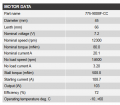
Data sheet would be helpful? > Attached, the model that I have is "775-5520F-CC". However, I don't know how you tell as there is nothing written on the motors themselves.

As I say, I not sure why I have kill two of these when they are 'supposed' to be rated at 24v... I just don't want to kill another one if it something that I am doing, not that I have been sold a device rated at a lower voltage.

Thanks again,
Harold
 

Attachments

gerty

Joined Aug 30, 2007
1,305
You say they are not marked, are you sure you have the 24 volt version as I see they have a 7.2 volt model..Have you tried running them at a lower voltage ? the 7.2 v version runs at 20 amps. I see contact info at the bottom of the page, I would call/email them for some sort of identifiers on what you have, possibly replacement on the burned up one as well..
 

Alec_t

Joined Sep 17, 2013
15,112
If yours is the 775-9008F motor then its rated voltage is only 7.2V !
Here is its spec :-
775_Spec.png
Note that at 7.2V the starting current is 108A, so your power supply may complain.
 

jpanhalt

Joined Jan 18, 2008
11,087
@Alec_t

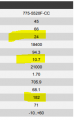
The -5520F-CC version is rated for 24V
1595927720474.png
Starting current is high, but it apparently did start.

After the blue flash, does the motor still work? I assume not, which leads me to the same conclusion about a teardown and/or communication with the manufacturer or seller.
 

Irving

Joined Jan 30, 2016
5,064
I'd hazard a guess it's thrown a commutator segment or the connection to one. That's a pretty high no load rpm... and some pretty high currents too...

Does it turn manually and make any noises?
 

MaxHeadRoom

Joined Jul 18, 2013
30,593
One way to check the right voltage is to run the motor on a known safe voltage level and record the rpm, then calculate the maximum voltage value, by extrapolation of the measured value rpm and the voltage required to operate at the max rated rpm level.
Max.
 

Irving

Joined Jan 30, 2016
5,064
Those numbers appear a little bogus, the stall torque is only .508Nm (4.5lb-in), and it draws 108amps at start?
Something seems off there!
Max.
Yes, I agree they seem unlikely at first glance (its 68A at start)

I have a wheel chair motor here, 90mm dia, 150mm long, rated speed 3100rpm, which gives 1Nm running torque (21Nm at 21:1 gearbox output). At rated speed/load its power output is 320W (1Nm @ 324rad/sec). Input is 24v @ 20A = 480W, about 67% efficiency, and losses = 160W. Its Kv @ no load speed of 3400rpm (356rad/s) is 356/24 = 14.8r/s/V, and Kt = 20/1 =20A/Nm which are close (ideal motor Kv = Kt). Its stall torque was measured as 12Nm so stall current is theoretically 22 * 20 = 240A and was measured (very briefly!) at 250A. The other factor is power loss per volume. 160W loss in a motor thtat size is 168kW/m^3 and that's rated for continuous open air operation too with an operational life of >30,000 hours.

This motor is much much smaller but applying the same calculations:
At rated speed of 18400rpm (1926rad/sec) it claims 0.094Nm = 181W power output (as spec'd), yet input = 24v @ 10.7A = 256W = 70% eff. and 75W losses. Its starting = stall current = 68A, not unreasonable at only 6 x operating current. Kv = 1926/24 = 80.25r/sec/V. Kt = 10.7/.094 = 113A/Nm, which are close enough and at stall 113 *.508 = 57A, close enough to 68A to be realistic. But @ 66mm x 45mm dia that's a staggering 357kW/m^3!

So the numbers sort of make sense, though they are large for that motor chassis. I'd expect it to need some serious forced air cooling or a big heatsink to run like that, reliably, for any length of time. And they say nothing about quality of manufacture or reliability. 68A starting current, even for a few mS is going to generte a lot of heat in the windings and soldered contacts to the commutator.. its not hard to imagine that softening enough to come apart under the G-forces shortly after starting, esp if joint was a bit 'dry'.
 
Last edited:

MisterBill2

Joined Jan 23, 2018
27,311
The very first thing to do when initially checking a new DC motor is to run it at a lower voltage and monitor the current while raising the voltage. When the supply voltage reaches the specified voltage only then should the current reach the specified no load current.
In this case it seems that was not done. AND one question is: "was the supply voltage actually 24 volts?" I have seen power supplies whose open voltage is far greater than the label claimed.
 

MaxHeadRoom

Joined Jul 18, 2013
30,593
The very first thing to do when initially checking a new DC motor is to run it at a lower voltage and monitor the current while raising the voltage. When the supply voltage reaches the specified voltage only then should the current reach the specified no load current.
In this case it seems that was not done. AND one question is: "was the supply voltage actually 24 volts?" I have seen power supplies whose open voltage is far greater than the label claimed.
Not so much the current, if the rated rpm is stated, then the rated voltage can be easily extrapolated by the low voltage/rpm method..
Max.
 

Tonyr1084

Joined Sep 24, 2015
9,744
Maybe this is a dumb question, but so far I've only seen the comment "24V". No mention of AC or DC. Am I missing something? Could DC hurt a motor that is otherwise intended to run on AC? I don't ask because I know - I ask because i don't know. And no, I'm not hijacking the thread - just asking a question that might lead to an answer as to why the blue flash.
 

MisterBill2

Joined Jan 23, 2018
27,311
ctually a good question, Tony. The simple answer is that simple Permanent Magnet brushed DC motors will not run on normal AC. Some field coil brushed DC motors will dun on AC while some others will not.
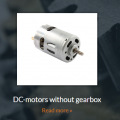
BUT when we see a motor like in the picture it is obvious to many of us that it is a permanent magnet brushed DC motor and will only run on DC. That is one of those things that comes from experience and insight. The motor has no place for field couils and so it must be a PM motor and therefore it must be DC.
 

Tonyr1084

Joined Sep 24, 2015
9,744
@MisterBill2; the TS posts, #1 & #3 didn't state anything more about the motor than the part number (775-5520F-CC), which I did not look up. There's an attachment, but when I clicked on it the attachment wanted to download to my computer. That's usually when I click cancel. In post #16 japanhalt posted a picture of what I know to be a permanent magnet motor - clearly a DC motor. Prior to that I didn't know that for sure. Hence, my comment about nobody saying it was a DC motor. So I asked the question.

I recall back when I serviced emergency lighting systems back in the 80's. We had a series of units that needed new transformers. The company bought a bunch of replacement 277V to 32V transformers and began installing them. Some failed within a day while others put on a spectacular show of light as soon as they were installed. And it wasn't just my installations, everyone on the crew who installed them experienced the same thing. It was a bad batch of transformers; improperly made.

I don't know this for a fact, but I suspect a possibility that the motors the TS has seen the light with may just have gotten a bad set of motors. Maybe the manufacturer mislabeled them and instead of 12 to 24 volt motors they're 5 volt motors. But that's merely conjecture. I've never seen a motor self destruct because of not having a load on it. I have heard that it can happen but I am not a big motors man. Lights, switches, batteries (SLA & LA) and some logic is about the extent of what I have some competence with. Not expertise, just competence. But I just had to ask, playing devil's advocate, if it was intended for AC or DC. I now know it's DC.
 

MisterBill2

Joined Jan 23, 2018
27,311
@MisterBill2; the TS posts, #1 & #3 didn't state anything more about the motor than the part number (775-5520F-CC), which I did not look up. There's an attachment, but when I clicked on it the attachment wanted to download to my computer. That's usually when I click cancel. In post #16 japanhalt posted a picture of what I know to be a permanent magnet motor - clearly a DC motor. Prior to that I didn't know that for sure. Hence, my comment about nobody saying it was a DC motor. So I asked the question.

I recall back when I serviced emergency lighting systems back in the 80's. We had a series of units that needed new transformers. The company bought a bunch of replacement 277V to 32V transformers and began installing them. Some failed within a day while others put on a spectacular show of light as soon as they were installed. And it wasn't just my installations, everyone on the crew who installed them experienced the same thing. It was a bad batch of transformers; improperly made.

I don't know this for a fact, but I suspect a possibility that the motors the TS has seen the light with may just have gotten a bad set of motors. Maybe the manufacturer mislabeled them and instead of 12 to 24 volt motors they're 5 volt motors. But that's merely conjecture. I've never seen a motor self destruct because of not having a load on it. I have heard that it can happen but I am not a big motors man. Lights, switches, batteries (SLA & LA) and some logic is about the extent of what I have some competence with. Not expertise, just competence. But I just had to ask, playing devil's advocate, if it was intended for AC or DC. I now know it's DC.
The destruction of a high speed motor or generator by overspeeding can be rather impressive, although usually the motor housing stops the fragments from flying.
In this case the destruction could possibly have been prevented by doing the low voltage checkout first, if the operter had recognized that something was wrong. Of course that would require knowing what should be happening.
 

MaxHeadRoom

Joined Jul 18, 2013
30,593
The destruction of a high speed motor or generator by overspeeding can be rather impressive, although usually the motor housing stops the fragments from flying.
This was the reason that the older, more common then, wound shunt field motors had field loss protection, if this occurred during operation, they could run uncontrollably up to extremely high RPM's to destruction and injury to personnel. o_O
Max.
 
Top