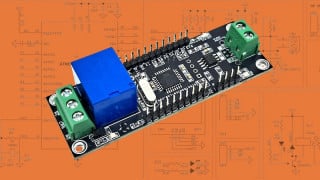
75V-12V Buck Converter with feedback

Status
Not open for further replies.

Thread Starter

Junaid Arshad

Joined Jul 7, 2023
24
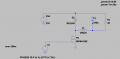
I want to design a buck converter for E-bike with 75V input and 12V,20A(240W ideal case) output to drive the other components of E-bike using n-mosfet as a low side, i also want to use a feedback using a microcontroller to adjust the output voltage to 12V when the load vary?
 

Attachments

Danko

Joined Nov 22, 2017
2,135
I want to design a buck converter for E-bike with 75V input and 12V,20A(240W ideal case) output to drive the other components of E-bike using n-mosfet as a low side, i also want to use a feedback using a microcontroller to adjust the output voltage to 12V when the load vary?
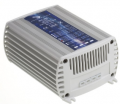
It is much cheaper to buy one:
Converter from 80 to 12 Volt
The IDC-360D-12 is a DC/DC converter that converts a DC voltage from 80V to 12V DC voltage and can supply a direct current of up to 30A.
The 360W converter has a wide input range of 60V – 120V DC.
The converter is short-circuit proof and protected against overloading, overvoltage and overheating.
If this occurs, the converter will switch itself off. When the situation returns to normal, the converter switches back on.
This 12V converter also provides a galvanic separation between the input and output.
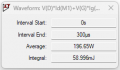
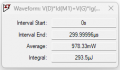
1689595621693.png1689595692775.png
========================================================
ADDED:
https://www.aliexpress.us/item/3256...4p_id=2023071705380481216901711350019053514_4
1689598012893.png
 
Last edited:

Thread Starter

Junaid Arshad

Joined Jul 7, 2023
24
It is much cheaper to buy one:
Converter from 80 to 12 Volt
The IDC-360D-12 is a DC/DC converter that converts a DC voltage from 80V to 12V DC voltage and can supply a direct current of up to 30A.
The 360W converter has a wide input range of 60V – 120V DC.
The converter is short-circuit proof and protected against overloading, overvoltage and overheating.
If this occurs, the converter will switch itself off. When the situation returns to normal, the converter switches back on.
This 12V converter also provides a galvanic separation between the input and output.
View attachment 298484View attachment 298485
If I wanted to buy i would have, i want to design, although i already have a basic circuit topology but need some help.
 

BobTPH

Joined Jun 5, 2013
11,463
using n-mosfet as a low side
If you make a buck converter with a low side switch, the output voltage will be relative to the + of the input. I doubt that this is what you want. What is your reasoning for this requirement?

There is a reason everyone uses a high side switch: so the the output is relative to the - of the input, i.e. the input and output share the ground. This is easily accomplished by either using a p-channel MOSFET or an n-channel with a high-side driver.
 

Thread Starter

Junaid Arshad

Joined Jul 7, 2023
24
If you make a buck converter with a low side switch, the output voltage will be relative to the + of the input. I doubt that this is what you want. What is your reasoning for this requirement?

There is a reason everyone uses a high side switch: so the the output is relative to the - of the input, i.e. the input and output share the ground. This is easily accomplished by either using a p-channel MOSFET or an n-channel with a high-side driver.
The benefits are:
Simple gate driving circuit , more current capacity can be increased easily, i don't want to use driver IC as gate driving for high side, as high side driving is a pain, which will again require DC voltage to operate the driving IC and i don't want to use external DC source, I can control the PWM directly from the microcontroller.
 

Thread Starter

Junaid Arshad

Joined Jul 7, 2023
24
The benefits are:
Simple gate driving circuit , more current capacity can be increased easily, i don't want to use driver IC as gate driving for high side, as high side driving is a pain, which will again require DC voltage to operate the driving IC and i don't want to use external DC source, I can control the PWM directly from the microcontroller.
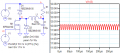
1689598951373.png1689598951373.png
 

DickCappels

Joined Aug 21, 2008
10,661
Just a suggestion: In cases like this that I have seen and built before the output filter capacitor was usually across the load, otherwise the equivalent resistance of the power supply will be in series with the capacitor.

A lot of people use microcontrollers to regulate their power supplies, making their lives more complicated than they need to be. In my book a simple analog regulation loop works very well and is not difficult to stabilize.

A couple of transistors or an opamp or regulator chip can do wonderful things that would take many lines of error-prone code to do.
 

Papabravo

Joined Feb 24, 2006
22,058
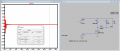
IMHO you will never be able to achieve satisfactory performance if this is your first SMPS. Trust me when I say it does not appear that you have the skills or knowledge to succeed on your first design. Maybe, buy this one and use it as a benchmark to try and build a better one. You also need to deal with the excessive startup transient. the auxiliary equipment will be most unhappy with those positive and negative excursions.
 
Last edited:

Thread Starter

Junaid Arshad

Joined Jul 7, 2023
24
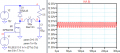
IMHO you will never be able to achieve satisfactory performance if this is your first SMPS. Trust me when I say it does not appear that you have the skills or knowledge to succeed on your first design. Maybe, buy this one and use it as a benchmark to try and build a better one. Also I think you duty cycle @ 84% is wrong for a standard open loop buck converter,
The duty cycle is correct to obtain 12V DC as the mosfet is used in the lower side, if i would have used it on the higher side the the duty cycle for the same schematic would be 14%, and yes absolutely the design need a lot of correction and i do lack knowledge otherwise i wouldn't have asked you guys here. Everything starts from scratch.....Doesn't it?
 

Thread Starter

Junaid Arshad

Joined Jul 7, 2023
24
Just a suggestion: In cases like this that I have seen and built before the output filter capacitor was usually across the load, otherwise the equivalent resistance of the power supply will be in series with the capacitor.

A lot of people use microcontrollers to regulate their power supplies, making their lives more complicated than they need to be. In my book a simple analog regulation loop works very well and is not difficult to stabilize.

A couple of transistors or an opamp or regulator chip can do wonderful things that would take many lines of error-prone code to do.
Thanks for the suggestion, can you share your book please?
 

Danko

Joined Nov 22, 2017
2,135
Last edited:

BobTPH

Joined Jun 5, 2013
11,463
I hope you realize that you will need a high side switch for your motor with that configuration, which carries far more current, so you have saved nothing, in fact, you have made matters worse.
 
Status
Not open for further replies.
Top