555 timer diodes usage?

Thread Starter

clarelluffyjjang

Joined Jun 8, 2017
35
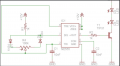
hi i am currently building this 555 circuit for pwm diming. but i dont understand the usage of these two diodes in this circuit. how does this diodes actually help in dimming the led just by changing the potientiometer?
upload_2017-6-14_19-36-37.png
i built and it really does dim the led just by changing but i dont understand the theory behind it. can someone explain to me pls?
 

AlbertHall

Joined Jun 4, 2014
12,624
Capacitor C1 charges through R1, D1, and the left hand part of R4 and discharges through the right hand part of R4 and D4. Changing R4 therefore alters the charge and discharge times in opposite directions.
 

Dodgydave

Joined Jun 22, 2012
11,395
The diodes act as Steering system, the capacitor can only charge through one diode and discharges through the other, the rate of charge and discharge varies with the resistance value of your potentiometer, the longer it takes to charge the capacitor the brighter the leds, and vice-versa.
 

Thread Starter

clarelluffyjjang

Joined Jun 8, 2017
35
Capacitor C1 charges through R1, D1, and the left hand part of R4 and discharges through the right hand part of R4 and D4. Changing R4 therefore alters the charge and discharge times in opposite directions.
does that means it wont change the frequency of the oscillation? cos PWM dimming not suppose to have changes in frequency?
 

Thread Starter

clarelluffyjjang

Joined Jun 8, 2017
35
The diodes act as Steering system, the capacitor can only charge through one diode and discharges through the other, the rate of charge and discharge varies with the resistance value of your potentiometer, the longer it takes to charge the capacitor the brighter the leds, and vice-versa.
does that means it wont change the frequency of the oscillation? cos PWM dimming not suppose to have changes in frequency?
 

OBW0549

Joined Mar 2, 2015
3,566
does that means it wont change the frequency of the oscillation? cos PWM dimming not suppose to have changes in frequency?
With that particular design, the frequency won't change very much as the duty cycle is varied; but even if it did, it wouldn't matter for something like LED dimming unless the frequency got so low that your eyes could see the LED flickering-- and that won't happen with the component values shown in your circuit.
 

Thread Starter

clarelluffyjjang

Joined Jun 8, 2017
35
With that particular design, the frequency won't change very much as the duty cycle is varied; but even if it did, it wouldn't matter for something like LED dimming unless the frequency got so low that your eyes could see the LED flickering-- and that won't happen with the component values shown in your circuit.
how can i actually design my circuit to led it pwm dimming when it's dark outside. i replace R1 with LDR and the resistance varies and so does my frequency
 

OBW0549

Joined Mar 2, 2015
3,566
how can i actually design my circuit to led it pwm dimming when it's dark outside. i replace R1 with LDR and the resistance varies and so does my frequency
Replacing R1 with a LDR would definitely change the frequency-- try putting the LDR in series with one end of R4 instead. (Which end it should go on depends on what you would like to happen as the outside light dims. Try them both.)
 

crutschow

Joined Mar 14, 2008
38,435
If you want to use an LDR to change the duty-cycle without changing the frequency, then you need a different circuit.

Here's an example using two 555's or one 556:
The first 555 is configured as an astable that sets the frequency and the second is configured as a monostable (one-shot) to set the pulse width.
You can put the LDR in place of the speed pot.


Here's a different circuit that can be built with one LM324/358 chip (or LM339/393 with added pullup resistors on their output):
The LDR with a series resistor can replace POT1 to control the duty cycle.
You don't need the 5V regulator as everything can operate from the same voltage.
Edit: You want to reduce the PWM frequency by increasing R4 and C1, particularly if you use the LM324/358 op amp. For example, R4=100k and C1=22nF should give about 200Hz.

 
Last edited:

Thread Starter

clarelluffyjjang

Joined Jun 8, 2017
35
If you want to use an LDR to change the duty-cycle without changing the frequency, then you need a different circuit.

Here's an example using two 555's or one 556:
The first 555 is configured as an astable that sets the frequency and the second is configured as a monostable (one-shot) to set the pulse width.
You can put the LDR in place of the speed pot.


Here's a different circuit that can be built with one LM324/358 chip (or LM339/393 with added pullup resistors on their output):
The LDR with a series resistor can replace POT1 to control the duty cycle.
You don't need the 5V regulator as everything can operate from the same voltage.
Edit: You want to reduce the PWM frequency by increasing R4 and C1, particularly if you use the LM324/358 op amp. For example, R4=100k and C1=22nF should give about 200Hz.

can i have the explanation link for this op amp circuit and the 555? i couldnt start until i understand how it works
 

GopherT

Joined Nov 23, 2012
8,009
can i have the explanation link for this op amp circuit and the 555? i couldnt start until i understand how it works

The left op amp (better to use a comparitor).
This is a simple oscillator circuit This produces the triangle wave (actually more like a shark fin wave) as shown in red.


The right op amp (better to use a comparitor).
This produces the PWM control. The voltage of POT 1 going into the amplifier will determine the duty cycle. To get a feel for what duty cycle you will have for each value of the POT, draw a horizontal line through the Triangle wave from the left Op Amp. The time the horizontal line is above vs below the horizontal line is the duty cycle. (Op amp compare the value of the oscillator to the value of the POT and turns On when the voltage from the POT is higher.

The MOSFET transistor on the far right allows current to flow (turns on) when voltage is supplied by the op amp. This MOSFET transistor is needed because op amps and comparitors can only output a few 10s of milliamps.
 

Thread Starter

clarelluffyjjang

Joined Jun 8, 2017
35
The left op amp (better to use a comparitor).
This is a simple oscillator circuit This produces the triangle wave (actually more like a shark fin wave) as shown in red.


The right op amp (better to use a comparitor).
This produces the PWM control. The voltage of POT 1 going into the amplifier will determine the duty cycle. To get a feel for what duty cycle you will have for each value of the POT, draw a horizontal line through the Triangle wave from the left Op Amp. The time the horizontal line is above vs below the horizontal line is the duty cycle. (Op amp compare the value of the oscillator to the value of the POT and turns On when the voltage from the POT is higher.

The MOSFET transistor on the far right allows current to flow (turns on) when voltage is supplied by the op amp. This MOSFET transistor is needed because op amps and comparitors can only output a few 10s of milliamps.
how do i know UTP LTP? Vsat+ Vsat-?
 

GopherT

Joined Nov 23, 2012
8,009
how do i know UTP LTP? Vsat+ Vsat-?
I usually play on my pressboard until I have the frequency and dynamic range I want. In your case, anything from 100Hz to 1000Hz will be fine.


and how do i calculate the duty cycle after comparatr?
The duty cycle does not have to be calculated, the comparitor is only On or Off - so the MOSFET will match the duty cycle of the comparitor.

Note, it you use comparitors, you will need one more resistor for each IC listed. Google '"open collector" and comparator for examples.
 
Top