555 Timer Delay ON

Thread Starter

scbullock

Joined Aug 19, 2023
69
So if you still want the delay with servo operation, then it would seem you will need to add a third 555 that generates two different pulse streams to control the servo.
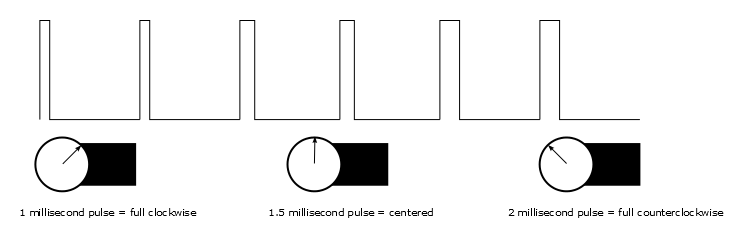
Typically the pulses needed are shown below:

The pulses occur at a 20 mSec (50 Hz) interval, and vary between 1 and 2 mSec in width.
Common servos rotate over a range of 90° as the pulses vary between 1 and 2 mSec -- they should be at the center of their mechanical range when the pulse is 1.5 mSec.


alt text

pulse to position
Understood. Hopefully I can tune the timing of the DC motor to produce about a 180 degree rotation in order to avoid using the servo. Motor gets here next week so I’ll try it then. I’d like to stay away from implementing a third timer chip, so hopefully the tuning works.
 

sghioto

Joined Dec 31, 2017
8,634
Understood. Hopefully I can tune the timing of the DC motor to produce about a 180 degree rotation in order to avoid using the servo. Motor gets here next week so I’ll try it then. I’d like to stay away from implementing a third timer chip, so hopefully the tuning works.
I think it will still require a third chip even if you get the timing correct. The motor turns 180 then stops briefly and either reverses 180 or continues 180. This
is going to require another timer.
 

crutschow

Joined Mar 14, 2008
38,508
Perhaps it would be good for you to post again, exactly what you want the motor to do, and when it should do it, as that's become a little fuzzy at this point.
 

Thread Starter

scbullock

Joined Aug 19, 2023
69
This is an overview of what this entire thread is about:
A timer circuit that does the following to output to a DC Motor:
1) Motor Starts OFF
2) Button is pushed
3) Motor stays OFF for 8 seconds
4) Motor turns on for 1 second
5) Motor OFF

I desire the motor to rotate 180 degrees. So, the 1 second is arbitrary and will require tuning. Some are saying that the motor will rotate more after the 1 second on period. Not sure until the motor ships next week and I tune the ON timing.
 

BobTPH

Joined Jun 5, 2013
11,515
Is the motor geared to 30 RPM? If not, how do you expect it to rotate only 180° in 1 second. An ungeared motor will spin at 1000s of RPMs. In one second it will spin many times around.

And using timing to achieve an accurate amount of rotation is not going to work. It will not be accurately repeatable. Trust me. Systems that rotate a controlled amount need feedback of some form. A servo uses a potentiometer. The resistance changes as it rotates. It is also geared. To make something rotate 180°, place a physical switch and cam of some sort such that the switch is activated at the desired position.
 

Thread Starter

scbullock

Joined Aug 19, 2023
69
Perhaps it would be good for you to post again, exactly what you want the motor to do, and when it should do it, as that's become a little fuzzy at this point.
Is the motor geared to 30 RPM? If not, how do you expect it to rotate only 180° in 1 second. An ungeared motor will spin at 1000s of RPMs. In one second it will spin many times around.

And using timing to achieve an accurate amount of rotation is not going to work. It will not be accurately repeatable. Trust me. Systems that rotate a controlled amount need feedback of some form. A servo uses a potentiometer. The resistance changes as it rotates. It is also geared. To make something rotate 180°, place a physical switch and cam of some sort such that the switch is activated at the desired position.
The motor I am looking at is geared it rotates at 200 rpm.
 

Thread Starter

scbullock

Joined Aug 19, 2023
69
Pretty accurate. The motor is fixed to a cam which drives a down a blade. Like a cam and follower system. It is a cutting mechanism. The motor is driving the cutting motion.
I’d say within 10 degrees of 180. If the cam doesn’t turn near 180 then the follower will not retract back to its original position. That would be an issue because there needs to be clearance under the cutter for the next cut (or button press).
 

crutschow

Joined Mar 14, 2008
38,508
I’d say within 10 degrees of 180. If the cam doesn’t turn near 180 then the follower will not retract back to its original position. That would be an issue because there needs to be clearance under the cutter for the next cut (or button press).
Then I think you need either the servo motor, or limit switches to control the motor movement.

Would it be possible to use a solenoid for the cutter?
 

Thread Starter

scbullock

Joined Aug 19, 2023
69
Then I think you need either the servo motor, or limit switches to control the motor movement.

Would it be possible to use a solenoid for the cutter?
I could use it if it is small enough. I’ve used a solenoid before with Arduino to fire a piston, but how do you expect it to drive down the razor?
 

Thread Starter

scbullock

Joined Aug 19, 2023
69
I could use it if it is small enough. I’ve used a solenoid before with Arduino to fire a piston, but how do you expect it to drive down the razor?
This is an interesting and exciting idea. I see how solenoid valves work now that I looked it up. Please let me know what the best solenoid application would be here (e.g. solenoid valve, etc.). I will mention that the razor must travel 1 inch in length for a full and proper cut.
 
Top