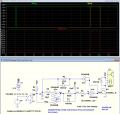
555 Timer Delay ON

crutschow

Joined Mar 14, 2008
38,506
Note for previous question It is a small 3.7V N20 motor I will be using. The entire board will be powered with 18650 3.7V 2500 maH battery.
The standard 555 won't work reliably down to 3.7V.
You will need to use the CMOS version such as the LMC555, which works down to 1.5V.
 

AnalogKid

Joined Aug 1, 2013
12,129
As in post #13, I don't think you can get all four conditions with a single 555. You can with a single CD4093 quad NAND gate (plus a relay driver transistor). Fewer parts, fewer connections. You don't mention any way to reset the circuit after the relay is on continuously. Easy to add with a second switch.

2 gates - flipflop. Reset by R-C power-on short timer, Set by pushbutton (no debounce needed).

8-second R-C timer. Series C, shunt R.

1 gate - comparator for 8-second ramp, and output transistor driver.

1 gate - spare.

2 diodes - reset both timing capacitors on power-down.

UPDATE: Another approach is to have the switch start the 8 s timer, and have its output set the flipflop and the output.

I'm traveling (dead uncle). Schematic on Monday.

ak
 
Last edited:

crutschow

Joined Mar 14, 2008
38,506
Trigger in which way?
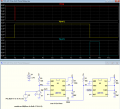
Since the 555 triggers from a negative going pulse (TRIG voltage below 1/3 of Vcc), you can use a series capacitor from the output of the first, which gives a negative going pulse when the first pulse terminates, to the TRIG input of the second.
The sim of the circuit below gives a 1 second output pulse (blue trace) after the initial 8 second delay (yellow trace).

1692497689787.png
 
Last edited:

Thread Starter

scbullock

Joined Aug 19, 2023
69
You've done it! Works just how I wanted it to.

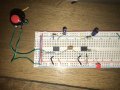
Here's a photo of the built circuit:
IMG-3215.jpg

Some resistor values not exact, but close enough. Is off for about 11 seconds after clicking button and then on for 1.5 seconds.

Can't wait to replace the LED with the motor when it comes in the mail.

Thank you so much.
 

AnalogKid

Joined Aug 1, 2013
12,129
The sim of the circuit below gives a 1 second output pulse (blue trace) after the initial 8 second delay (yellow trace).
My read of post #1 is that condition 4 is a steady state output that energizes the relay coil continuously.

If you configure U2 as a flipflop with no timing components, setting the output high, that should work.

ak
 

crutschow

Joined Mar 14, 2008
38,506
I’d like to implement a rocker switch to account for saving battery life.
If concerned about power, you can use a CMOS circuit which draws only a very small leakage current when quiescent, so likely would not need to be powered off.

Sim of example below, which uses just one CD4093 Schmitt-Trigger, quad 2-input NAND-gate IC for timing (total parts count only one more than the 555 circuit):
Red trace is the current through the relay coil.

Note that the circuit is designed to power up in the off state.

M1 can be just about any logic-level type N-MOSFET with a Vgs(thres) of ≤2V maximum.

The circuit quiescent current is just the leakage of U1, M1, and C2 (C1 has 0V across it), which would likely be not more than a few microamps total.

This circuit has somewhat less timing accuracy than a 555 circuit so, if the times are critical, may need some tweaking of values to get the timing you want.
R1-C1 adjusts the delay, and R2-C2 adjusts the pulse width.

1692631781749.png
 
Last edited:

Thread Starter

scbullock

Joined Aug 19, 2023
69
What if we were to replace the DC Motor with a microservo?
Instead of spinning the Motor for 1 second, we just have a servo that rotates 180 degrees one direction and then 180 degrees back to its starting position.

I’d like this to be done without an Arduino. I’ve seen people use two push buttons. One button sends servo 180 deg. in a direction and other button sends it in opposite direction 180. The servo was hooked up to a 2N2222 transistor which gave it the correct signal.

Like I said, I want to keep the same format as before, but change the motor from 1 second ON period to a servo rotation 180 in one direction, possibly a very short delay and then 180 degrees back to starting position (can be forward an extra 180 degrees, or back in other direction 180, doesn’t matter).

Thank you and all the help is much appreciated.
 

crutschow

Joined Mar 14, 2008
38,506
What if we were to replace the DC Motor with a microservo?
Instead of spinning the Motor for 1 second, we just have a servo that rotates 180 degrees one direction and then 180 degrees back to its starting position.

I’d like this to be done without an Arduino. I’ve seen people use two push buttons. One button sends servo 180 deg. in a direction and other button sends it in opposite direction 180. The servo was hooked up to a 2N2222 transistor which gave it the correct signal.

Like I said, I want to keep the same format as before, but change the motor from 1 second ON period to a servo rotation 180 in one direction, possibly a very short delay and then 180 degrees back to starting position (can be forward an extra 180 degrees, or back in other direction 180, doesn’t matter).
How would the 2N2222 transistor do that?
Would it need two transistors, one for each direction?

So you want the delay in one direction but not the other?
 
Last edited:

Thread Starter

scbullock

Joined Aug 19, 2023
69
The YouTube video where the guy uses a 2N222 transistor with a servo is here: (go towards end of video)
555 timer w/ Servo Example

I made a mistake in my logic and I over complicated it with a delay. I actually don’t need two different rotations. I only need one 180 degree servo rotation. The motor, or servo, is driving a Cam, so one 180 degree rotation is actually all I need.

I will reemphasize that steps 1-3 all the same, but replace the step 4 of 1 second ON to simply a 180 degree rotation of a servo.

thank you
 
Top