555 timer circuit design

sghioto

Joined Dec 31, 2017
8,634
I suppose the only clarification I need here is when you say they 'remain closed', does that mean when the circuit is de-energized? IDK. I will contact the manufacturer.
No, meaning stays closed until the next time a train activates a sensor before existing the loop as from your statement:

"The S1 and S2 relay contacts alternate between open and closed depending on which way the train is going in the loop. They stay in that position while the train is in the loop and don't change their position until an exiting train activates an IR sensor.
 
Last edited:

Thread Starter

Jibebuoy

Joined Nov 5, 2025
59
No, meaning stays closed until the next time a train activates a sensor before existing the loop as from your statement:

"The S1 and S2 relay contacts alternate between open and closed depending on which way the train is going in the loop. They stay in that position while the train is in the loop and don't change their position until an exiting train activates an IR sensor.
Ah, ok. Yes, this statement is still correct: The S1 and S2 relay contacts alternate between open and closed depending on which way the train is going in the loop. They stay in that position while the train is in the loop and don't change their position until an exiting train activates an IR sensor.
 

Thread Starter

Jibebuoy

Joined Nov 5, 2025
59
Unfortunately doesn't tell me much.
Anytime you light a signal on a railroad automatically, you need to know the direction of traffic. If sensor1 and sensor2 are "occupancy detectors", then the direction can be "implied" based on the train occupancy sequence.
Initial state:
Sensor1=0, Sensor2=0 = unknown

Enter at Sig1:
Sensor1=1, Sensor2=0 = entered at Sig1
Sensor1=0, Sensor2=1 = exiting at Sig2

Enter at Sig2:
Sensor1=0, Sensor2=1 = entered at Sig2
Sensor1=1, Sensor2=0 = exiting at Sig1

These are implied conditions as there is no positive way to know if the whole train is in the loop and clear of the turnout. This state would be:
Sensor1=1, Sensor2=1, OS=0

where "OS" would be the turnout occupancy detector
(turnout is locked from movement during occupancy).

Please comment.
I uploaded a diagram in post #10 that should help. My scenario has a lot of nuisances which adds to this discussion's complexity. Thank you for your input.
 

Thread Starter

Jibebuoy

Joined Nov 5, 2025
59
When first powered ON which ever Sensor contact is close will start a 10 second delay before the Signal LEDs light up.
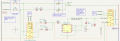
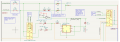
Full schematic with both Sensors and Signals.
View attachment 358582
Thank you so much once again. Can you please explain the purpose of the MOSFETs? For instance, why can't the 555 just energize the LEDs directly once it completes its 10 second countdown? Also, what is the purpose of cap C1?
 

sghioto

Joined Dec 31, 2017
8,634
Thank you so much once again. Can you please explain the purpose of the MOSFETs? For instance, why can't the 555 just energize the LEDs directly once it completes its 10 second countdown? Also, what is the purpose of cap C1?
The mosfet was included because I didn't know what type of LEDs you plan on using or how much current they require. Typical small LEDs at 20ma can be driven directly by the 555 with the appropriate current limiting resistor.
C1 in this circuit is called a bypass filter to suppress any high frequency noise in the 12 volt supply and is always recommended. If driving the LEDs directly change the value to 10uf.
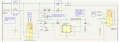
Direct driving the LEDs
1762790220859.png
 
Last edited:

Thread Starter

Jibebuoy

Joined Nov 5, 2025
59
The mosfet was included because I didn't know what type of LEDs you plan on using or how much current they require. Typical small LEDs at 20ma can be driven directly by the 555 with the appropriate current limiting resistor.
C1 in this circuit is called a bypass filter to suppress any high frequency noise in the 12 volt supply and is always recommended. If driving the LEDs directly change the value to 10uf.
Direct driving the LEDs
View attachment 358627
I confirmed with the signal manufacturer that the LEDs in the signals are SMDs and they draw about 20 milli-amps each. So, it appears I don't need the MOFSETs (as you have shown here), need to size R2 and R3 (which my signal guy will do) and change C1 to 10 uF (again, as you have shown). My polarity is reversed from yours - I have 12V-at the left. Just need to maintain correct component orientation and I should be good to go.
Thank you so much for your help, patience and persistence. :)
 

sghioto

Joined Dec 31, 2017
8,634
Just a note.
At 40ma which is two LEDs the output voltage on pin3 of the 555 will actually be 10 volts not 12 for calculating the resistors.
 

Thread Starter

Jibebuoy

Joined Nov 5, 2025
59
Just a note.
At 40ma which is two LEDs the output voltage on pin3 of the 555 will actually be 10 volts not 12 for calculating the resistors.
Ah, thank you for that. I will let my signal guy know. And just to confirm, the 555 timer will reset itself after it completes its countdown, right? Also, is the timer mode still monostable? Thank you again for all your help. This has been a great learning opportunity
 

sghioto

Joined Dec 31, 2017
8,634
Ah, thank you for that. I will let my signal guy know. And just to confirm, the 555 timer will reset itself after it completes its countdown, right? Also, is the timer mode still monostable? Thank you again for all your help. This has been a great learning opportunity
The 555 timer is a monostable but doesn't reset until the Sensor relay contact opens.
 

Thread Starter

Jibebuoy

Joined Nov 5, 2025
59
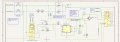
I've ordered my parts and tested them on my breadboard. It works, but... I have moved my senor switch (YC-Y1) to the output side of the 555 timer (see my one-line, below). Post #52's one-line has these switches on the + side of the 555. So my issue is that with my arrangement, the 555 doesn't reset when the sensor switch is opened and closed. It does with the arrangement in post #52. It's because the input power to the 555 (pin 8) is cycled. Is there something that can be done to reset the 555 with my arrangement other than moving my sensor switches to the input side of the 555? My relay on the far right side will primarily be as shown and typically won't cycle power to the 555. Thank you.
1764119384478.png
 
Top