555 self modifying trigger timing.

Thread Starter

Suzimx

Joined Apr 28, 2018
4
Howdy All,
I have a simple running led circuit using a 555ic and a 4017ic.
The trigger is currently using a 50k variable resistor to control the trigger timing.
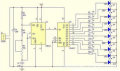
upload_2018-4-29_13-13-37.png
What I am trying to make it do is vary the led timing, so that the led's timing gets faster and then slower, continuously, when power is applied.
Is there a way to use the out signal of the 555 to charge a capacitor in part of the timing control? can the control input be changed? or can i bolt on some extra circuit part to achieve what I'm after?
Thanks for your help.
 

crutschow

Joined Mar 14, 2008
38,503
How fast do you want the frequency to vary?
Should this variation be synchronized to the LED sequence?
A triangle-wave generator could be used to vary the 555 frequency.
 

dl324

Joined Mar 30, 2015
18,326
Welcome to AAC!

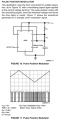
You could use another 555 to drive the control input of the existing timer:
upload_2018-4-28_21-6-22.png
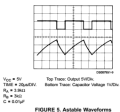
If you're not picky about linearity, you can use the capacitor voltage of the second timer as the modulator:
upload_2018-4-28_21-7-25.png

Circuits from NatSemi datasheet.
 

Attachments

Thread Starter

Suzimx

Joined Apr 28, 2018
4
Cheers for the calc, Scott.
Yup that is the total hz range but to the eye becomes irrelevant up near 65. and the eventual outcome is visual.

The 555 out (pin 3) drives the rate of change in pin 14 of the 4017. So as the frequency of the 555 output changes the led's appear to speed up and slow down in their flow (across the 10 led's). Rate of timing or acceleration/deceleration timing needs only be a duty time of 10secs.
 

ScottWang

Joined Aug 23, 2012
7,501
Yup that is the total hz range but to the eye becomes irrelevant up near 65. and the eventual outcome is visual.
For 10 LEDs then the 15 Hz should be up to 150 Hz, why is 65 Hz?

Rate of timing or acceleration/deceleration timing needs only be a duty time of 10secs.
2Hz is 0.5 seconds, one of 10 seconds is 1 second why they are different?

What is the real range that you want?
 

Alec_t

Joined Sep 17, 2013
15,118
Here's another way to vary the timing. I haven't shown the LEDs and their respective current-limiting resistors (which would be connected as in post #1).
FaderSequencer.PNG
 

Thread Starter

Suzimx

Joined Apr 28, 2018
4
For 10 LEDs then the 15 Hz should be up to 150 Hz, why is 65 Hz?


2Hz is 0.5 seconds, one of 10 seconds is 1 second why they are different?

What is the real range that you want?
Scott you are awesome at picking short comings lol.
Original config as you noted is 11 to 65 hz this is going to be changed to 2 to 15hz, thanks again for the calculations.
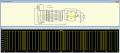
This figure represents the actual driving pulses ie turning on and off 1 to 10 of the 4017. this is going to be good at max of 15hz.

The 10 second is a line in the sand, it is not critical and may have to be recalculated to best suit, this would be the duty cycle of going from 2hz to 15hz and back to 2hz.

The effect, needed is to have an array of ten led's, that turn on in sequence ie running flow, during multiple cycles of the flow the rate is to speed up and slow down.
As said this is purely visual just for the hand on willy factor.
 
Last edited:

ScottWang

Joined Aug 23, 2012
7,501
Scott you are awesome at picking short comings lol.
Original config as you noted is 11 to 65 hz this is going to be changed to 2 to 15hz, thanks again for the calculations.
This figure represents the actual driving pulses ie turning on and off 1 to 10 of the 4017. this is going to be good at max of 15hz.

The 10 second is a line in the sand, it is not critical and may have to be recalculated to best suit, this would be the duty cycle of going from 2hz to 15hz and back to 2hz.

The effect, needed is to have an array of ten led's, that turn on in sequence ie running flow, during multiple cycles of the flow the rate is to speed up and slow down.
As said this is purely visual just for the hand on willy factor.
If you want to make the flashing speed can be speed up and down automatically then there is an easy way that you can try and that is:
NE555 Astable Multivibrator → RC Integrator → NE555 V to F(Voltage Controlled Oscillator (VCO)) → CD 4017 → R x10,LED x10
 
Top