555 output voltage spike?

Thread Starter

Lee697

Joined Aug 31, 2014
27
I've built a circuit using a pair of 555's in monostable config - I'm doing testing using my scope to measure timings etc - I've noted that when I cut power to the circuit (12.7V) that the voltage on the output (pin 3) jumps to around 0.7V, then degrades back to zero over a couple of seconds or longer.
Is this normal? I've built this circuit before, but not used the scope for testing, so have never noted this before.
cheers
Lee
 

ScottWang

Joined Aug 23, 2012
7,498
Are you sure the voltage isn't 0.2V or less?
Maybe you can using multimeter turn to V range to measure it.
Whatever 0.7V or 0.2V, they are all the low level for logic, it can delay some more time because the capacitor or timer cause it.
 

Thread Starter

Lee697

Joined Aug 31, 2014
27
It's definitely between 0.5-1V....
I'll eventually use the output to drive the gate of a BUZ71 or similar MOSFET, so it shouldn't cause any problems.... I was curious if it was usual??
 

ScottWang

Joined Aug 23, 2012
7,498
The 0.7V delay time was came from Vcc, when the timer is time up, the output will change from high to low, so it's ok, you can measure they for Vcc and output pin, to compare their time, when the output going to 0V, how much voltage the Vcc will left?
 

Thread Starter

Lee697

Joined Aug 31, 2014
27
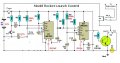
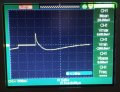
Here is the circuit schematic.... The scope trace shows the initial flat line as the 555 waiting for triggering, so pin 3 is low. The upwards deviation occurs as power is cut off to the circuit.
Scope trace measured at pin 3 of U1 (before the cap).
U2 does similar, but doesn't drop below zero, just degrades back to zero..... I'm assuming this has something to do with the cap and diode? Can anyone explain??

circuit-mk2sm.jpg scope trace.jpg
 

k7elp60

Joined Nov 4, 2008
562
Here is the circuit schematic.... The scope trace shows the initial flat line as the 555 waiting for triggering, so pin 3 is low. The upwards deviation occurs as power is cut off to the circuit.
Scope trace measured at pin 3 of U1 (before the cap).
U2 does similar, but doesn't drop below zero, just degrades back to zero..... I'm assuming this has something to do with the cap and diode? Can anyone explain??

View attachment 72743 View attachment 72744
I don't see any reason for the resistor from pin 4 to Vcc and the capacitor from pin 4 to ground. All it does is delay the operation for a short time when power is applied.
 

#12

Joined Nov 30, 2010
18,224
I don't see any reason for the resistor from pin 4 to Vcc and the capacitor from pin 4 to ground. All it does is delay the operation for a short time when power is applied.
This might be the cause because letting pin 4 go to ground quickly would force a zero on the output (if power was applied continuously). What this chip does during shut-down is not specified in the datasheets, but it's worth a try. Just connect pin 4 to Vcc and see if that fixes the non-problem.
 

Thread Starter

Lee697

Joined Aug 31, 2014
27
I don't see any reason for the resistor from pin 4 to Vcc and the capacitor from pin 4 to ground. All it does is delay the operation for a short time when power is applied.
That is intended - otherwise U2 triggers on power-up - and U2 fires the rocket....
 

Thread Starter

Lee697

Joined Aug 31, 2014
27
This might be the cause because letting pin 4 go to ground quickly would force a zero on the output (if power was applied continuously). What this chip does during shut-down is not specified in the datasheets, but it's worth a try. Just connect pin 4 to Vcc and see if that fixes the non-problem.
I'll try that out on a previous prototype (which does the same thing on power-down), but expect I'll need the RC delay in place on pin 4 for the working version.... unless anyone can suggest another way to stop the false trigger of U2..... :)
 

#12

Joined Nov 30, 2010
18,224
If this glitch comes anywhere near firing the output transistor, you can add a couple of 1N4001 diodes or a 3.3 volt zener in series with pin3 and adjust R9 to lower ohms accordingly. I might also add a 1K to ground on the base of Q1.

You could also move the power line to J1 over to the switched power line for the chips. That would kill the power to the rocket at the instant you turn off the power to the chips.
 

Thread Starter

Lee697

Joined Aug 31, 2014
27
If this glitch comes anywhere near firing the output transistor, you can add a couple of 1N4001 diodes or a 3.3 volt zener in series with pin3 and adjust R9 to lower ohms accordingly. I might also add a 1K to ground on the base of Q1.

You could also move the power line to J1 over to the switched power line for the chips. That would kill the power to the rocket at the instant you turn off the power to the chips.
It shouldn't - I use a BUZ71 FET instead of the darlington, which has a min gate threshold of 2-3V, and the MOSFET gate is isolated from U2 by a separately controlled relay (and a keyswitch). I'm not anticipating this causing an unintended launch, just curious as to why.... I think the last one I tested I was using the scope set to 10V per div, and likely just didn't notice/appreciate it happening.
 
Top